
Bulk Fidget Toys After the $671M Squishy Surge: Building a Multi-Texture Sensory Counter
Plan bulk fidget toys with Circana's +20% toy market, three texture lanes, CPC citations and an illustrative $4.00-unit reorder calculation.
A buyer for a 40-store U.S. regional chain sits down in November 2026 with a planogram that worked in spring: one viral squishy mold, four facings, reordered every 18 days. Then the reorder confirmation comes back thin, the mold is being copied by six other importers, and the counter has nothing to fall back on. The fix is not a bigger bet on the same mold. It is a bulk fidget toys counter built from three distinct texture lanes, each with its own buyer job, age grading and reorder signal.
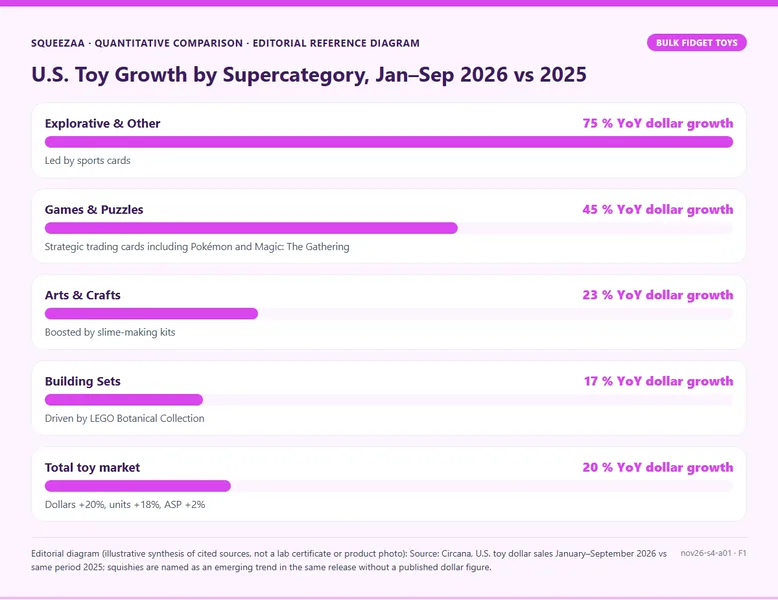
The market context is real but narrower than the headlines. s U.S. toy dollar sales up +20% for January–September 2026 versus the same period last year, with units +18% and average selling price +2%. The same release runs a section headed 'From Squishies to Danglecore: Self-Expression Drives Emer' — squishies are named inside the emerging-trend discussion, not published as a dollar line. That distinction is the whole planning discipline: build the counter around texture jobs a shopper can feel, and let the trend headline supply the timing, not the quantity.
What the +20% Actually Contains — and What It Leaves for Squishy
The +20% dollar growth is led by collectibles, not by squeeze texture. fastest-growing supercategory was Explorative and Other Toys at +75%, led by sports cards, and Games & Puzzles rose +45% on strategic trading cards including Pokémon and Magic: The Gathering. Arts & Crafts rose +23% on slime-making kits and Building Sets rose +17% on the LEGO Botanical Collection. A buyer who reads the +20% as a fidget tide will over-order; the squishy lane is one texture story inside a market where trading cards and slime kits are doing the heavy lifting.
The squishy signal is a trend label, and it is strong enough to plan against without inventing a dollar figure. release names squishies in its emerging-trend section alongside self-expression and personalization, which tells you the shopper is buying these items to display and attach, not only to squeeze at a desk. That is a merchandising cue: a counter that sells a squishy and a clip in one transaction captures two lines of the same shopper's spend.
The baseline matters as much as the surge. U.S. retail toy sales reached $30.3 billion in 2025, up +6% versus 2024, but the total dollar value stayed relatively flat versus 2021's $30.4 billion. In 2025 supercategory dollars, Games/Puzzles hit $4.9 billion (+37%), Building Sets $4.3 billion (+15%), Explorative & Other Toys $3.1 billion (+20%) and Outdoor & Sports Toys $4.0 billion (-6%). A fidget counter competes for space inside a stable pie, so the gain comes from reallocating facings away from declining outdoor and seasonal play, not from waiting for the category to lift the counter.
Three Texture Lanes, Three Buyer Jobs
Slow-rise squeeze serves the desk-calm job: a dense, slow-returning foam or gel body that takes 3–5 seconds to recover after a full-hand squeeze, sized at roughly 3 inches so it sits in a palm without rolling off a keyboard. The Toy Association's Cozy Culture trend describes exactly this shopper — low-tech, no-tech play that engages the senses through tactile materials and gentle interactivity as families counterbalance digital overstimulation. Stock slow-rise in 2 colors minimum and 3 sizes if shelf depth allows, because the buyer job is repeat purchase, not one-time novelty.
Quiet clickers serve shared and quiet spaces: a detent mechanism or silicone dome that produces a soft, low-decibel click rather than a sharp snap. The buyer job is fidgeting without drawing attention in a classroom, office or library, so the merchandising note on the shelf should read 'quiet' in plain language. Keep the clicker body at 2 inches or larger and free of detachable caps, because a 3+ desk item with a loose button becomes a small-parts conversation at compliance review.
Stretch texture serves two-hand play: a putty, mesh or elastic body that pulls to roughly 2–3 times resting length and returns without tack. The buyer job is active, visible fidgeting — the shopper who wants a physical pull, not a squeeze. Stretch SKUs carry the highest mess risk (residue, color transfer, packaging staining), so specify a non-greasy finish and a resealable tin or clamshell in the purchase order, and keep the stretch lane at 20% of facings rather than the anchor position.
Texture Lane Comparison for a Bulk Fidget Counter
Use this table as the planogram brief: each lane carries a different buyer job, a different age grading and a different reorder signal, so the counter does not collapse when one mold cools.
| Buyer job | Texture lane | Sound profile | Reorder signal | Overweight risk | Age grading / CPC citation to request |
|---|---|---|---|---|---|
| Desk calm, palm-sized repeat squeeze with 3–5 second recovery | Slow-rise squeeze | Silent | Sell-through above 60% of facings in 21 days | Commodity foam copies compress margin | 3+ typical; under-3 only if the whole item passes the 16 C.F.R. § 1501.4 small parts cylinder, CPC cites '16 CFR part 1501 – Small parts' |
| Low-noise fidgeting in classrooms, offices and libraries | Quiet clicker | Soft detent click under normal room conversation | Two consecutive weeks of full-price sell-through | Loud clones damage the 'quiet' promise | 3+ typical; CPC cites '16 C.F.R. part 1307 – Phthalates' for accessible plasticized parts |
| Two-hand pull and active fidgeting | Stretch texture | Silent to soft stretch | Rising unit velocity with stable return rate | Residue and packaging staining raise returns | 3+ typical; CPC cites '16 C.F.R. part 1307 – Phthalates' plus '16 CFR part 1501 – Small parts' if any detached piece fits the cylinder |
| Bag and backpack personalization plus squeeze | Squishy clip / keychain | Silent | Attach-rate at register above 15% of squishy sales | Fashion cycle turns faster than mold amortization | 3+ typical; CPC cites '16 C.F.R. part 1307 – Phthalates'; clip hardware checked against 16 C.F.R. § 1501.4 |
Age Grading and the Two CPC Citations a Mixed Carton Needs
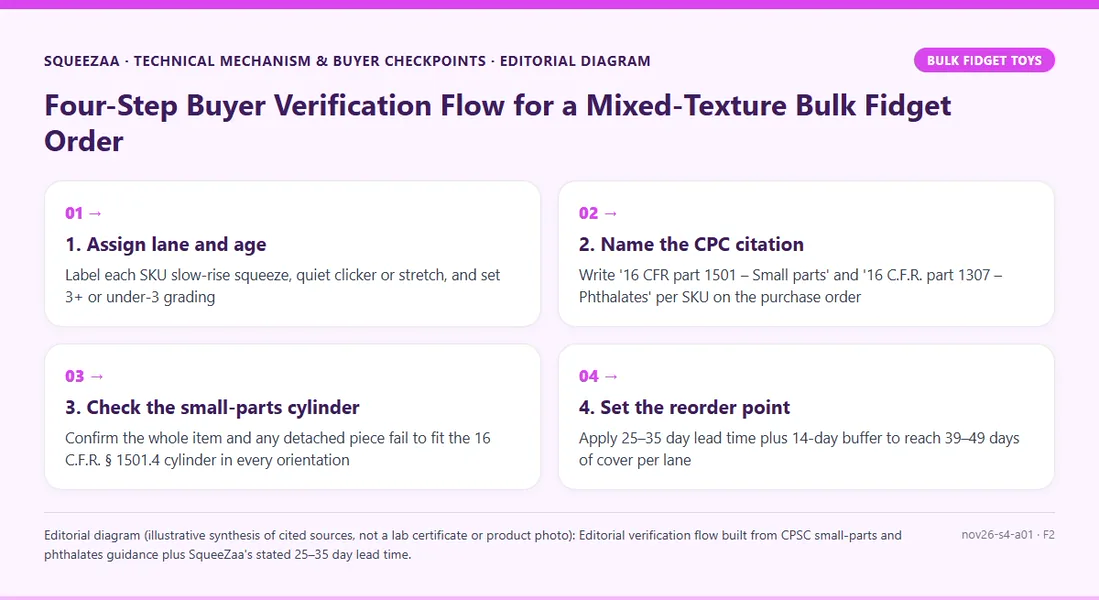
A mixed bulk fidget carton fails at compliance review when the age grading and the CPC citations do not match. Children's products intended for use by children under 3 that present a choking, aspiration or ingestion hazard because of small parts are banned hazardous substances under 16 C.F.R. part 1501, and the citation to use in section 2 of the CPC is '16 CFR part 1501 – Small parts'. A small part is any object that fits, without compressing and in any orientation, entirely into the small parts cylinder at 16 C.F.R. § 1501.4, which approximates the fully expanded throat of a child under three years old.
The second citation is chemical. 16 C.F.R. part 1307 bars more than 0.1% (1000 ppm) of eight listed phthalates in an accessible plasticized component of children's toys, and the CPC citation is '16 C.F.R. part 1307 – Phthalates'. A 'children's toy' under that rule is a consumer product designed or intended by the manufacturer for a child 12 years of age or younger for use when the child plays — which covers the squishy, the clicker and the stretch putty alike, because all three are plasticized and all three are sold to children.
The practical carton rule: never blend an under-3 item with a 3+ item in the same polybag or display tray without separate labeling, because the under-3 item carries the small-parts ban and the 3+ item carries a choking-hazard warning label. Keep the under-3 lane to zero facings unless the entire item — body, cap, clip and any detached piece — clears the 16 C.F.R. § 1501.4 cylinder in every orientation. SqueeZaa's profile lists no held certifications, so EN71, ASTM, CPSIA, CPC, CE and RoHS are matchable on request per order; the purchase order should name the exact CPC citation for each SKU rather than a generic 'compliant' line.
Worked Planning Example: Sizing a Three-Lane Counter
This is an illustrative planning example, not a lab test or a price quote. Take an assumed $671,000,000 squishy planning input — a round number chosen to stress-test the counter, not a -published figure — and assume a mid-size counter holds 0.01% of it. That equals $67,100 in category sales. At an assumed $4.00 wholesale unit price, the counter moves 16,775 units a year, or about 1,398 units per month across 12 months.
Split that 16,775-unit plan across three lanes at 45% slow-rise squeeze, 35% quiet clicker and 20% stretch: 7,549 units, 5,871 units and 3,355 units respectively. Now set the reorder trigger. SqueeZaa's stated 25–35 day lead time plus a 14-day safety buffer gives 39–49 days of cover, so a lane selling 1,398 units a month needs a reorder point of about 1,817–2,283 units. The arithmetic is the argument: even a tiny slice of a large squishy pool is a four-figure unit hole if one mold is delisted, and three lanes at 45/35/20 keep any single lane from owning the counter.
Order Planning Against a Selective Holiday
2026 U.S. Holiday Purchase Intentions Study of 3,534 consumers forecasts Q4 holiday spending ranging from a 1% decline to a +2.5% increase versus 2025, with average planned spend of $779 versus $796 last year. 74% of surveyed consumers expect to adopt money-saving behaviors, and 29% expect to spend more, with more than half of those citing higher prices. That is a flat-to-slightly-up window, not a surge window, so the opening buy should be narrow and the reorder cycle short.
Translate the range into quantities: plan the opening order at the low end of the range and hold the upper end as reorder capacity. If the counter's three-lane plan is 16,775 units a year, the Q4 opening buy should cover roughly 90 days at the low-end sell-through assumption, with the remaining capacity released on texture-level sell-through rather than on a single mold's velocity. Track sell-through by lane, not by SKU count, because a 45/35/20 split that drifts to 70/20/10 is the early warning that the counter is becoming a one-SKU bet again.
The supply side supports a fast refresh. Chenghai reports about 68,100 toy production and trading entities, roughly 200,000 direct workers, and 2025 full-chain toy output value above RMB 50 billion, producing over half of China's plastic toys and about one-third of the world's. The cluster also reports that nearly 100% of toy parts can be sourced locally, new products can go from design to mass production in as fast as 7 days, and the operating rhythm is '24-hour supporting, samples in three days, ship in one week'. SqueeZaa's own planning inputs — MOQ from 3 pieces, a 25–35 day lead time, 300+ staff and 500,000 pcs monthly capacity — fit a narrow opening buy with texture-level reorders rather than a deep single-mold commitment.
Did squishy toys really grow six-fold in 2026?
No. January–September 2026 release names squishies inside its 'From Squishies to Danglecore' emerging-trend section but the excerpt reviewed includes no squishy dollar figure, no 6x growth rate and no keychain percentage. The verified headline numbers are +20% dollar growth, +18% units and +2% ASP for the total U.S. toy market in that window.
How many texture types should a bulk fidget counter carry?
Three distinct lanes at minimum: slow-rise squeeze, quiet clicker and stretch. Each serves a different buyer job — desk calm, low-noise shared spaces and two-hand play — and each carries its own age grading and CPC citation, so a 45/35/20 split keeps one mold from owning the counter when it cools.
What safety paperwork should a U.S.-bound bulk fidget order include?
A Children's Product Certificate citing the applicable rules for each SKU: '16 CFR part 1501 – Small parts' where the under-3 small-parts ban applies, and '16 C.F.R. part 1307 – Phthalates' for the 0.1% (1000 ppm) limit on the eight listed phthalates in accessible plasticized components. SqueeZaa lists no held certifications, so ASTM, CPSIA, EN71 and CE are matchable on request per order, and the purchase order should name the exact citation per SKU.
Build the Three-Lane Counter Before the Next Mold Cools
SqueeZaa sources bulk fidget toys from the Chenghai cluster with MOQ from 3 pieces, a 25–35 day lead time and 500,000 pcs monthly capacity, so a 45/35/20 texture plan can open narrow and reorder by lane. Send the planogram with the three lane quantities, the target age grading and the exact CPC citation for each SKU, and the quote comes back matched to the counter rather than to a single viral mold.
Sources
www.cpsc.gov — Small Parts Ban and Choking Hazard Labeling | CPSC.gov
www.cpsc.gov — Phthalates Business Guidance | CPSC.gov
stgsl.shantou.gov.cn — 融媒观察 | 澄海把玩具的门开给世_图片新闻_汕头市工商业联合会(总商会)