
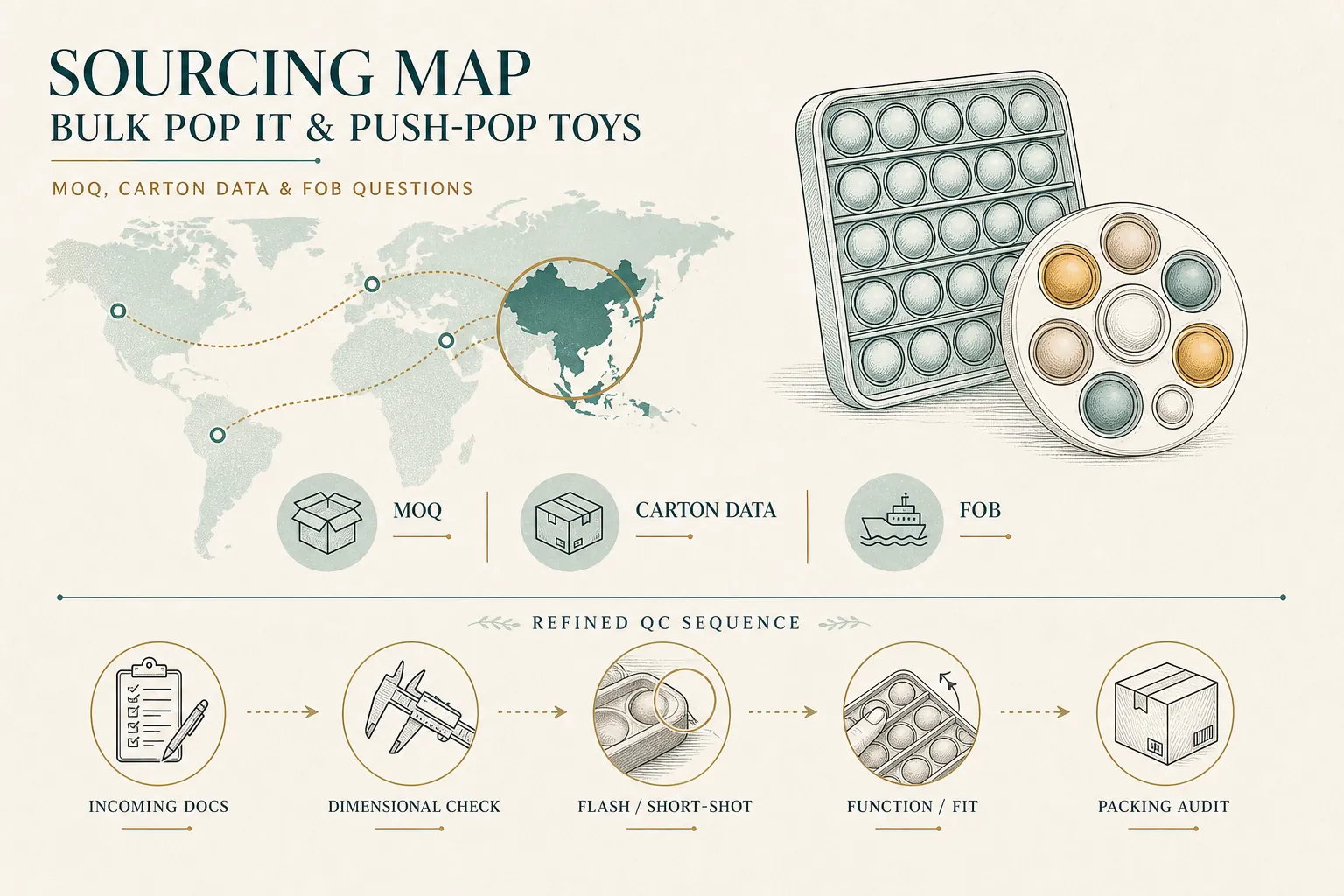
Bulk pop it and push-pop toys sourcing map: MOQ, carton data and FOB questions
Source pop it and push-pop toys wholesale: compare MOQs for stock vs custom, carton data checks, FOB pricing questions, safety evidence, and delivery inspection.
For a first bulk order of wholesale fidget toys, typical MOQs range from 100 pieces for stock geometric pop-its to 5,000–10,000 pieces for custom shapes with mold costs—so the first question to ask is not price but which MOQ tier you belong to: stock printing, custom printing, or custom shape. This guide covers product fit, packaging and MOQ questions, safety evidence, delivery checks, and a quote-ready next step. Buyers should evaluate pop it and push-pop toys through documented product fit, assortment economics, and supplier evidence rather than a generic best-list claim.
Key Takeaways
- Stock-design pop-its (geometric shapes like round, square, heart) typically start at 100–500 pieces with faster turnaround, while custom shapes require 5,000–10,000 pieces and a mold fee—plan inventory and lead time accordingly.
- Custom printing (silk screen, sublimation, water printing) on standard shapes offers lower MOQs (around 100–500 pcs) and quicker delivery than custom molds, making it the cost-effective choice for promotional runs.
- Two-dimensional barcodes can carry more structured data than a linear symbol, but the required data application and scanner support must be agreed with your supplier before production.
- Safety evidence is non-negotiable: request ASTM F963 (US), EN71 (EU), and CPSIA documentation per SKU, and verify whether the material is food-grade silicone or ABS plastic—do not assume compliance from marketing claims.
- Carton data (units per carton, dimensions, weight) should be confirmed before FOB quote; missing carton details can derail freight quotes and cause customs delays.
Suppliers Compared
| ThePopIt (custom pop-it fidget toy) | MOQ: 100–500 pcs (stock shapes), 5,000–10,000 pcs (custom shapes with mold cost); Price: varies by spec; Authorized: manufacturer; Ships from: China |
|---|---|
| Consumer Silicone Products (Z.S.R.) | MOQ: 100 pcs (standard), 500–3,000 pcs (custom); Price: varies by size and design; Authorized: manufacturer; Ships from: China |
| Bagwell Promotions (push-pop fidget toy) | MOQ: 50 units (standard imprint), 1,000 units (custom production with $250 mold fee); Price: varies by spec; Authorized: promotional distributor; Ships from: USA or China |
Where to Buy Pop It & Push-Pop Toys in Bulk
You can source pop it and push-pop toys wholesale from three main channels: factory-direct manufacturers (typically in China), promotional product distributors (often with US-based fulfillment), and online B2B marketplaces. Factory-direct gives you the lowest per-unit cost but requires you to manage compliance, shipping, and quality control. Promotional distributors like Bagwell offer lower MOQs (50 units for imprints) and faster delivery, but per-unit prices are higher and customization is limited to printing on existing shapes. Online marketplaces (e.g., Alibaba) aggregate many factories, but you must vet each supplier individually for certifications and reliability.
For retail wholesale, factory-direct is usually the right call when you have 500+ units and can wait 3–6 weeks for production plus sea freight. For promotional campaigns or small test runs, a distributor with a 50-unit MOQ lets you validate demand without tying up cash in inventory. Match the channel to your volume and timeline, not the other way around.
What MOQ Should You Expect for Stock vs. Custom Pop-Its?
MOQs vary by customization type. For stock geometric pop-its (e.g., round, square, heart), manufacturers like ThePopIt offer MOQs as low as 100 pieces, and Consumer Silicone Products lists 100 pieces for standard items. For custom printing on standard shapes, MOQs typically rise to 500–1,000 pieces, depending on the printing method (silk screen is cheaper for simple designs, sublimation for full-color). Custom shapes—where you create a new mold—require 5,000–10,000 pieces and a separate mold fee, which can be several hundred dollars.
Tiered pricing kicks in above these thresholds: the more units, the lower the per-unit cost, but only if the factory can commit to a production slot. Always ask for a price break at 1,000, 5,000, and 10,000 pieces to see where the curve flattens. If you are a novelty importer planning a 20-foot container, you may need to combine multiple SKUs to hit the MOQ per design—or negotiate a mixed-container MOQ with the factory.
How to Vet a Supplier for Safety Compliance
Safety compliance is not a marketing claim—it is documented evidence. For the US market, ask for a Children's Product Certificate (CPC) based on ASTM F963 testing; for the EU, request a Declaration of Conformity and test report to EN71. Verify whether the material is food-grade silicone (with FDA or LFGB certification) or ABS plastic, and check for specific hazards: painted plastic figures need coating adhesion, lead/chemical, abrasion, and small-part checks because the coating can change after play and abuse.
Go/no-go gauges can provide fast assembly or feature checks when the gauge is validated and linked to the product tolerance—ask the supplier if they use such gauges for pop-it buttons. If one SKU is produced across factories or lots, the split should be visible in the order, carton code, and compliance evidence. Request a sample for your own third-party testing before mass production, and ask for the test report to be shared with the specific lab that issued it.
Carton Data and FOB Pricing: What to Confirm Before You Pay
FOB price is meaningless without carton data. You need units per carton, carton dimensions (length x width x height), and gross weight per carton to calculate freight costs and container utilization. Many suppliers quote FOB without these details, forcing you to guess shipping costs. Ask for the carton data in the RFQ, and verify it on the packing list when your shipment is ready.
Two-dimensional barcodes (like QR codes) can carry more structured data than a linear symbol, but the required data application and scanner support must be agreed with your supplier—useful for tracking mixed lots or for retail compliance. Also confirm whether the carton uses a standard export carton (usually 5-ply) and whether inner packaging (e.g., individual polybags) is included, as this affects both cost and shelf presentation.
For FOB terms, clarify the port of loading (usually Shenzhen or Ningbo for pop-it factories), and whether the price includes export packing, customs clearance, and any certifications. Payment terms are typically 30% deposit and 70% balance before shipment—ask if the balance can be tied to inspection reports or shipping documents to protect your cash flow.
Lead Times and Shipping: Sea vs. Air for Bulk Orders
Lead times vary by factory and order size: ThePopIt cites about 15 days for 10,000 pieces, with production of 6–12 business days plus 5–9 days express shipping. For sea freight from China to the US West Coast, add 15–25 days; to the East Coast, 25–35 days. Air freight cuts transit to 5–10 days but triples shipping cost per unit.
For a first bulk order, plan for 4–6 weeks from order confirmation to delivery on the West Coast (production + sea). If you need faster turnaround, ask if the factory offers urgent production slots—but expect a premium. For small test orders under 100 kg, courier shipping (DHL, FedEx) is the only practical option, and per-unit shipping cost can exceed the product cost. Factor this into your landed cost calculation.
A worked example (illustrative, not a real shipment): A buyer orders 5,000 pieces of a custom-printed pop-it, each in an individual polybag. Carton data: 200 pcs per carton, carton dimensions 60x40x30 cm, gross weight 12 kg. Total: 25 cartons, 0.72 CBM, 300 kg. Sea freight from Shenzhen to Los Angeles at $20/CBM yields a freight cost of $14.40, or $0.0029 per unit—negligible. But if you air-freight the same order at $3/kg, the cost jumps to $900, or $0.18 per unit, which is more than half the unit cost. This is why carton data and shipping method are decision-critical.
What to Ask Suppliers (RFQ Checklist)
Before sending an RFQ, prepare a checklist of questions that turn a vague quote into a comparable one. Start with product fit: confirm the material (food-grade silicone vs. ABS), size, and whether it meets your target market's safety standards. Then move to packaging: ask for units per carton, carton dimensions, gross weight, and whether inner packaging is included. For MOQ, ask for tiered pricing at 500, 1,000, 5,000, and 10,000 pieces, and clarify whether custom shapes require a mold fee. For compliance, request test reports to ASTM, EN71, or FDA/LFGB, and confirm whether the reports are per SKU or per material. Finally, ask about lead times: production time, sea/air transit, and whether urgent production is available at a premium.
Include your target price range, destination port, and expected order volume in the RFQ. The more specific you are, the more accurate the quote. If a supplier cannot provide carton data or test reports upfront, treat that as a red flag—it suggests they are not used to export compliance.
FAQ
What are typical MOQs for wholesale fidget toys from Chinese manufacturers?
Stock designs start at 100–500 pieces; custom printing on standard shapes typically 500–1,000; custom shapes require 5,000–10,000 pieces plus mold costs. Tiered pricing applies above these thresholds.
Can a supplier offer custom color or logo molding, and what are the costs?
Yes, custom color and logo molding are common. Custom printing (silk screen, sublimation) on standard shapes has lower MOQs (around 500–1,000) and no mold fee. Custom shapes require 5,000–10,000 pieces and a mold fee (e.g., $250 for a small mold, but costs vary).
How do lead times and shipping methods affect total cost?
Production takes 6–15 days for 10,000 pieces; sea freight adds 15–35 days, air freight 5–10 days. Air freight can triple shipping cost per unit, so for bulk orders sea is usually more cost-effective. Always factor in carton data for accurate freight quotes.
What safety certifications should I request for pop-it toys?
For US, ask for CPC and ASTM F963 test reports; for EU, EN71 compliance. For silicone materials, request FDA or LFGB certification. Verify that the certification applies to your specific SKU, not just the material.
How can I verify the supplier's quality control?
Request a pre-production sample, ask about go/no-go gauges for feature checks, and confirm that any multi-factory production is traceable via carton codes. Consider third-party inspection (AQL sampling) before shipment, but note that inspection standards must be agreed upfront.
What is the difference between custom printing and custom shape for pop-its?
Custom printing applies a logo or design to an existing shape (e.g., round, heart) using silk screen or sublimation, with lower MOQs and faster turnaround. Custom shape requires a new mold, higher MOQs (5,000+), and a mold fee, but offers a unique product.
Sources
Related Products & Categories
Request a Quote
Ready to turn this checklist into a purchase plan? Use the RFQ template above to compare suppliers, or contact a sourcing partner with the carton data and compliance evidence you need. Start with a small test order to validate quality and lead times before committing to a full container.