
Squeeze Toys & Shelf Fidgets: Choose by Landed Cost
Compare a light-up rotating ball and burger spinner using catalog MOQs, carton quantities and a six-line landed-cost worksheet.
Choose squeeze toys and shelf fidgets by mechanism fit and per-unit landed cost, not catalog price alone. The burger-shaped spinner is the lower-reference-MOQ candidate for a small-order comparison; the rotating light-up ball is the display-led alternative. For SqueeZaa’s sensory shelf, advance either only after a sample meets the intended play brief. Neither a stress-relief product name nor a material label establishes soft squeeze feel, filling, quiet operation or suitability for repeated desk play.
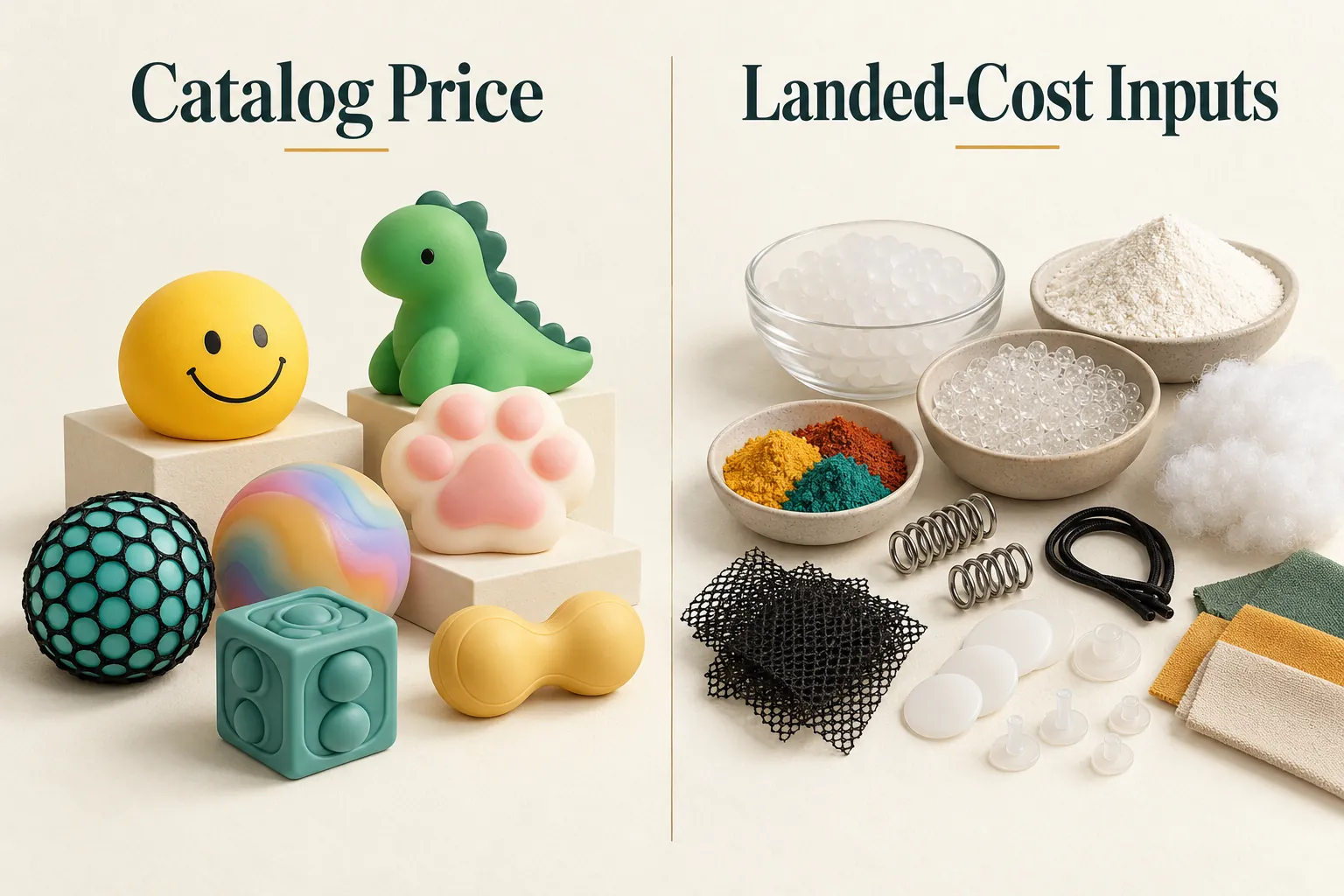
What does each toy do, and where does it fit on a sensory shelf?
| Rotating light-up pressure-relief ball | Catalog description: rotating pressure-relief ball with light, 24 pieces per box. Recorded material: ABS. Packing: display box. Reference MOQ: 864 units. Recorded carton quantity: 288 units. |
|---|---|
| Burger-shaped mini fidget spinner | Catalog description: mini stress-fidget spinner, magic-bean burger design. Recorded material: plastic. Packing: box. Reference MOQ: 20 units. Recorded carton quantity: 160 units. |
What can the catalog price tell you before requesting a quote?
A catalog price is a merchandise reference, not a warehouse-delivered cost or an approval to buy.
The October 9, 2026 catalog snapshot records a $0.56 reference price for the rotating light-up ball. Request a current quote that states whether the price is per individual toy or another sales unit, the applicable quantity, currency, Incoterm and named place. The 24-piece display-box description makes the sales-unit check particularly important.
For the burger-shaped spinner, request the same quote fields against the proposed order quantity. Compare individual toys with individual toys—not a display-box price against a single-item price. Keep reference MOQs separate from the quantities and packing arrangements accepted in the current quote.
Which landed-cost inputs should buyers request for each toy?
| 1. Goods | Rotating ball: request a current per-toy quote at the proposed quantity, confirming the relationship between individual toys, 24-piece display boxes and cartons. Burger spinner: request a current per-toy quote and confirm how many toys each sales box contains. For both, record quote date, validity, currency, Incoterm and named place. |
|---|---|
| 2. International freight | For each candidate, request the proposed shipment’s carton count, external carton dimensions, gross weight, origin, destination, transport mode and itemized freight quote. Ask which weight or volume basis determines the charge and which handling charges are included. |
| 3. Cargo insurance | Request the premium, covered shipment value and coverage basis for each scenario. Record whether insurance is included in another quoted amount or separately purchased. |
| 4. Import duties | For each toy, obtain a broker’s destination-specific calculation using the actual product description, construction, origin and proposed entry details. Keep US and EU purchasing scenarios separate rather than copying a duty assumption from one destination into another. |
| 5. Customs clearance | Request itemized brokerage and clearance charges for the proposed shipment. Identify any destination handling charges already included in freight or delivery to avoid duplicate entries. |
| 6. Inland delivery | Request delivery from the arrival point to the same named warehouse for both scenarios. State the delivery address and unloading or appointment requirements, and confirm which destination charges the quote includes. |
How should carton size affect the freight comparison?
Request freight against measured packing data, not the toy’s apparent size or catalog material alone.
Light, bulky squeeze-toy cartons can be charged for occupied space as well as scale weight, as described in the Landed Cost Calculator for Toy Imports. That is a reason to collect dimensions—not a reason to assume these two candidates have the same freight behavior.
For the rotating ball, have the quote identify the display-box configuration inside the shipping carton. For the spinner’s smaller proposed order, request the actual shipping pack: a partial carton may not retain the dimensions or cost allocation of a full carton.
How do the reference MOQs change the worked comparison?
| Rotating ball: 864-unit reference scenario | 864 ÷ 288 units per carton = 3 full cartons, if the recorded packing is retained. Request freight for that confirmed configuration. The 24-piece display-box description should also be reconciled with the quote’s sales unit. |
|---|---|
| Burger spinner: 20-unit reference scenario | 20 units leave a remainder of 20 against a 160-unit full-carton quantity. Request the packing and freight arrangement for the proposed 20-unit order. Do not automatically increase it to 160 units or assume a partial-carton order is accepted. |
| Per-unit comparison basis | For each candidate: landed cost per individual toy = (goods total + international freight + cargo insurance + import duties + customs clearance + inland delivery) ÷ quoted order quantity. Use 864 and 20 only if those quantities are accepted for the respective scenarios. |
How should buyers compare the two per-unit results?
Compare per-unit landed cost alongside total purchasing commitment; the smaller invoice is not automatically the lower-cost unit.
For the reference scenarios, divide the rotating ball’s allocated shipment costs by 864 and the spinner’s by 20. A fixed shipment charge has a different per-toy effect at those quantities. Do not give each product the same freight allowance simply because both belong on a fidget shelf.
If the products travel together, request a combined shipment quote and document how shared charges are allocated to each item. Use a stated allocation basis appropriate to the charge—for example, measured volume for a volume-based freight charge—rather than splitting every charge equally.
The recommendation to compare scenarios on landed cost per unit, rather than grand total alone, is also made in the Landed Cost Calculator for Toy Imports. It is a purchasing method, not a promise of a particular margin.
What must be confirmed before either toy receives buying approval?
| Record identity and revision | Identify the product, variant, sample reference, packaging revision, quote revision and worksheet date. Tie the freight scenario to the same proposed packing configuration. |
|---|---|
| Mechanism target versus sample observation | State the intended shelf role and the required rotation, light, noise or squeeze characteristics. Record what the identified sample actually does and whether the buyer accepts any difference. |
| Cost target versus calculated scenario | Record the maximum acceptable landed cost per toy and total purchase commitment beside the calculated results. Include accepted quantity, destination warehouse, currency, shipment assumptions and the source and date of each charge. |
| Decision, conditions and approver | Choose advance, hold or reject. State any condition still preventing purchase release, name the responsible approver and record the approval date. A pending cost line should trigger a specific quote request, not a zero-cost assumption. |
| Follow-up and closure | Assign an owner and due date to each condition. Record the revised quote, packing confirmation or sample observation that closes it, then date the final approval. Keep commercial cost approval separate from product-safety approval. |