
Custom Stress Balls for Brand Campaigns: Balancing Pad-Print Clarity, Squeeze Recovery and Carton Math
Plan custom stress balls for brand campaigns: pad-print distortion tolerances, ink-flex squeeze checks, CPSC material-change retests, and a 1,200-pc carton split.
A campaign manager stands at an event table with a 60 mm branded stress ball in one hand and a flat logo proof in the other. The proof is crisp; the ball shows a logo that has wrapped, stretched and softened at the edges. Three decisions now collide: how much curvature distortion the pad-print process adds to custom stress balls, how long the ink survives repeated squeezing before it cracks, and how a 1,200-piece mixed event pack splits into cartons that each carry batch and country-of-origin marks.
This guide treats those as engineering and compliance inputs, not artwork preferences. It walks a US-bound children's product through CPSC material-change logic when a pigment source changes, sets an illustrative distortion allowance before sampling, and runs a 12-carton split for three logo variants at 100 pcs per master carton. SqueeZaa supplies custom stress balls and sensory fidget toys from the Chenghai toy cluster in Shantou, Guangdong, with OEM/ODM logo printing and mixed trial orders from a 3-piece minimum; every compliance document is verified per order because the brand profile lists no held certificates.
Why a flat logo wraps on a spherical squeeze surface
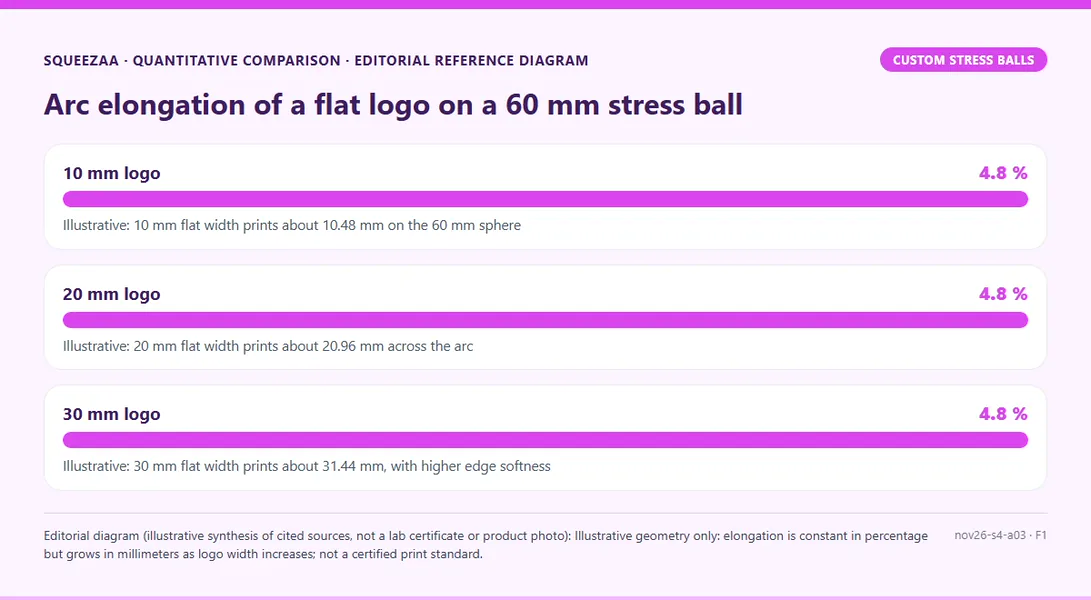
Pad printing transfers ink from a silicone pad onto a curved substrate, so the pad compresses against the ball and releases the image across an arc rather than a plane. On a 60 mm diameter ball, a 20 mm wide flat logo spans about 19.1 degrees of arc (20 / 60 x 57.3). The squeegee contact path is roughly 4.8% longer than the flat artwork width, so the printed mark measures about 20.96 mm across the curve (20 x 1.048). That is the geometric reason a 20 mm logo reads slightly wider and softer on the ball than on the proof sheet.
Set the tolerance before sampling: a 2 mm distortion allowance per 20 mm of logo width keeps the printed mark inside the approved envelope, and any letter stroke under 0.5 mm at 60 mm ball diameter collapses at the edge of the pad contact. Request a distortion-adjusted proof that shows the logo mapped onto the actual ball diameter, then approve on a physical printed sample rather than flat artwork. For multi-color marks, count the pad stations: each color adds one pass and one registration risk on the same curved surface.
The same geometry governs custom stress balls with two or three logo colors: wider logos gain more arc length than narrow ones, so a horizontal wordmark distorts more than a compact icon. Keep the primary mark within a 25 mm wide zone on a 60 mm ball and move secondary text to the packaging.
Ink-flex wear: testing print on a surface that flexes thousands of times
Print on a stress ball sits on a surface that stretches with every squeeze, so ink adhesion and elongation matter more than print resolution. Run a hand-squeeze check before bulk: 500 cycles at 1 squeeze per second takes about 8.3 minutes per sample, and a 3-sample check runs about 25 minutes. Inspect at 100-cycle intervals for cracking, flaking and color shift at the logo edge, and photograph the same logo zone each time so the comparison is repeatable.
Tie the print route to squeeze recovery. A ball that rebounds slowly keeps the ink stretched longer per cycle, which accelerates edge cracking; a ball with fast recovery returns the print to its resting dimension between squeezes. Record recovery as the time from full compression to the original diameter, and reject any sample whose logo shows edge cracking before the ball itself shows rebound loss. This is an illustrative engineering check, not a certified test method; the pass/fail line is set by the buyer's own sample approval.
Material chemistry sets the floor. US children's toys must stay at or below 0.1% (1000 ppm) of eight listed phthalates in accessible plasticized components, and at or below 100 ppm total lead in any accessible component. Pigment and ink suppliers are part of that chain, which is why an ink source change is a compliance event, not a cosmetic one.
When a pigment change becomes a material change
CPSC defines a material change as a change to a children's product's design, manufacturing process, or source of component parts that could affect the product's ability to comply with applicable requirements. After a material change, samples of the product or the changed component part must be tested by a third-party CPSC-accepted laboratory, and a new Children's Product Certificate must be issued. A logo ink swap that changes the pigment source falls inside that definition when the ink is an accessible component of a children's product.
The component-part route can limit the retest scope. CPSC's painted wooden toy car example: changing the paint supplier requires testing only the paint to issue a new CPC, because unchanged parts such as the metal axles need not be retested; changing the axle supplier may require retesting the whole finished product. Applied to a stress ball, an ink-only change scopes the retest to the printed ink system, while a body-material or base-polymer supplier change is a full-product event.
Periodic testing applies to continuous manufacture at minimum 1-, 2-, or 3-year intervals under 16 CFR § 1107.21, performed by a CPSC-accepted third-party laboratory. A single seasonal run of less than 1 year with no material changes carries no periodic testing obligation, but a ball kept in the catalog across multiple campaign seasons does. Beginning July 8, 2026, importers of most regulated consumer products must eFile certificates of compliance with US Customs and Border Protection through a Partner Government Agency Message Set.
Three print routes for custom stress balls, compared
Pick the print route per campaign size, then map the compliance and labeling burden onto the carton plan. The table compares pad print, heat-transfer label and molded-in color across the four decision fields this guide covers.
| Print route | Ink-flex wear risk | Carton labeling burden | Curvature distortion risk | Pigment change triggers retest |
|---|---|---|---|---|
| Single-color pad print | Medium: ink sits on the flexing surface, so a 500-cycle squeeze check applies | Batch/run, production date, manufacturer name and English country of origin on every carton and inner box | Low: one pad contact, about 4.8% arc elongation on a 20 mm logo at 60 mm diameter | Yes when the ink is an accessible component: ink-only retest plus new CPC |
| Two- or three-color pad print | Medium to high: edge cracking shows first at the color boundary | Same fields plus variant code per carton to keep colors countable | Medium: each color adds a registration pass on the same arc | Yes: each changed ink color is a separate component-part retest scope |
| Heat-transfer label | High: film edge lifts under repeated squeeze | Same fields plus adhesive batch reference for traceability | High: a flat film wraps the sphere and wrinkles at the poles | Yes: the film and its adhesive are accessible components |
| Molded-in color, no print | None: no ink to crack | Same fields; colorant lot recorded against the batch/run number | None: no artwork on the curve | Likely yes: a colorant change in the base material is treated as a body-material change under CPSC material-change logic, because the base material is the source of the component part; the retest scope is the changed body material plus any accessible component it touches |
The 1,200-piece event pack: a 12-carton split that stays countable
Run the illustrative carton math on a 1,200-piece order across three logo variants at a planning figure of 100 pcs per master carton. Total cartons: 1200 / 100 = 12. Units per variant: 1200 / 3 = 400. Cartons per variant: 400 / 100 = 4, and 4 x 3 = 12 checks out. Inner boxes: 12 x 4 = 48 at 25 pcs each, and 48 x 25 = 1200 checks out. The split is clean, but it is a labeling decision as much as a counting one.
Tracking labels must be visible and legible, permanently affixed to the product and its packaging to the extent practicable, and must make ascertainable the manufacturer or importer name, location and date of production, batch or run number, and other source-identifying information. Separately, every article of foreign origin entering the United States must be legibly marked with the English name of the country of origin. A mixed event pack that drops the batch code on one inner box breaks traceability for that box alone.
Map the fields onto all 12 cartons and all 48 inner boxes: manufacturer name, production date, batch or run number, variant code, and English country of origin. Keep the CPC in English and cite each applicable children's product safety rule; the responsible firm is the domestic manufacturer or the importer. For EU-bound campaign packs, the regime differs: Directive 2009/48/EC governs toys now, and Regulation (EU) 2025/2509 enters into force on 1 January 2026 with application from 1 August 2030, adding a digital product passport requirement.
Sample-approval sequence before bulk
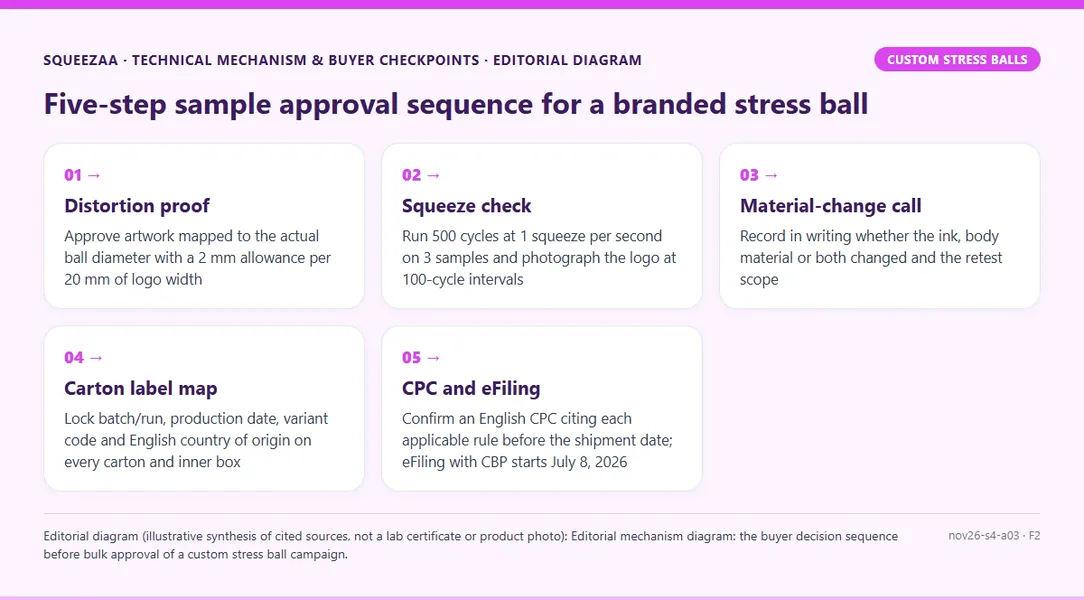
Step 1: approve a distortion-adjusted proof mapped to the actual ball diameter, with a 2 mm allowance per 20 mm of logo width. Step 2: run the 500-cycle hand-squeeze check on 3 printed samples and photograph the logo zone at 100-cycle intervals. Step 3: record the material-change determination in writing, naming whether the ink, the body material or both changed, and whether the retest scope is component-part or full-product. Step 4: lock the carton label map across all master cartons and inner boxes, including batch/run and English country of origin. Step 5: confirm the CPC is in English and cites each applicable rule before the shipment date, and note that eFiling with CBP begins July 8, 2026.
Does changing the logo ink color on a custom stress ball require new third-party testing?
Yes, when the ink is an accessible component of a US children's product and the pigment source changes. CPSC treats a change to the source of component parts that could affect compliance as a material change, so the ink system is retested by a CPSC-accepted third-party laboratory and a new CPC is issued; the painted wooden toy car example shows the retest can be scoped to the changed paint alone when unchanged parts are not affected.
How do I keep a pad-printed logo readable on a curved squeeze surface?
Approve a distortion-adjusted proof on the actual ball diameter, not flat artwork. On a 60 mm ball a 20 mm logo spans about 19.1 degrees of arc and prints about 4.8% wider than the flat file, so a 2 mm allowance per 20 mm of logo width and a 0.5 mm minimum stroke keep the mark legible after the pad contact flattens it.
How should a mixed event pack be split into cartons?
Split by variant at 100 pcs per master carton: 1,200 pcs across 3 variants gives 12 cartons, 4 per variant, and 48 inner boxes at 25 pcs each. Every carton and inner box must still carry the manufacturer name, production date, batch or run number, variant code and English country of origin, so the split is a labeling decision as much as a counting one.
Build the campaign pack from the Chenghai cluster
SqueeZaa works from the Chenghai toy cluster in Shantou, Guangdong, where about 68,100 toy production and trading entities and about 200,000 direct workers generated more than RMB 50 billion in 2025 full-chain toy output, producing more than half of China's plastic toys and about one third of the world's. The brand supports OEM/ODM logo printing, color and shape customization, packaging and mixed trial orders from a 3-piece minimum, with products matched on request to EN71, ASTM, CPSIA, CPC, CE and RoHS standards and every compliance document verified per order.
Sources
www.cpsc.gov — Material Change Testing | CPSC.gov
www.cpsc.gov — Third Party Testing Guidance | CPSC.gov
www.cpsc.gov — Periodic Testing | CPSC.gov
www.cpsc.gov — Children's Product Certificate | CPSC.gov
www.cpsc.gov — Tracking Label Business Guidance | CPSC.gov
www.cpsc.gov — Total Lead Content | CPSC.gov
www.cpsc.gov — Phthalates Business Guidance | CPSC.gov
www.cbp.gov — Marking of Country of Origin on U.S. Imports | U.S. Customs and Border Protection
stgsl.shantou.gov.cn — 融媒观察 | 澄海把玩具的门开给世_图片新闻_汕头市工商业联合会(总商会)