
Hong Kong Toy Fair 2027: Squeeze, Spin or Press? Reading Sensory Toy Actions Before You Commit
Sort sensory toys by hand action before the January 2027 Hong Kong Toys & Games Fair: slow-rise squeeze, press-launch spin, gear morph, button click and pop-eye squeeze, with shelf roles and booth questions.
At the January Hong Kong toy fair, how do you tell a squeeze toy, a spinner and a press-and-pop fidget apart—and decide which belongs in your assortment? Start with what the hand does, then describe what the toy does back. A slow-rising cheese character, a press-launched fruit top and a clicking football offer different reasons to pick them up, even when they sit under the same “sensory toys” label.
The Hong Kong Toys & Games Fair runs January 11–14, 2027, at in Wan Chai. Use the visit to build an action-led shortlist: squeeze for deformation and rebound, spin for rotation or transformation, press for a localized button response. Record a secondary action when a toy crosses categories.
The seven products below are existing SqueeZaa catalogue references, not confirmed 2027 exhibits; the shelf roles are buying suggestions, not reports of tested performance, sales or age suitability.
Build your fair route around actions, not a sensory-toy sign
Treat your shortlist as a comparison route rather than an assumed floor-plan route. The includes Educational Toys & Games, Kidult World and Soft Toys & Dolls, among other sectors. Those are useful search contexts, but they do not identify a dedicated sensory-toy aisle or establish where these catalogue products will appear.
For a gift shop or online sensory assortment, keep the mechanism comparison separate from the character comparison. First decide whether you need a yielding object, a rotating object or a button object. Then judge whether the food, fruit, animal or sports treatment adds a distinct shopper reason to choose it.
Pop&Play offers a complementary character-and-design stop: it runs January 10–13 at the Convention Hall, welcomes trade and public visitors, and emphasizes designer toys, IP and co-branding. Use it for that design perspective, rather than assuming its programme is a sensory-product sourcing list.
Squeeze: give rebound and compactness different shelf jobs
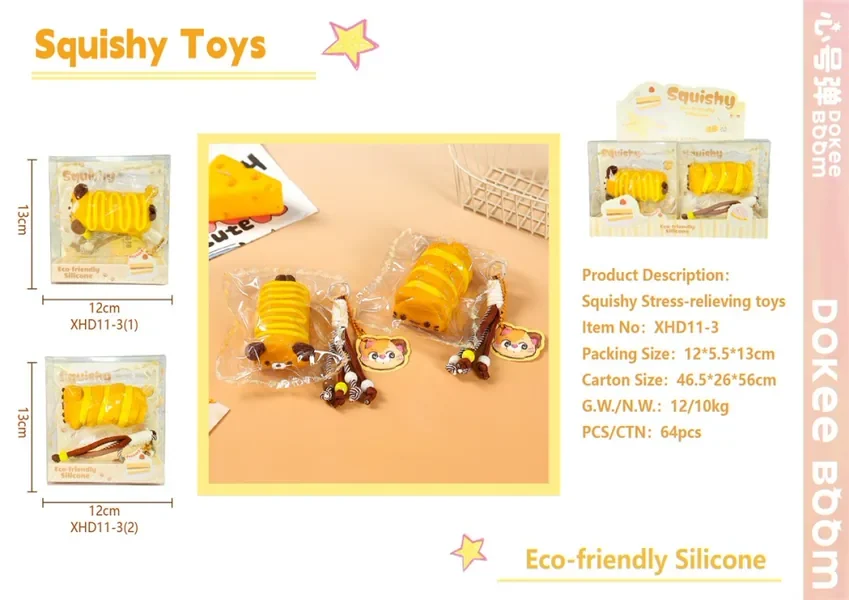
Baking Workshop Squeezable Fun, CPS344332, gives you a clear squeeze reference. The original supplier detail describes slow-rising play in smiling cheese-triangle and honey-toast designs. The relevant sequence is compression, release, then recovery—not a button moving inside a rigid shell.
Its listed product size is 12 × 5.5 × 13 cm, with display-box packaging, 64 pieces per carton and a reference MOQ of 192 pieces. The package size is listed separately at 24.5 × 22.5 × 13.3 cm, so a shelf-depth check should use the package figure, not the product figure. On your fair comparison sheet, treat the food character and the delayed recovery as separate attractions. The character supplies the gift theme; the rebound supplies the demonstration. A desk-gift position would be an assortment choice, not something the slow-rise label alone proves about the intended user.
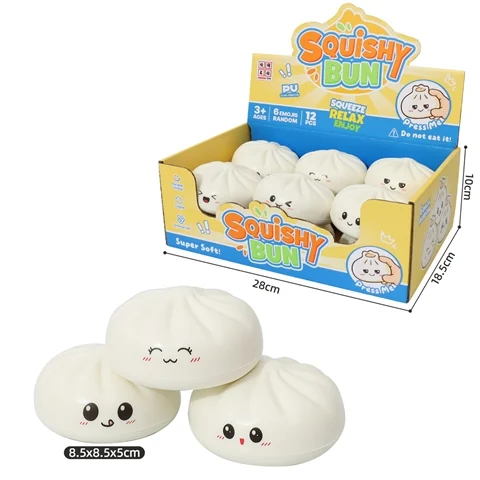
White Mini Bun Squishy Display Box, CPS350800, is a more compact reference at 8.5 × 8.5 × 5 cm, also listed with display-box packaging, 288 pieces per carton and a reference MOQ of 864 pieces. That makes it worth considering for the counter-add-on job rather than automatically giving it the main gift-shelf position. Its bun shape still belongs in a food-themed group, but the footprint gives you a different merchandising option. Its material entries conflict: the structured record says PU foam, while the range-style description refers to TPR and several fillings. This shortlist therefore uses the documented shape and dimensions without assigning a filling or glow effect to this exact bun.
At the fair, compare the proposed feature item and counter item together. Ask to see the complete squeeze-and-release movement, then look at how the supplied display presents that action. For an online listing, the useful visual is the change of shape and return—not just another front-facing character portrait.
Spin: separate bead play, press-launched rotation and gear changes
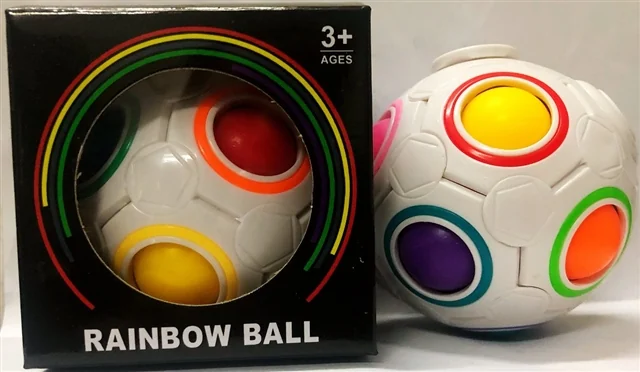
The 12-Hole Rainbow Stress-Relief Spinning Ball, CPS342716, is described in the original supplier detail as a mechanical, non-electric spinning ball with silicone beads and 12 holes. Those are the supported features to put on your fair comparison sheet. The listed 7 × 7 × 7 cm measurement belongs to its color-box package, not a verified measurement of the ball itself; the record also lists a reference MOQ of 240 pieces, 240 pieces per carton.
Give this reference a bead-and-rotation discovery role. During the demonstration, follow the silicone beads and rotating parts together; a whole-object spin does not explain how the 12-hole mechanism works.
The Finger-Tip Stress-Relief Fruit Series Top, CPS351683, presents a different sequence. Its listing describes pressing the top on a flat surface to initiate spinning through a mechanical spring-and-bearing structure, with handheld flicking as an alternative mode. The ABS product measures 5.7 × 5.7 × 6.4 cm and ships 288 pieces per carton. The package size is listed at 24 × 18.3 × 13.5 cm, a separate figure for shelf planning. The listing also describes four fruit patterns—watermelon, strawberry, lemon and pumpkin—as a collectible set, and states the toy is completely uncharged with no lights, music, circuit boards or motors.
Here, pressing is the input and rotation is the payoff. That makes it a candidate for a tabletop demonstration position, rather than the button-click shelf simply because the shopper presses it. During a fair comparison, watch the transition from hand pressure to released movement; do not reduce the demonstration to fruit graphics.
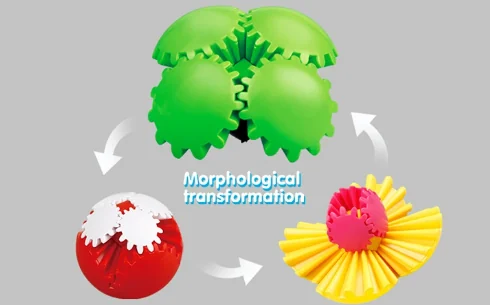
The 3D Rotating Gear Rubik’s Cube, CPS349464, adds another distinction. Its listing describes a gear ball that twists, clicks and changes from a sphere into flower-like shapes. This is rotation used to transform the object, not merely keep it spinning. The listed packing is 24 pieces per display box, 288 per master carton and a reference MOQ of 864 pieces: useful quantities when considering a counter display versus back stock. The product size is listed at 6.1 × 6.1 × 6.1 cm and the package size at 6.4 × 6.4 × 6.1 cm. The listing also describes six color combinations, such as red-white, yellow-pink and green-black; these are appearance options rather than different mechanisms.
Put bead interaction, press-and-release rotation and twist-to-transform play in different shortlist rows so that the demonstrations explain the apparent variety.
Press: a clicking football is not the same as popping eyes
The Button decompression football, CPS348750, is the clearest local-button reference here. It is listed as a 7 × 7 × 7 cm ABS product in window-box packaging, with raised buttons described as delivering a tactile, audible click, and 216 pieces per carton. The buyer’s comparison is the individual button response, not whole-body compression. The listing also describes a built-in keychain ring for clipping to bags, keys or belt loops, and states a typical supplier lead time of 25 to 35 days for standard wholesale orders.
For your fair shortlist, consider it for an explicitly click-led novelty position. A window box can present the object visually, while a demonstration explains what the buttons do. If your intended shelf is a quiet-desk edit, listening to that action should be part of the visit rather than assuming that every small fidget belongs there.
Squeezing Toy, CPS349725, needs a different label. The original supplier detail identifies animal pop-eye squeeze fidgets in multiple animal designs; the structured record gives a 6 × 6 × 8 cm product size, display-box packaging and 576 pieces per carton. The hand squeezes the toy and the eyes provide the visual response.
File that animal under squeeze-actuated novelty, not button pressing. “Pop” describes the visual gag here, whereas the football’s documented response is a button click. This distinction helps you avoid buying apparent variety that disappears once the shopper actually handles the toys.
The animal toy's recorded display package is 26.5 × 21 × 8.5 cm, distinct from its 6 × 6 × 8 cm body. Use the display footprint when comparing counter space, while the smaller body dimensions remain the reference for the squeeze demonstration.
Your fair comparison sheet: action, shelf role and shopper mission
Use this matrix as a set of proposed shelf jobs, then compare actual demonstrations at the fair. “Buyer type” means the shopper mission you would target, not a tested user profile or age recommendation.
| Action and reference | Proposed shelf role | Buyer type / shopper mission | Sample question at the booth |
|---|---|---|---|
| Squeeze and recover — Baking Workshop CPS344332 | Food-themed feature or small-gift story | Gift shopper choosing a character plus a tactile action | Can you show the full compression-and-recovery movement? |
| Compact squeeze — White Mini Bun CPS350800 | Counter add-on within a food-squishy group | Shopper adding a small novelty to another purchase | Can I see how the supplied display presents the bun? |
| Mechanical rotation with beads — Rainbow Ball CPS342716 | Tactile discovery comparison | Shopper interested in manipulating moving parts | How do the beads and rotating parts interact? |
| Press to spin — Fruit Series Top CPS351683 | Tabletop demonstration item | Shopper looking for a visible moving-toy payoff | Can you demonstrate the flat-surface press-and-release mode? |
| Twist, click and transform — Gear Cube CPS349464 | Mechanical transformation counter item | Shopper choosing shape-changing hand play | Can you show the sphere-to-flower transformation? |
| Local button press — Football CPS348750 | Click-led novelty | Shopper seeking repeated button feedback | Can I hear and feel the individual button action? |
| Squeeze to activate eyes — Animal CPS349725 | Visual-gag gift or animal-novelty group | Shopper choosing a character with an immediate visual response | Can you demonstrate the squeeze-to-eye movement? |
Keep the action decision separate from the price decision
Action gives each shortlisted toy a job; it does not automatically determine its price band. The captured public listings illustrate the difference: the gear cube shows an indicative EXW reference of US$0.51–0.53 per piece, while the button football shows US$1.35–1.42 per piece. These are catalogue references, not January fair quotations or suggested retail prices.
Use the demonstrations to decide whether the football’s button interaction and the gear toy’s transformation earn separate shelf positions; a second mechanism adds more play variety than another face on the same action.
Turn the shortlist into a useful Hong Kong visit
The official timetable gives you room to extend product conversations beyond the exhibition hall. lists Click2Match for January 4–21, 2027, and the period for December 11, 2026–February 10, 2027. The is the timetable reference for planning pre-fair comparisons and post-visit follow-up; its 2026 statistics record 1,815 exhibitors from 32 countries and regions and 41,215 physical buyers from 121 countries and regions.
For buyer registration, documented route starts through the fair’s To Visit entry. It covers personal or SSO information, company details, business-matching categories and purpose, followed by an email after successful registration. The explains the process; it does not itself establish that this edition’s registration is already live.
For arrival planning, places Exhibition Centre MTR station, Wan Chai MTR station and Wan Chai ferry pier within a ten-minute walk. Keep your comparison sheet accessible on arrival: the useful first conversation is about the action you need, not a broad request to see every sensory toy.
Make the meeting request about a demonstration
A useful meeting brief names the mechanism and intended shelf role: “We are comparing slow-rise food squishies for a gift feature and compact squeeze items for the counter,” or “We need to distinguish press-launched rotation from local button clicking.” These are more focused discussion starters than a general request for sensory toys.
During the visit, provides a practical continuation route. In the Marketplace App, scanning an exhibitor’s booth or product QR code opens product information and supports favorites, chat, enquiries and meeting scheduling. Use those functions to attach the action you saw to the relevant exhibitor conversation; a scan alone is not an appointment confirmation.
Leave the fair with each shortlisted item assigned a primary action, an observable response and a shelf job. That is the useful distinction between a collection of attractive objects and an assortment whose items offer genuinely different play.
Start your action-led shortlist
Browse the SqueeZaa wholesale catalogue and mark each candidate squeeze, spin or press before building your Hong Kong fair comparison sheet.