
How Can B2B Buyers Source Safe Squishy Toys After UK Safety Seizures?
B2B guide to sourcing safe squishy toys after UK safety seizures. Covers EN71/UKCA compliance, chemical safety, IP verification, and OEM factory vetting for importers.
UK border seizures of unsafe squishy toys and counterfeit Labubu dolls in 2025 revealed a hard truth: a CE mark or an old EN71 report on file does not keep your shipment out of a destruction facility. Compliance is an active, shipment-by-shipment process. B2B buyers who source safe, profitable squishy toys wholesale now demand full EN71 and UKCA technical files, verify chemical migration limits for phthalates and BPA, and audit whether a factory actually controls its material inputs and respects intellectual property. This guide walks through the exact steps to find and vet suppliers producing slow-rise PU foam, TPR squeeze toys, and food-shaped squishies that meet UK and EU safety standards—so your stock reaches shelves, not a customs hold.
What Are Safe Squishy Toys & Why Import Them Now?
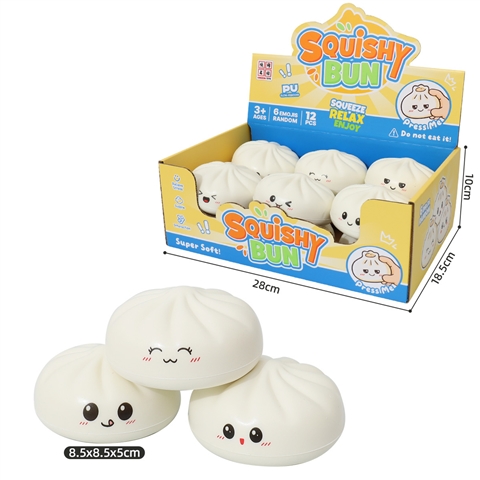
Squishy toys are soft, slow-rising foam or gel-filled products—typically made from PU (polyurethane) foam or TPR (thermoplastic rubber)—that compress when squeezed and slowly return to their original shape. The category includes miniature food replicas, animal characters, and stress-relief shapes sold through toy stores, gift shops, bookstores, and increasingly through blind-box and short-video e-commerce channels.
The UK safety seizures did not kill demand. They created a supply gap. With counterfeit and chemically unsafe stock cleared from the market, retailers are actively searching for suppliers who can provide legitimate EN71 test reports, UKCA documentation, and traceable material certifications. For the buyer who gets sourcing right, the 2026 wholesale market offers less competition on shelf space and a stronger negotiation position with risk-averse distributors.
Benefits of Buying Wholesale from Verified Factories
Buying wholesale from a verified factory rather than a trading company or marketplace reseller changes your risk profile entirely. A direct OEM manufacturer who pours PU foam or molds TPR can give you batch-level material safety data sheets, not just a photocopied certificate that covers a sample from two years ago.
You also gain control over the three variables that matter most post-seizures: material formulation (you can specify phthalate-free, BPA-free compounds), packaging labeling (UKCA mark placement, traceability codes), and IP integrity (own-mold development avoids the counterfeit Labubu problem that triggered border actions). Wholesale pricing from factories running dedicated production lines typically lands below $1.00 USD per unit for standard PU mini squishies at MOQs around 800 pieces, with tiered breaks as volumes scale. Custom OEM development costs more upfront but locks in exclusivity and safety ownership.
How to Source Safe Squishy Toys: A Step-by-Step Verification Process
The UK border seizures targeted two failure points: chemical non-compliance and IP infringement. Your supplier verification process needs to address both before you place a purchase order. This isn't about asking 'do you have EN71?' and accepting a yes. It's about requesting the test report's certificate number, verifying it with the issuing lab, and cross-checking that the tested material matches what will run on your production batch.
Start with the UK's specific requirements. UKCA (UK Conformity Assessed) marking is mandatory for toys sold in Great Britain. EN71 is the harmonized standard, broken into parts: EN71-1 (mechanical/physical), EN71-2 (flammability), and EN71-3 (migration of certain elements). The chemical part—EN71-3—is where squishies frequently fail, because cheap PU foam and soft PVC can leach heavy metals or contain restricted phthalates above the 0.1% weight limit. Ask for the EN71-3 report specifically, and check the test date. Reports older than 12 months without a valid factory audit are a red flag.
For IP safety, request evidence of design ownership: original mold photos, design sketches with timestamps, or brand authorization letters if the squishy uses a licensed character. Counterfeit Labubu and other pop-culture IP toys are exactly what UK customs are scanning for. If a factory can't show you the mold development process or a licensing agreement, walk away. Your shipment will be flagged under suspicion of IP infringement even if the chemical tests pass.
Sourcing Verification Checklist for Bulk Squishy Toys
| Step | What to Check |
|---|---|
| 1. Verify EN71-3 Certificate | Request the full EN71-3 technical report with lab name and certificate number. Cross-check with the issuing lab directly (SGS, Intertek, TÜV, Bureau Veritas). |
| 2. Confirm UKCA Marking Readiness | Ask for the UK Declaration of Conformity and confirm labeling includes UKCA mark, manufacturer address, and batch code. |
| 3. Audit Material Inputs | Request Material Safety Data Sheets for the specific PU foam or TPR compound. Test for phthalates, BPA, and heavy metals migration. |
| 4. Validate IP and Mold Ownership | Request original mold photos, design sketches with timestamps, or official character license agreements. |
| 5. Request Batch-Level Testing Agreement | Negotiate a contract clause requiring random batch testing before shipment, with results sent to you before cargo release. |
What to Ask Squishy Toy Suppliers Before Ordering
Use this RFQ checklist when contacting factories. The order of questions matters—lead with safety compliance to filter out non-serious suppliers immediately, then discuss commercial terms.
1. 'Please share your latest EN71-3 test report and UK Declaration of Conformity for PU foam squishy products. What lab issued the report and when was the last factory audit?' A legitimate factory answers with specific lab names (SGS, Intertek, TÜV) and dates within the last year. Hesitation or generic 'we have all certificates' answers are disqualifying.
2. 'What is the phthalate content in your standard PU foam compound? Can you provide an MSDS sheet for the exact material used in my production run?' This separates trading companies who don't know their upstream materials from manufacturers who compound or source foam with traceable supply chains.
3. 'Do you own the molds for these designs, or are you producing for a brand owner? If OEM, what is your mold development cost and timeline for custom shapes?' Listen for concrete numbers: a custom PU squishy mold typically costs $200-$600 USD with a 10-15 day development cycle. Factories quoting zero mold fees for popular characters are likely using shared or copied molds—an IP risk.
4. 'What is your standard MOQ for stock designs versus custom OEM, and how does pricing tier at higher volumes?' Stock PU mini bun squishies often start at 600-864 pieces per design. Custom OEM may push MOQs to 1,200-2,000 units but you own the mold and the compliance trail.
5. 'Can you arrange FOB shipment with full labeling compliance, and what are the current sea freight lead times to UK/EU ports?' FOB terms mean the factory handles export clearance and loads the container. Sea freight from Chinese ports to Felixstowe or Rotterdam runs 30-45 days in 2026. Air freight is 5-7 days but multiplies your unit cost, wiping out margins on low-priced squishies.
OEM vs Stock Squishy Sourcing: Key Differences
| Factor | Stock Design (PU Foam) |
|---|---|
| Typical MOQ | 600-864 pcs per design |
| Mold Cost | $0 (existing mold) |
| Lead Time | 15-25 days after order confirmation |
| IP Safety | Verify factory owns mold; still check for character similarity risks |
| Compliance Control | Limited to material spec negotiation |
| Price Per Unit (FOB) | $0.55-$0.67 USD (PU mini buns) |
Material Safety Deep-Dive: PU Foam vs TPR
Not all squishy materials carry equal risk. PU foam—the classic slow-rise material—can emit volatile organic compounds and often requires a surface coating (spray oil) to prevent sticking. The safety question centers on what's in that foam and coating. Factories cutting costs use industrial-grade polyurethane with high plasticizer content, which is exactly what triggers phthalate failures in EN71-3 testing.
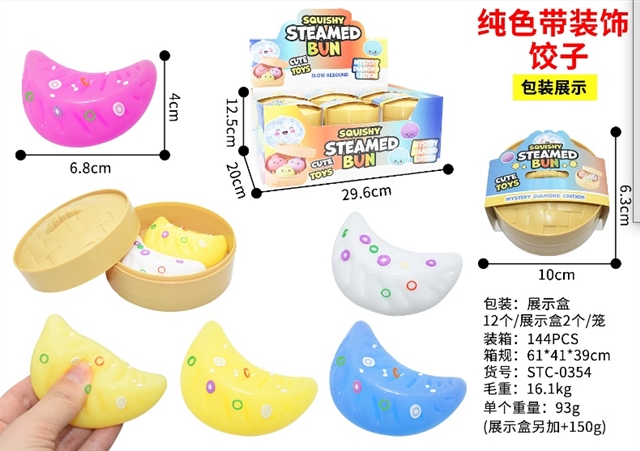
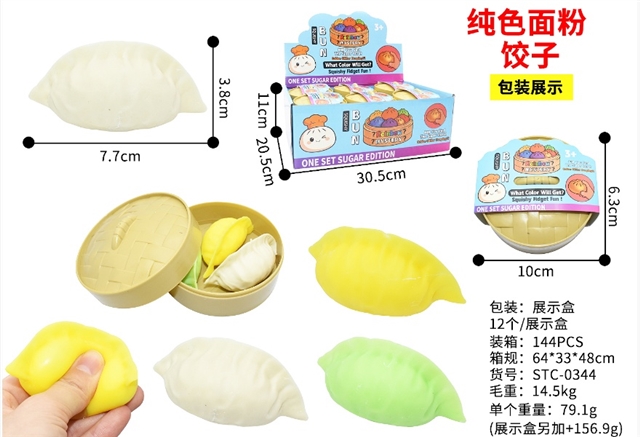
TPR (thermoplastic rubber) avoids some of PU's chemical volatility because it doesn't require the same blowing agents and surface treatments. TPR can be formulated to be phthalate-free and BPA-free at reasonable cost, and it holds up better to repeated squeezing without surface degradation. The trade-off: TPR feels different—more gel-like and bouncy, less that pillowy slow-rise sensation that made PU squishies viral. For the safety-conscious buyer, TPR squeeze toys like decorated dumpling sets offer an easier compliance path.
The smart sourcing move is to specify your material compound upfront. Tell the factory: 'PU foam must use food-grade or toy-grade polyol and isocyanate, phthalate-free, with EN71-3 migration limits met.' Or for TPR: 'SEBS-based compound, no PVC fillers, BPA-free certification required.' Suppliers who can answer these specs with data sheets are the ones who understand the post-seizure market.
Packaging and Display for Retail Compliance
UK and EU customs officers look at the box as much as the product inside. A squishy toy that passes chemical testing can still be detained if its packaging lacks proper labeling. Every retail unit needs: UKCA or CE mark (visible, legible), manufacturer name and address, batch or serial number for traceability, and age suitability markings.
For wholesale buyers, display-ready packaging solves two problems at once. Steamer display boxes—like those used for mini bun squishy sets—keep the foam from compressing during shipping (PU foam deforms permanently if crushed for weeks) while presenting the product for immediate shelf placement. The packaging becomes part of your compliance strategy: batch codes printed on each display box let you isolate and recall specific production runs if a safety issue ever emerges.
FAQ: Sourcing Safe Squishy Toys After UK Seizures
What certifications do I need to import squishy toys into the UK in 2026?
UKCA marking backed by a UK Declaration of Conformity, plus EN71 testing covering parts 1, 2, and 3. EN71-3 (chemical migration) is the critical one for squishies. CE marking alone no longer covers Great Britain; you need UKCA for England, Scotland, and Wales.
How do I verify an EN71 certificate is real and not faked?
Obtain the full test report—not just the summary page—with the issuing lab's name and certificate number. Contact the lab directly (SGS, Intertek, TÜV, Bureau Veritas) and ask them to confirm the report is authentic and corresponds to the factory placing your order. A supplier unwilling to share the lab name is a red flag.
What chemical hazards cause squishy toys to fail UK safety checks?
The main failures are phthalate plasticizers above the 0.1% weight limit, heavy metal migration (lead, cadmium) exceeding EN71-3 limits, and BPA leaching. PU foam can also emit formaldehyde or other VOCs. Cheap soft PVC components in squeeze toys are the highest-risk material for phthalate failures.
How can I avoid buying counterfeit IP-infringing squishy toys?
Only buy from factories that can show original mold development records, design sketches, or official character license agreements. If a factory offers popular characters like Labubu or Sanrio at low MOQs without a license, assume the goods are counterfeit. UK customs specifically target known IP-infringing toy shipments.
What is a typical MOQ for OEM custom squishy toys with full safety documentation?
OEM custom PU foam squishies typically start at 1,200–2,000 pieces per design, with mold costs between $200 and $600 USD. Stock designs run 600–864 pieces. The higher OEM MOQ is offset by owning the mold and having complete control over material specifications and batch testing.
Should I use sea freight or air freight for squishy toy imports?
Sea freight is the only economically viable option for low-price-per-unit squishies. Air freight from China to the UK multiplies your per-unit shipping cost and erases margins on products wholesaling under $2.00 USD. Plan for 30–45 days sea transit plus 1–2 weeks for customs clearance and UKCA documentation checks.
Related Products & Categories
Source EN71-Certified Squishy Toys with Full Compliance Documentation
If you're rebuilding your squishy toy supply chain after the UK seizures, start with a supplier who provides batch-level EN71 testing, UKCA-ready labeling, and OEM mold development with full IP transparency. SqueeZaa's PU foam and TPR squeeze products—including mini bun display boxes and dumpling sets—ship with complete compliance documentation. Request a quote for your market, and specify your safety requirements upfront.
Buyer verification path
Turn safety questions into an order-control record
List the exact formula or material, model, age grade, destination, package and test scope beside the approved sample. Confirm who controls substitutions and how each batch is traced. Use the factory audit checklist for production controls, the safety-document guide for report matching and the supplier-vetting guide for a comparable factory review.