
Squeeze Toys Wholesale: How to Approve Shelf-Fidget Samples
Compare push-game and slide-puzzle samples with written specs, record unanswered questions, and decide whether to approve, hold, or request corrections.
Approve a shelf-fidget sample only when its push, slide, or squeeze action matches the agreed written specification and intended shelf role. For squeeze toys wholesale buying, a light-up push game and a slide puzzle need different checks: input response and bubble return for one, sliding resistance and puzzle operation for the other. Resolve those questions before committing, then retain the approved sample as a production reference alongside the specification and change record—not instead of them.
Which sample belongs on an active-play or quiet-fidget shelf?
| Light-up quick-push game — recorded identity | Model: CPS290030. Description: astronaut-themed electronic quick-push bubble game with lights. Recorded material: plastic. Retail packing: printed color box. Reference MOQ: 120. |
|---|---|
| Light-up quick-push game — questions to resolve | Does each intended press register? Do bubbles return consistently? What sound and light behavior occurs during play? Confirm power requirements, controls, instructions, component materials, and the proposed production configuration. |
| Slide puzzle — recorded identity | Model: CPS282085. Description: slide puzzle advertised with 1,500+ levels. Recorded material: ABS. Retail packing: printed color box. Reference MOQ: 36. Recorded quantity: 36 units per carton. |
| Slide puzzle — questions to resolve | Do pieces slide and stop as intended without binding? How are puzzles selected, followed, and reset? Verify the advertised level offering against the instructions and sample operation. Check sound during sliding and any other operating modes before selecting it for a quiet shelf. |
What must be agreed before the first sample is approved?
Compare the first physical sample with the agreed written specification and design requirements; it does not become the approved reference merely because it arrived.
Define the intended action, acceptable operating sound, dimensions and measurement points, component materials, finish, artwork, and retail packaging. For the push game, include the expected relationship between a press and the game response. For the slide puzzle, describe the permitted movements and how a puzzle is set up and completed. Turn “pleasant feel” into a specific handling comparison the buyer and supplier can repeat.
Ask which components the plastic or ABS declaration covers. A casing material does not identify the bubble surface, internal parts, or any filling. If a separate squishy or stress ball is being reviewed, specify its fill or foam construction and expected recovery behavior rather than borrowing the game’s material description.
Record the model, sample ID, color, dimensions, material declaration, packing, and receipt or inspection date before handling. This identification sequence is also recommended by the Sensory Toy Evaluation Lab. Assign a revision to the specification so later observations point to an identifiable target.
How should the physical sample be inspected?
Inspect identity and condition first, then operate the mechanism under a repeatable buyer-defined protocol and compare the results with the agreed target.
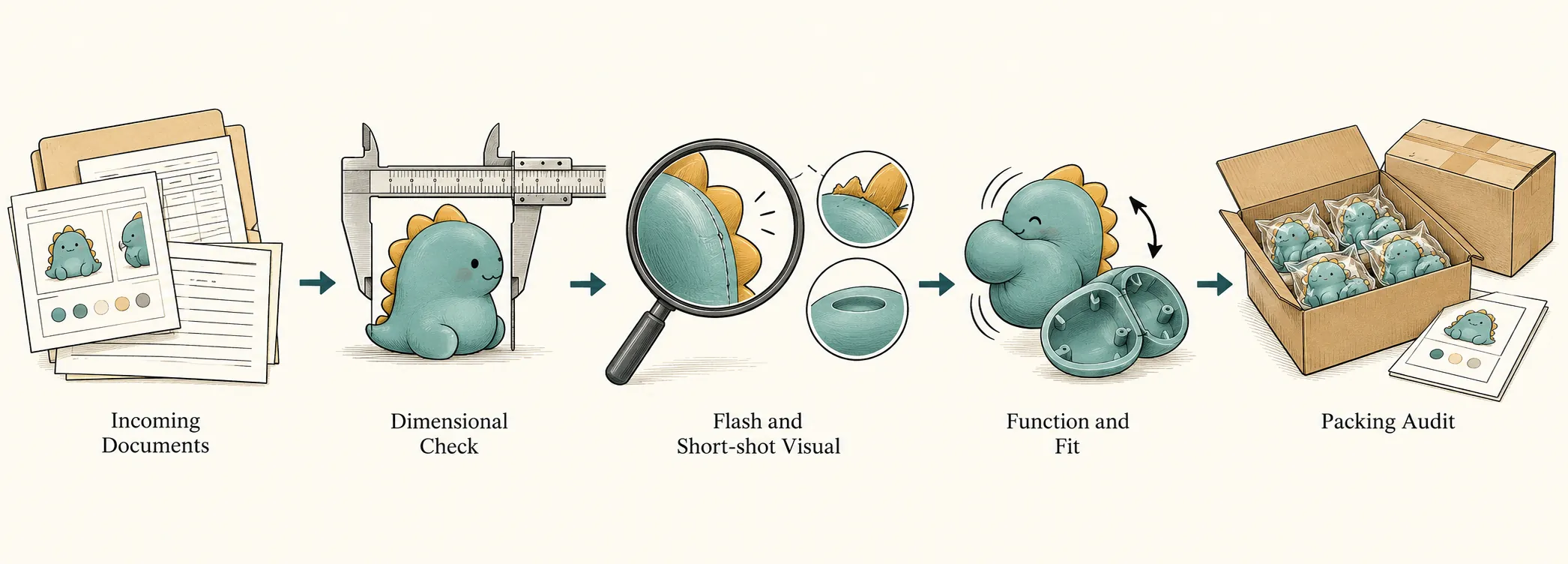
Before play, measure the agreed dimensions at the stated points. Compare color and print placement with the design reference; inspect seams, surface marks, coating where present, housing gaps, and visibly loose components. Note unusual odor without treating its presence or absence as a chemical-safety result. A mismatch calls for a recorded correction or investigation, not an improvised safety verdict.
For the quick-push game, use the intended operating mode and power arrangement. Press each operating position in a consistent way and observe both the physical return and the game response. A bubble that returns while the intended input fails to register is a functional discrepancy; record those two observations separately. Compare controls, lights, and sound with the specified behavior.
Move the slide puzzle through the permitted movements and follow the supplied instructions. Record where a piece binds, drags, shifts unexpectedly, or produces sound inconsistent with the shelf brief. Compare that position and movement with the agreed design before deciding whether the issue is a defect, a setup error, or a question requiring clarification.
For a genuinely squeezable sample, agree hand position, approximate compression, hold time, recovery endpoint, and ambient conditions before comparing pieces. Record changes in resistance, shape, surface, seams, or leakage where relevant. Do not impose a foam-recovery check on a rigid slide mechanism.
Repeat the relevant handling sequence across multiple pieces and assortment variants. Agree any screening count or repeated-use cycle count with the supplier as a purchasing criterion—not a legal standard or a predictor of returns. Comparing several pieces can reveal differences within the sample set; one good sample does not establish production consistency, as the Sensory Toy Evaluation Lab cautions.
Finish by checking the actual retail pack against the agreed artwork, insert, instructions, and product fit. Look for pressure marks, rubbing, or deformation after unpacking. If the proposed production packaging differs from the sample packaging, keep that packaging decision open until the revision is reviewed.
What should the two-product sample worksheet record?
| Review identity and revision | Enter product/model, supplier reference, individual sample IDs, color or variant, receipt date, inspection date, inspector, specification revision, and artwork revision. |
|---|---|
| Push-game function — target versus observation | Target: copy the agreed press, bubble-return, control, light, and sound behavior. Observation: identify the operating mode and position checked, the action performed, and the response seen or heard. Record each discrepancy separately. |
| Slide-puzzle function — target versus observation | Target: copy the agreed movement, resistance, stopping behavior, sound requirement, and instruction sequence. Observation: identify the piece or position, movement attempted, and any binding, unintended movement, or instruction mismatch. |
| Construction, dimensions, and finish | Enter the declared material by component, specified dimensions and tolerances, actual measurements, and observations on seams, housing, surface, color, and print. Separate a declaration received from a property actually observed. |
| Handling protocol and sample coverage | Record the handling method, operating conditions, agreed repeat count, pieces and variants checked, and changes seen during handling. For squeezable products only, include compression, hold time, and recovery endpoint. |
| Packaging target versus observation | Identify the agreed printed box, artwork, inserts, instructions, and product fit. Record the sample packaging received and any rubbing, pressure marks, missing elements, or revision differences. |
| Unanswered question and proposed resolution | Write the exact observation or question, the supplier response needed, the responsible owner, and the agreed due date. State whether closure requires clarification, a revised document, a corrected component, or another physical sample. |
| Decision and approval authority | Select move forward, hold, or request information. State the scope of acceptance and any conditions. Enter the responsible approver’s name and decision date; do not let an unresolved condition read as final production approval. |
| Follow-up closure and retained reference | Record the response or corrective action, revised specification or sample ID, recheck result, closure owner, and closure date. After approval, identify the retained reference, its storage location, and the revision it represents. |
What happens when an observation does not match the specification?
Hold approval of the affected requirement, describe the discrepancy precisely, and define what evidence will close it.
For example, if a quick-push bubble returns but the expected game response does not occur, report the operating mode, bubble position, handling sequence, and response observed. Ask the supplier to reproduce that sequence and explain or correct the difference. If the mechanism changes, review a corrected physical sample against the revised specification; an explanatory email alone does not demonstrate corrected operation.
For a slide puzzle that binds, identify the position and direction of travel rather than reporting only “too stiff.” A clarified movement instruction may resolve a setup question. A construction change needs a physical recheck. The next decision follows the cause and proposed correction, not the supplier’s choice of reassuring adjective.
Move forward when the agreed sample criteria are satisfied and required questions are closed. Hold when an observed discrepancy conflicts with an acceptance requirement. Request information when a question cannot yet be decided from the sample or written specification. These are review decisions, not judgments about the supplier’s honesty or capability.
Send the observation record, relevant images or video where useful, the requested correction, owner, and due date. The Sensory Toy Evaluation Lab similarly recommends sending observations and must-not-appear defects rather than subjective praise.
Which commercial and safety questions stay separate from hand inspection?
Keep sample performance, current purchasing terms, and destination-specific safety documentation as separate approval tracks.
Reconfirm the quoted configuration, current MOQ, and packaging before commitment. Request the proposed units per carton for the push game and reconfirm the slide puzzle’s recorded carton quantity. A carton quantity is not automatically an order multiple, and a reference MOQ is not a current commercial promise.
Ask for the proposed age designation and its supporting assessment, then request applicable reports and labeling for the intended destination and exact construction. Keep US and EU document requests distinct. A hand check cannot establish regulatory safety, determine age suitability, or replace the specified laboratory testing; the Sensory Toy Evaluation Lab also distinguishes buyer scorecards from safety standards.
Do not allow a satisfactory tactile review to close a separate documentation question. Equally, a document question does not erase valid observations about dimensions, finish, or function.
What becomes the reference for bulk inspection?
Bulk inspection should compare production with the approved written specification, retained sample, packaging revisions, and authorized change records together.
After first-sample approval, label and retain the accepted production reference with its approval date and revision. Preserve the worksheet and closure decisions so the next inspector knows which behavior was accepted and which defects must not appear.
At the bulk stage, use the agreed inspection plan to check identity, mechanism response, dimensions, materials documentation, finish, and packaging against those references. The retained sample provides a useful physical comparison; it neither replaces the specification nor proves that every production unit matches it. Traceable records support review, but they do not by themselves reveal an undisclosed production change.