
Import compliance for fidget spinner assortments: safety, materials and labeling questions
Learn which safety certifications (ASTM F963, EN71) and documents to verify before importing fidget spinner assortments to the US or EU.
The classification of a fidget spinner as a "children's product" or a general-use item determines the entire set of US safety rules and the paperwork you must collect. A fidget spinner sold to adults or marketed for ages 13+ does not need a Children's Product Certificate; the same spinner repackaged, promoted, or displayed as a toy for a 6-year-old triggers third-party testing, a Children's Product Certificate (CPC), and a permanent tracking label. That single classification decision determines nearly every document, label, and test requirement that follows.
This guide walks a novelty importer, distributor, or e-commerce buyer through the classification step, the material and component checks (magnets, button batteries, plastics), the US and EU certification frameworks, and the labeling and inspection points to build into a purchase order. The goal is a quote-ready checklist: you should be able to send a supplier a short list of documents and label requirements before you commit to a container.
Why the classification step decides everything
The CPSC classifies fidget spinners as either general-use products or children's products based on manufacturer intent, packaging, promotion, and the CPSC's Age Determination Guidelines. The same physical spinner can fall into either category depending on how it is marketed and displayed, so a buyer cannot assume that a supplier's "fidget" label tells you which rules apply.
If the spinner is a general-use product, the requirements are narrower: compliance with 16 C.F.R. part 1262 if it contains loose or separable magnets, and compliance with 16 C.F.R. § 1263.3 if it contains button cell or coin batteries. Where those rules apply, the supplier must issue a General Certificate of Conformity (GCC).
If the spinner is a children's product, the obligations multiply. The product must meet limits on lead in paint (0.009% or 90 ppm), total lead content (100 ppm), and phthalates (0.1% or 1000 ppm), and it must comply with 16 C.F.R. part 1250, which incorporates the ASTM F963 toy safety standard. It must be third-party tested at a CPSC-accepted laboratory, carry a Children's Product Certificate (CPC), and bear a permanent tracking label with manufacturer identity, date and place of manufacture, and batch or lot information. Any party in the supply chain — manufacturer, importer, distributor, or retailer — must report a product that fails to comply, has a defect, or poses an unreasonable risk.
What about the EU: where EN71 fits in
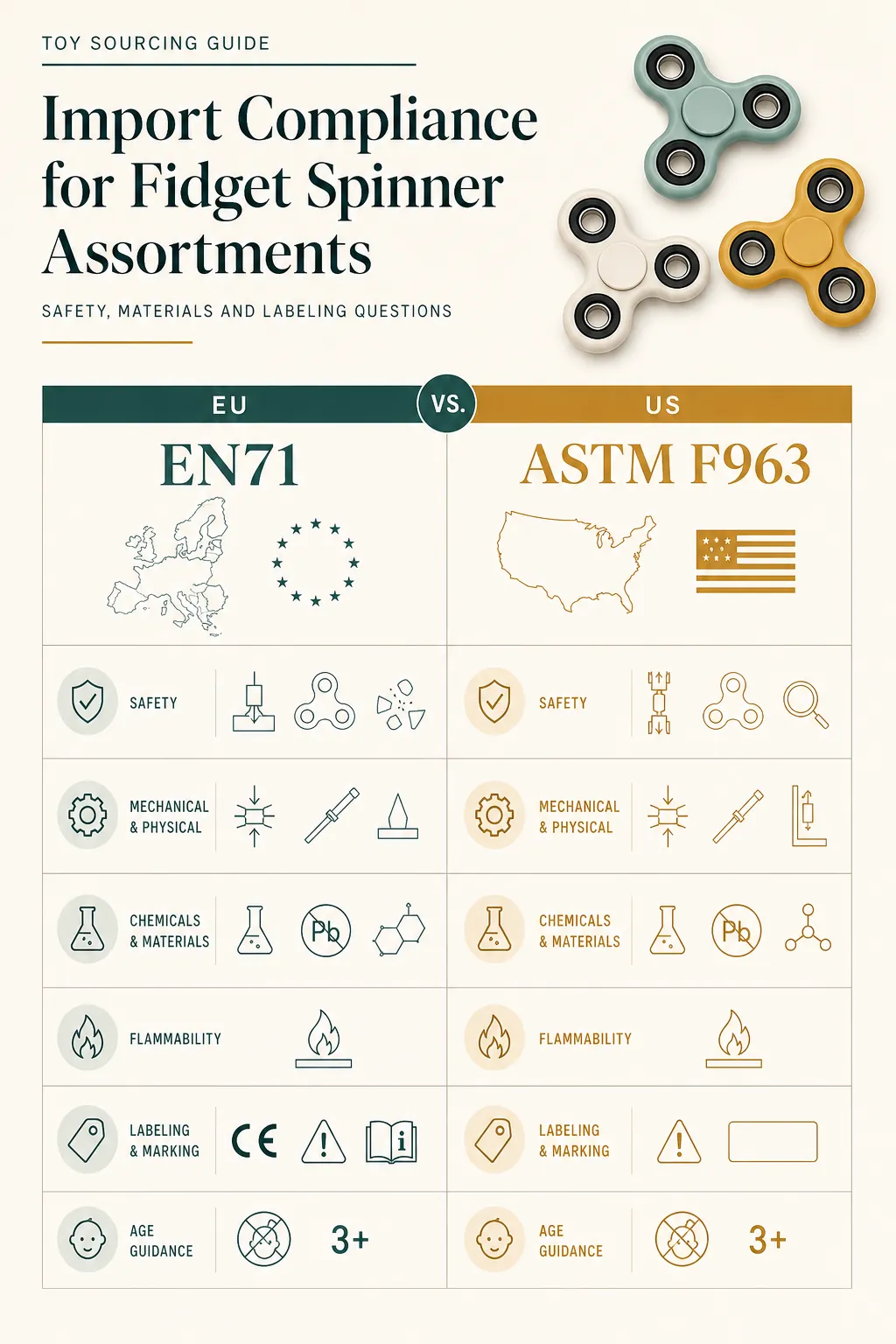
The Toy Safety Directive is the relevant EU framework, with EN71 as the harmonized standard that demonstrates compliance. A fidget spinner assortment imported into the EU must meet these requirements and carry the CE marking. The CE marking must be visible, legible, and indelible on the toy or an affixed label; if the toy cannot carry it, the packaging or accompanying documents may be used.
Fidget spinners have appeared on EU rapid-alert systems for safety issues, so EU customs and market surveillance authorities do actively check this product category. Buyers should treat EN71 test reports as a baseline document request, not an optional extra, and confirm that the report covers the specific product configuration being shipped, not a similar model.
Note that the EU is also introducing a Digital Product Passport (DPP) under the Ecodesign for Sustainable Products Regulation, and the General Product Safety Regulation (GPSR) has its own documentation duties. These are separate regimes from the Toy Safety Directive with different timelines and requirements; do not assume a single deadline covers all three. For the specific application date of the DPP to toys, the official text does not confirm a uniform date — confirm the timeline from official EU sources before building it into your compliance calendar.
Which safety certifications should I verify before placing a wholesale order?
For a US-bound assortment, request a Children's Product Certificate (CPC) if the product is intended for children 12 and under, or a General Certificate of Conformity (GCC) if it is a general-use product subject to the magnet or battery rules. The CPC must cite the specific CFR sections the product meets, including 16 C.F.R. part 1250 (ASTM F963), and must be based on testing at a CPSC-accepted laboratory. Test reports are batch-specific: a report is valid only for the specific production lot, and retesting is required if the material, design, or supplier changes.
For an EU-bound assortment, request an EN71 test report and confirm the CE marking appears on the product or packaging. The report should cover the relevant parts of EN71 for mechanical hazards (small parts), chemical limits, and flammability.
A single certificate does not cover everything. The ASTM F963 standard itself has sections that are not mandatory or are covered by other regulations, so the certificate must list the exact citations that apply to your product. Ask the supplier to walk you through which sections of the standard apply to the specific spinner configuration you are buying.
Key Takeaways
- Classification comes first: a fidget spinner marketed as a children's product (under 13) in the US requires a CPC, third-party testing at a CPSC-accepted lab, and a permanent tracking label; the same spinner sold as a general-use item does not. Confirm which category your supplier's packaging and marketing place the product in.
- Magnets and button batteries trigger extra rules even for general-use spinners: 16 C.F.R. part 1262 for loose or separable magnets and 16 C.F.R. § 1263.3 for button cell or coin batteries, with a GCC required when those rules apply.
- US children's toys must meet ASTM F963 (16 C.F.R. part 1250) plus limits of 90 ppm lead in paint, 100 ppm total lead, and 1000 ppm for regulated phthalates. Test reports are batch-specific — a new production run, material change, or new supplier means new testing.
- For the EU, EN71 is the harmonized standard under the Toy Safety Directive, and the CE marking must be visible on the product or packaging. The Digital Product Passport and GPSR are separate regimes with separate timelines — do not merge them into one deadline.
- Incoterms® (FOB, CIF, DDP) allocate cost and risk; they do not certify safety. Compliance documents are a separate deliverable that must be written into the purchase order.
US compliance requirements for fidget spinners at a glance
| General-use product (no magnets/batteries) | No specific CPSC certification required; verify product safety and reporting obligations. |
|---|---|
| General-use product with loose/separable magnets | Must comply with 16 C.F.R. part 1262; requires a General Certificate of Conformity (GCC). |
| General-use product with button cell/coin battery | Must comply with 16 C.F.R. § 1263.3; requires a General Certificate of Conformity (GCC). |
| Children's product (intended for 12 and under) | Third-party testing at CPSC-accepted lab; Children's Product Certificate (CPC); permanent tracking label; 90 ppm lead in paint; 100 ppm total lead; 1000 ppm phthalates; ASTM F963 per 16 C.F.R. part 1250. |
| Children's product with magnets or button batteries | ASTM F963 sections 4.38 (magnets) and 4.25 (button cell/coin batteries) apply in addition to the children's product requirements above. |
How to assess a supplier's quality control before signing a contract
A supplier can hold a valid CPC for one batch and ship you a different, untested batch, so the purchase order must tie the documents to the specific production run. Three checks matter most.
First, inspect the incoming materials. Incoming resin inspection should verify supplier, grade, color, lot, packaging condition, and required material documents before molding. This is the point where a supplier who substitutes a cheaper, non-compliant plastic grade gets caught. Ask your supplier what their incoming material checks cover and whether they can share the records.
Second, do a final inspection before shipment release. The final inspection should verify the product, packaging, markings, quantity, documents, and test status before the goods leave the factory. This is your last chance to catch a missing tracking label, a wrong CE mark, or a batch number that does not match the test report.
Third, build the documentation into the purchase order as a deliverable. Incoterms® such as FOB, CIF, or DDP allocate cost and risk; they do not certify product safety. If the PO only states a price and a delivery term, you have no contractual right to the test reports and certificates you need for customs clearance. Write them in as required documents with a deadline before shipment.
Packaging and labeling: the details that stop a shipment at customs
For US children's products, the permanent tracking label must include the manufacturer's identity, the date and place of manufacture, and batch or run information. It must be on both the product and the packaging. This is not optional — it is a legal requirement for children's products.
For the EU, the CE marking must be visible, legible, and indelible on the toy or an affixed label; if the toy cannot carry it, the packaging or accompanying documents may be used. The supplier must also provide the EU importer's address and the required safety warnings in the language of the destination market.
For light-up spinners with lithium coin cell batteries, packaging should include warnings about ingestion risks, and the battery compartment must be secure. CPSC has warned that ingested coin cells can cause severe internal burns. If the spinner is rechargeable, the charging instructions must specify the correct cable and warn against using a different charger.
What should the MOQ conversation include?
Because test reports are batch-specific, a low MOQ from a new supplier may mean the test report covers a sample batch, not your production batch. Ask the supplier whether the test report will cover your specific order quantity and production run, or whether a separate testing charge applies per batch.
If you are sourcing a mixed assortment — for example, a set that includes spinners with and without batteries — confirm that the test report covers each configuration. A report for a plain plastic spinner does not cover a light-up version with a coin cell battery, even if the body is identical. Each distinct product configuration needs its own testing and its own certificate citation.
This is also the point to ask about retesting policy. A supplier who changes materials or design mid-production must retest; the buyer should confirm in writing that any such change will be communicated before shipment, not after.
FAQ: Fidget spinner import compliance questions buyers actually ask
What safety certifications, like ASTM or EN71, should I verify before placing a wholesale fidget toys order from a new Chinese supplier?
For the US, ask whether the product is a children's product or general-use. If children's, request a Children's Product Certificate (CPC) citing 16 C.F.R. part 1250 (ASTM F963) and a test report from a CPSC-accepted lab. For the EU, request an EN71 test report and confirm the CE marking. Test reports are batch-specific, so confirm the report covers your production run.
Which safety certifications (like ASTM F963 or EN71) are mandatory for importing bulk fidget toys into the US or EU markets?
In the US, ASTM F963 (16 C.F.R. part 1250) is mandatory for children's toys, with a CPC and third-party testing at a CPSC-accepted lab required for products intended for children 12 and under. In the EU, EN71 is the harmonized standard under the Toy Safety Directive, with the CE marking required. General-use spinners in the US may only need a GCC if they contain magnets or button batteries.
What safety compliance certificates should a distributor verify before placing a bulk order with a fidget toy manufacturer?
Verify the product classification first. For a children's product, request the CPC, the batch-specific test report from a CPSC-accepted lab, and confirm the tracking label. For a general-use product with magnets or batteries, request the GCC. For the EU, request the EN71 report and confirm CE marking placement. Write these documents into the PO as deliverables.
How can a retailer assess the quality control and material safety standards of a fidget toy manufacturer before signing a contract?
Ask about incoming resin inspection (supplier, grade, color, lot, material documents), final inspection before shipment (product, packaging, markings, documents, test status), and whether test reports will cover your specific batch. Confirm that any material or design change triggers retesting and that the supplier will notify you before shipment. Consider using a third-party inspection service.
Do I need a separate certificate for fidget spinners with lights or batteries?
Yes. Spinners with button cell or coin batteries must comply with 16 C.F.R. § 1263.3 (US) even as general-use products, and children's products must meet ASTM F963 section 4.25 for button cell/coin batteries and 4.38 for magnets. A test report for a plain spinner does not cover a light-up version. Confirm each configuration has its own report.
Is a General Certificate of Conformity (GCC) enough for a fidget spinner?
Only if the spinner is a general-use product subject to the magnet or battery rules. If the spinner is a children's product (intended for children 12 and under), a Children's Product Certificate (CPC) based on third-party testing is required instead. The GCC does not cover lead, phthalate, or ASTM F963 requirements — those apply to children's products.