
Import Compliance for Silicone, TPR & Foam Toys: Which Documents to Check
Before importing fidget toys, verify test reports, certificates, and labels. A buyer-ready guide to silicone, TPR, and foam compliance for US and EU.
For any silicone, TPR, or foam fidget toy import, the decisive buyer question is whether the supplier's test reports, certificates, and labels actually match the specific SKU, production lot, and destination market you are buying. A type-test or golden-sample report does not automatically cover a later production lot—importers must match the report's SKU, materials, colors, and production date or cohort to the purchase order. This article frames the compliance review as a document-matching exercise: you define the product and age grade, request evidence tied to that exact configuration, verify the correct standard edition for your market, and lock the specification into the RFQ before you sign.
Key Takeaways
- Certificates are product-specific: a Children's Product Certificate (CPC) for the US or an EU Declaration of Conformity for the EU must identify the exact SKU, materials, age grade, and responsible party—it is not a blanket factory certificate.
- Match the test report to your production lot: a report from a golden sample does not cover later shipments; verify SKU, materials, colors, and production date or cohort against the PO.
- Silicone is an elastomer, not a thermoplastic: it requires a different molding and material-compliance review than PP, ABS, or PVC—ask for material-specific evidence, not a generic 'plastic' report.
- Incoterms do not certify safety: FOB/CIF/DDP allocate cost and risk only; compliance documents are a separate deliverable on the PO.
- Labeling is part of compliance: US tracking labels must be permanent and support product identification; packaging wording and markings are controlled fields that change with the SKU.
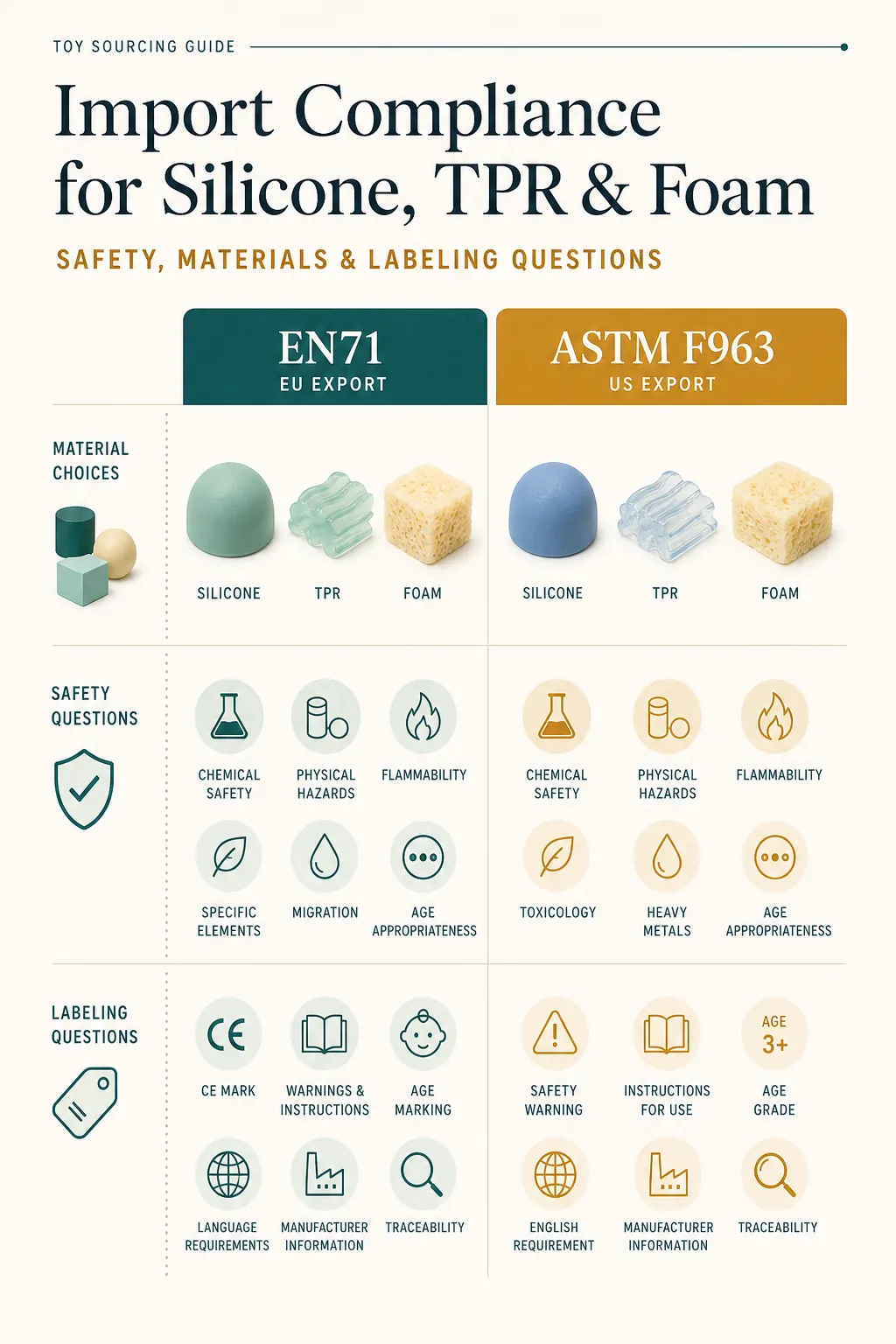
Why Material Choice Changes the Compliance Review
Silicone rubber is an elastomer rather than a conventional thermoplastic, so it needs a different molding and material-compliance review from PP, ABS, or PVC. TPR and foam each bring their own processing and additive profiles. The material alone does not determine compliance—it determines which review path you take and which test data you should demand.
For a tactile novelty product, the starting point is always the age grade. In the US, testing and certification generally apply to toys intended primarily for children 12 and under; for 13+, the product may still need to meet ASTM F963 but does not require third-party testing or a CPC. In the EU, the Toy Safety Directive applies to all toys placed on the market, with stricter chemical limits for toys intended for children under 36 months or for mouthing.
You cannot ask for 'a certificate.' You must ask for evidence that matches your exact product and your exact market.
Which Certifications Are Mandatory for US and EU Imports?
In the US, children's toys generally require testing at a CPSC-accepted laboratory and a Children's Product Certificate (CPC). The CPC is based on testing results, must be in English, and must include seven elements: product identification, citation of applicable safety rules, manufacturer/importer identification, record-keeper contact, date and place of manufacture, date(s) and place(s) of testing, and lab identification. It is product-specific, not a factory-wide certificate.
In the EU, toys must meet the essential safety requirements of Directive 2009/48/EC (the Toy Safety Directive). CE marking and an EU Declaration of Conformity are part of the conformity process and must be matched to the product scope. The General Product Safety Regulation (EU) 2023/988 is a separate legal instrument from the Toy Safety Directive—do not conflate their deadlines or requirements. The GPSR sets a horizontal safety framework for consumer products, including those sold online.
The exact standard edition matters. For the US, the applicable ASTM F963 edition must be read from the current regulation before a report is quoted; a test report should identify the product configuration, age grade, and standard edition. In the EU, harmonised standards from CEN/Cenelec provide a presumption of conformity, but the specific version must be checked against the current Official Journal.
Standard | Region | What it covers | Proof document
| ASTM F963 (16 CFR Part 1250) | US | Mandatory toy safety standard: hazardous substances, small parts, sharp edges/points, cords/elastics, magnets, expanding materials, labeling | CPC and third-party test report from a CPSC-accepted lab |
|---|---|
| Toy Safety Directive 2009/48/EC | EU | Essential safety requirements: physical/mechanical, flammability, chemical, electrical, hygiene, radioactivity | CE marking and EU Declaration of Conformity |
| General Product Safety Regulation (EU) 2023/988 | EU | Horizontal safety framework for consumer products; complements the Toy Safety Directive | Safety documentation and product-identification info; separate from toy-specific conformity |
| Children's Product Certificate (CPC) | US | Certifies that a children's product (12 and under) meets applicable safety rules; product-specific | CPC with seven required elements, based on third-party testing |
How to Verify a Supplier's Test Report and Certificates
Before you sign, confirm that the evidence matches the product you are buying. Run this checklist on any silicone, TPR, or foam fidget toy order:
1. Match the report to the SKU. Check that the test report names your exact product code, materials, colors, and age grade. A report for a similar item is not a report for yours.
2. Check the production lot. A type-test or golden-sample report does not automatically cover a later production lot. Ask for the production date or cohort on the report and match it to the PO.
3. Verify the standard edition. For the US, confirm the ASTM F963 edition cited in the report matches the current regulation. For the EU, confirm the harmonised standard version. If the report cites an outdated edition, it is not evidence of current compliance.
4. Confirm the certificate is product-specific. The CPC (US) or Declaration of Conformity (EU) must name your product and the responsible party. A 'factory certificate' that does not reference your SKU is not sufficient.
5. Treat Incoterms as what they are. FOB/CIF/DDP allocate cost and risk; they do not certify product safety. Compliance documents are a separate deliverable on the PO.
Labeling and Packaging: The Overlooked Compliance Field
Labeling is not a marketing afterthought—it is a controlled compliance field. In the US, tracking labels should be permanent and support product identification, and packaging wording and product markings must be reviewed together. In the EU, the importer's name and address must appear on the toy or packaging, unless size or nature prevents it.
Age grading and small-part risk are connected and must be assessed for the actual product configuration. Assemblies, detachable accessories, and packaging components need the same review discipline. A fidget toy with a detachable charm or a foam piece that can be chewed may trigger additional small-parts or expanding-material requirements. The RFQ is the tool to force this upstream: state destination market, age grade, materials and colors, packaging language, requested tests, sample policy, tooling terms, and trade term so the supplier's quote and later documents can be checked against the same specification.
What to Put in the RFQ to Lock Down Compliance
A useful toy RFQ states: destination market, age grade, materials and colors, packaging language, requested tests, sample policy, tooling terms, and the requested trade term. This list is the specification against which you will check the test report, the CPC, and the labels.
For silicone, add a specific note that you need material-compliance evidence for an elastomer, not a thermoplastic. For TPR and foam, ask whether the report covers the actual formulation used in production, including any additives that could affect chemical limits. And always request the report before you approve samples, not after.
If a supplier cannot produce a report that matches your SKU and production lot, that is a red flag—regardless of how good the sample feels.
FAQ
Which safety certifications are mandatory for importing fidget toys into the US?
For toys intended primarily for children 12 and under, children's toys generally require testing at a CPSC-accepted laboratory and a Children's Product Certificate (CPC) citing all applicable safety rules under 16 CFR Part 1250 (ASTM F963). For toys for 13+, testing and CPC are not required, but the product may still need to meet ASTM F963.
Which certifications are mandatory for importing fidget toys into the EU?
Toys placed on the EU market must meet the essential safety requirements of Directive 2009/48/EC, with CE marking and an EU Declaration of Conformity as part of the conformity process. The General Product Safety Regulation (EU) 2023/988 is a separate instrument that also applies to consumer products—do not confuse its requirements with the Toy Safety Directive.
Can a supplier's 'golden sample' test report cover my entire production run?
No. A type-test or golden-sample report does not automatically cover a later production lot. You must match the report's SKU, materials, colors, and production date or cohort to your specific PO.
Does FOB or CIF mean the supplier is responsible for safety compliance?
No. Incoterms like FOB, CIF, and DDP allocate cost and risk for shipping; they do not certify product safety. Compliance documents (test reports, CPC, Declaration of Conformity) are a separate deliverable on the PO.
What should I ask a new supplier before placing a bulk fidget toy order?
Ask for a test report matched to your SKU and production lot, a product-specific certificate (CPC for US, DoC for EU), confirmation of the standard edition, and a permanent tracking label (US). Use the RFQ to state destination market, age grade, materials, colors, packaging language, and requested tests.
Is silicone the same as plastic for compliance purposes?
No. Silicone rubber is an elastomer, not a conventional thermoplastic, so it requires a different molding and material-compliance review than PP, ABS, or PVC. Ask for material-specific test evidence rather than a generic plastic report.
Sources
Related Products & Categories
Request Certificates Before You Commit
The right time to verify compliance is before you sign, not after the container lands. Use the RFQ fields above to lock the specification, and request the test report and certificate alongside the sample. If you are sourcing silicone, TPR, or foam fidget toys and need a supplier who can provide matched documentation, send your RFQ with the destination market and age grade—and ask for the evidence up front.