MOC Compatible Building Blocks OEM: A Guide to Customizing STEAM Toys
OEM custom MOC-compatible STEAM building blocks: what's actually customizable, real MOQ bands, tooling logic, sampling, and IP protection—from a factory view.
Yes, you can OEM custom MOC-compatible building blocks. The typical entry point lands around 1,000–3,000 units for a private-label run with custom packaging, and drops lower if you start with stock-plus-logo. This guide explains exactly what you can customize, how tooling actually works, what MOQ bands look like on the ground, how sampling and lead times play out, and how to protect your designs when working with a Chinese factory. If you're an importer or brand owner looking to launch your own STEAM building set, this is the straight answer.
Key Takeaways
- Three customization paths exist—OEM (your design, your mold), ODM (our design, your brand), and Stock+Logo (off-the-shelf with printing). Each has a different MOQ, timeline, and cost structure.
- Typical OEM MOQ for custom MOC building blocks starts at 1,000–3,000 units per SKU when a new mold is involved; ODM MOQ can go as low as 500–1,200 units; stock-plus-logo MOQ may drop to 120–480 units.
- Mold/tooling costs apply only to OEM with new shapes or unique connectors. ODM repurposes existing molds, so you avoid tooling charges but share the design library.
- Sample lead time ranges from 7–15 days for an existing ODM sample, to 15–30 days if a new mold and color match are required.
- MOC compatibility is not a guess—factories verify clutch power, stud dimensions, and material shrinkage against the reference system on every new mold.
OEM vs ODM vs Stock + Logo: Which Customization Path Fits Your Budget?
| Mode | OEM (your design) |
|---|---|
| Who provides the design? | You supply CAD, 3D files, or detailed sketches. Factory engineers for mold flow and compatibility. |
| Is a new mold required? | Almost always yes—for any non-standard brick shape, connector, or figure. |
| Typical MOQ | 1,000–3,000 units per SKU (varies by part count and mold complexity) |
| Lead time (after sample approval) | 30–45 days for mold making + production |
| Tooling cost | Yes; mold fee quoted per cavity, varies by spec |
| Who owns the mold? | You, by contract—mold ownership transfer is standard in OEM agreements |
| Mode | ODM (our design + your brand) |
| Who provides the design? | Factory offers an existing catalog of MOC-compatible sets. You select and modify packaging/colors. |
| Is a new mold required? | No—you use existing molds |
| Typical MOQ | 500–1,200 units per SKU |
| Lead time (after sample approval) | 25–35 days |
| Tooling cost | None |
| Who owns the mold? | Factory retains mold ownership; you buy the production runs |
| Mode | Stock + Logo |
| Who provides the design? | Factory stock product. You add your logo, brand colors on packaging. |
| Is a new mold required? | No |
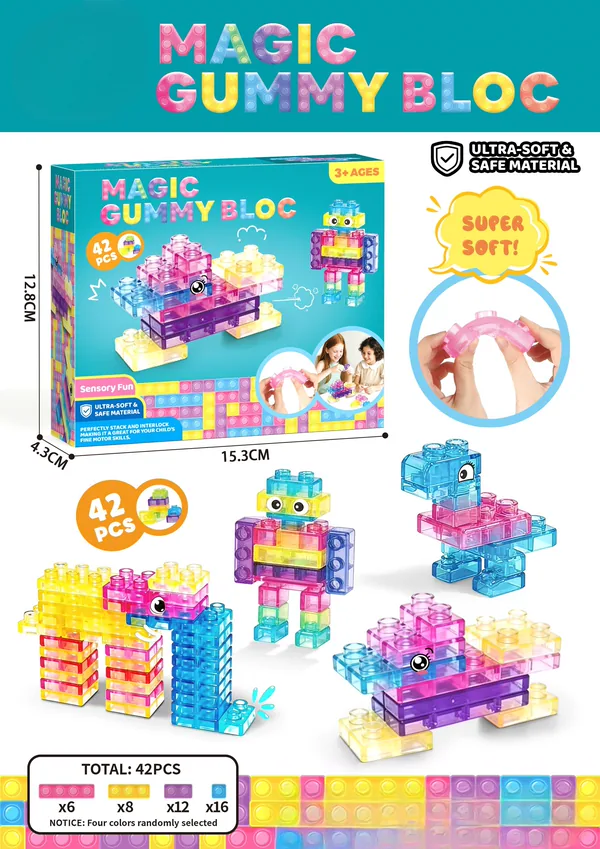
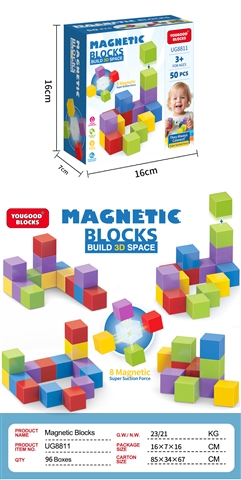
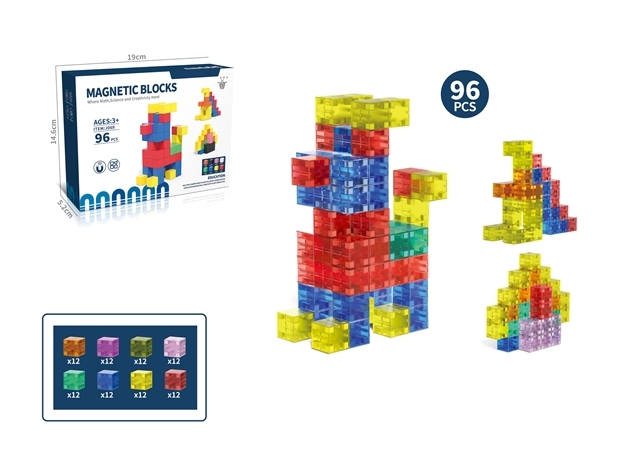
| Typical MOQ | 120–480 units per SKU (e.g., 480 for DIY Soft Building Blocks, 120 for 96PCS magnetic blocks) |
| Lead time (after sample approval) | 15–25 days |
| Tooling cost | None |
| Who owns the mold? | Factory |
What Can You Customize on MOC-Compatible Building Blocks?
The customization surface on MOC-compatible building blocks is deeper than most buyers realize. It's not just about slapping a logo on a box.
Brick shape and new elements. This is the core of OEM. If your STEAM set needs a custom gear, a unique connector, a character head, or a specialty axle that doesn't exist in the reference system, you're looking at a new mold. Factories will ask for a 3D file (STEP or IGES), then run a mold-flow analysis to ensure the part fills correctly and maintains clutch consistency with standard bricks. They'll also calculate shrinkage for the chosen material—ABS shrinks at a known rate, and the mold cavity is cut slightly oversized to compensate.
Color. You can specify any Pantone number and the factory matches it in ABS masterbatch. One caution: metallic and glow-in-the-dark formulations change the material's friction coefficient slightly, so clutch power needs re-validation. Expect a color chip approval step before production.
Material. Standard is ABS. You can upgrade to eco-friendly ABS with recycled content, or specify PC for transparent elements. If you want a softer touch on certain parts (like animal figures), TPE overmolding is possible but adds a second mold and a two-shot molding step.
Packaging. This is where most brands start. Custom box art, instruction manuals with your brand voice, inner trays, and retail-ready display boxes are all on the table. Some buyers ship their own packaging to the factory; others let the factory source and print. If your market requires EAN/UPC barcodes, provide them at the artwork stage.
Logo and private label. Pad printing, laser engraving, or in-mold labeling on studs and bricks is standard. For private label, the factory affixes your brand on the product, manual, and outer carton. They'll also use neutral shipping marks if you're drop-shipping to Amazon FBA.
Set composition. You can mix and match elements from the factory's existing ODM library to build a unique set—say, a 150-piece STEAM kit that combines gears, axles, and magnetic connectors. This avoids new molds entirely while creating a product that doesn't exist on anyone else's shelf.
What MOQ, Tooling Costs, and Mold Ownership Look Like in Practice
MOQ in building-block OEM is driven by one number: how many cavities the mold needs to fill a single set efficiently. If your set uses a custom brick that appears 20 times, a single-cavity mold means 20 molding cycles just for that one brick type. That's slow and expensive per unit. So the factory will often cut a multi-cavity mold—4, 8, or 16 cavities—which amortizes faster but pushes the minimum order up, because you need to run enough shots to justify the mold changeover.
A realistic OEM MOQ for a custom MOC set with 2–4 new molds lands at 1,000–3,000 units per SKU. Below that, the per-unit mold amortization cost eats your margin. For ODM sets where no new molds are cut, MOQ typically sits at 500–1,200 units. Stock-plus-logo can go as low as 120–480 units, depending on the existing product. For example, a 96PCS magnetic blocks set carries a 120-unit MOQ; the DIY Soft Building Blocks 42-PCS starts at 480 units.
Who pays for the mold? You do, typically 50% upfront and 50% on sample approval. The mold remains your property—a standard clause in any OEM contract worth signing. You can take the mold elsewhere after the contract term, though practically, moving a precision mold between factories requires re-qualification and you'll lose time. Most brands keep the mold at the factory that cut it and just re-order.
Tooling cost varies wildly by cavity count, part complexity, and steel grade. A simple single-cavity ABS brick mold costs far less than a multi-cavity mold for a transparent PC windshield with a sliding core. The factory will quote mold cost after reviewing your 3D file—never accept a ballpark number before they've seen the part geometry.
How Sampling and Lead Times Work for Custom Building Blocks
Samples are where theory meets plastic. You'll go through at least two stages.
Stage one: 3D-printed or SLA prototype. Before cutting steel, the factory can 3D-print your custom brick in a resin that approximates ABS stiffness. You check fit, clutch, and aesthetics. This takes 5–10 days and costs a few hundred dollars. It's cheap insurance against a bad mold.
Stage two: T1 mold sample. The first shots off the new mold. Expect surface finish to be rough, flash on the parting line, and color not yet matched. You're checking geometry and clutch. The factory then polishes the mold, adjusts gate size, and shoots T2 and T3 samples until the part is production-ready. This cycle takes 15–30 days depending on complexity.
For ODM and stock-plus-logo, sampling is faster—7–15 days for an existing product sample with your color or packaging mockup.
Full production lead time after sample approval: OEM 30–45 days (mold making plus production), ODM 25–35 days, stock-plus-logo 15–25 days. Add 2–4 weeks for ocean freight to US/EU ports, or 5–8 days for air freight if you're restocking mid-season.
The OEM/ODM Process for MOC Building Blocks, Step by Step
Every factory's workflow varies slightly, but the skeleton is the same. Here's how a MOC building block OEM project moves from idea to container.
Step 1: Inquiry. You send your design brief—sketches, 3D files, reference images, target retail price, and target market (US, EU, etc.). The more concrete, the better. "I want a 200-piece STEAM robot kit with a custom gearbox" beats "I want a custom building set."
Step 2: Quotation. The factory reviews your files, assesses mold complexity, material, packaging, and target certifications. They return a quote covering mold cost, unit price at different MOQ tiers, and tooling timeline. Expect this within 3–5 working days for a complete brief.
Step 3: Sample & proofing. For OEM, this means 3D-printed prototypes, then T1 mold samples. For ODM/stock, it's existing samples with your color and logo proofs. You approve in writing before the next step.
Step 4: Mold/tooling. Once you approve the sample and pay the mold deposit, steel is cut. Mold making takes 15–25 days. The factory sends T1 shots; you iterate through T2/T3 if needed.
Step 5: Mass production. All molds are qualified, materials are in-house, packaging artwork is approved. Production runs 15–25 days for a typical 2,000-unit OEM order. Inline QC checks clutch force, dimensional tolerance, and color at set intervals.
Step 6: QC & safety testing. For US/EU markets, the factory sends random samples to a third-party lab (or your nominated lab) for EN71, ASTM F963, CPSIA, or CE testing. Don't ship without a passing report—one failed customs hold wipes out your margin. The factory also performs an AQL 2.5/4.0 final random inspection before packing.
Step 7: Shipping. Goods are packed in master cartons, palletized, and loaded into a container. FOB Shantou or Shenzhen is standard. You can nominate your own forwarder or use the factory's recommended shipper.
How to Protect Your Brand and Intellectual Property
Worried about your design walking out the back door? That fear is common and manageable. Three layers of protection are standard in a well-structured OEM relationship.
NDA. Sign a mutual non-disclosure agreement before you send any files. A factory that hesitates on an NDA is a red flag. Reputable manufacturers execute an NDA within 48 hours of a serious inquiry.
Mold ownership clause. Your OEM contract should state explicitly that you own the mold and all intellectual property in the custom parts. The factory may not use the mold for any other customer, period. This is non-negotiable.
No re-sale of custom packaging. Your branded boxes, manuals, and inserts are yours. The contract should forbid the factory from selling your packaged product to any third party. Many buyers also split production: molds and bricks from one factory, packaging printed elsewhere and shipped in. That adds logistics complexity but gives you total control over branded materials.
A practical note: the building-block industry in Shantou runs on reputation. A factory that leaks a client's design loses more future business than it could ever gain from one copied product. Long-term relationships matter more than quick wins.
Frequently Asked Questions About Custom MOC Building Blocks
What's the minimum order to customize MOC building blocks?
Stock-plus-logo: 120–480 units depending on the set. ODM (existing design, your brand): 500–1,200 units. Full OEM with new molds: 1,000–3,000 units per SKU.
Do I have to pay for samples?
Existing ODM/stock samples are usually free; you cover shipping. For OEM with a new mold, the prototype and T1 sample cost is typically rolled into the mold fee. A standalone 3D-printed prototype before commitment costs a few hundred dollars.
Who owns the mold after it's made?
You do, by contract. The OEM agreement must include a mold ownership clause stating the mold is your property and cannot be used for other clients. You can request the mold be shipped to you after the contract term.
Can you print a logo directly on the bricks?
Yes. Pad printing works on studs and flat surfaces. Laser engraving is permanent and precise. In-mold labeling embeds the logo during injection so it cannot wear off.
Will the factory sign an NDA before I send my design?
Yes. A mutual NDA is standard practice and should be executed before any design files are shared. If a factory refuses, find another supplier.
How is MOC compatibility verified?
The factory tests clutch force on a calibrated gauge against reference bricks, measures stud diameter and height with a digital micrometer, and runs a fit test on a standard baseplate. For new molds, ABS shrinkage (typically 0.4–0.6%) is accounted for in cavity dimensions. Compatibility is verified at T1 sample stage and again during inline QC.
Related Products & Categories
Request a Quote for Your Custom MOC Building Blocks
Custom MOC-compatible STEAM building blocks don't start with a catalog—they start with your idea. Send us your sketches, 3D files, or even a rough concept, and we'll return a detailed quotation covering mold cost, unit pricing at your target MOQ, packaging options, and a realistic timeline. Reach out at www.squeezaa.com and let's build something that doesn't exist yet.