
PO checklist for seasonal tactile novelty drops: from sample approval to shipment release
Move from sample approval to shipment release with fewer omissions. A practical PO checklist for seasonal tactile novelty drops covering fit, MOQ, safety evidence, and delivery checks.
Choose a seasonal tactile novelty supplier that can document product fit, assortment economics, and safety evidence in writing — if they can only send a photo of a sample and a verbal promise, keep looking. This checklist walks novelty importers, fidget distributors, gift retailers, and ecommerce buyers from the moment a sample is approved to the moment a shipment is released. The gap between "sample approved" and "shipment released" is where most seasonal drops go wrong: colors drift, packaging language is wrong for the destination, tooling ownership is unclear, and a lab report that does not match the production lot gets treated as a shipment certificate. Work through the eight checkpoints below, ask the supplier questions verbatim, and you will release shipments with fewer surprises.
Key Takeaways
- A type-test or golden-sample report does not automatically cover a later production lot — match report SKU, materials, colors, and production date/cohort to the PO before release.
- Seasonal packaging does not waive toy safety rules: Halloween, Christmas, and Easter novelty toys remain toys if designed for play, so EN 71 / ASTM F963 / CPSIA still apply.
- Production release must reference an identified approved sample, not a loose reference photo — especially for color, texture, logo, and assembly.
- Tooling ownership, storage period, and idle-tool disposition must be written into the PO or a separate agreement; a paid sample or development fee does not automatically transfer the mold.
- Set inspection and defect-handling terms in the PO — agree on the inspection plan, defect classes, and lot-release rules before shipment, not in a catalogue sentence.
Verify product fit against your channel and end-user
Before you commit a PO, map each shortlisted product to the channel where it will actually sell: retail shelf, ecommerce listing, gift box, or promotional program. A squeeze toy that works as a countertop impulse buy may not survive as an online SKU with a high return rate, and a fidget that sells to adults in an office gift exchange may not meet the age grading you need for a kids' channel.
Run the tactile re-squeeze test on every sample: does it make someone want to squeeze it again? That is the product-fit lens for this category. Document three things per product: (a) channel fit, (b) tactile appeal rationale, and (c) who the end-user is and why they would re-squeeze. If you cannot write those three lines, the product does not belong on the PO.
Assess assortment economics and display behavior
Decide whether each product works as a standalone SKU or needs a curated assortment. In one illustrative case, a manufacturer curated sensory toys and large pop-its for shared tables with simple packaging and short Spanish instructions, and a distributor entered three private school "sensory corner" programs with a silent contract renewed each semester. The lesson: assortment composition and packaging simplicity can open channels a single SKU cannot.
Consider how the product behaves on a physical display. One distributor reported fewer counter returns after switching to a tactile line because the display became a "test zone" where customers squeeze before buying, acting as free marketing. If your product cannot survive being handled in a store, it may generate returns instead of sales. Document the assortment composition, packaging simplicity, language requirements, and whether the display encourages trial-before-buy.
Verify supplier credibility and client base
Ask the supplier for named client references in your channel and your geography. A general "we work with big retailers" claim is not evidence. One toy group's customer wall includes top-tier retailers and chains across toys, party, and mass market — that is the kind of verifiable track record you want, not a verbal assurance.
Ask: "Can you provide named client references in [your channel] and [your geography]?" If the supplier hesitates or offers only logos without contact details, treat it as a red flag. You are not looking for the biggest supplier; you are looking for one that has shipped comparable tactile novelty products to buyers like you.
Define tooling ownership and storage terms in writing
If the PO involves custom tooling or molds, freeze the terms in writing before you pay. In one real case, a buyer asked who owned the tool after paying a fee, and the contract had not frozen storage years or release conditions. The supplier now writes fee, ownership, storage period, and what happens if the tool sits idle. Tooling policy is a document, not a handshake.
Ask: "Who owns the tooling after the fee is paid? How long will you store it? What happens if it sits idle for [X] months?" A mold cannot be assumed transferable merely because you paid a sample or development fee; transfer conditions should be written. Put the answers in the PO or a separate tooling agreement.
Set inspection and defect-handling terms in the PO
Agree on the inspection plan, defect classification, and lot-release rules before shipment — not in a catalogue sentence. A reputable factory will isolate a failed lot, record defect class, and release only after rework. Buyers who want a number get it from the agreed inspection plan on the PO, not from a catalogue sentence.
Ask: "What inspection plan is referenced in this PO, and what are the defect class definitions?" If the supplier cannot name a sampling standard (such as ISO 2859-1 / ANSI Z1.4) and define critical, major, and minor defects, you are not ready to release a shipment. Typical AQL settings for consumer goods are 0 for critical, 2.5 for major, and 4.0 for minor — but confirm the actual plan in your PO rather than assuming.
Confirm packaging, labeling, and language requirements
Verify packaging format, label content, and language requirements match the destination market and channel. In one illustrative case, a manufacturer used simple packaging and short Spanish instructions for Latin American school programs — the packaging was part of the product fit, not an afterthought.
Confirm packaging dimensions, label copy, language(s), and any channel-specific formats such as retail-ready, polybag, or hangtag. For seasonal drops, also verify that the packaging does not conflict with the destination market's labeling rules. Remember: seasonal packaging does not waive toy safety requirements — Halloween, Christmas, and Easter novelty toys remain toys if they are designed or intended for play.
Validate safety documentation and compliance evidence
Request current safety documentation appropriate to the destination market, and do not accept verbal assurances. Ask: "What specific test reports, certificates, or compliance documents do you hold for [destination market]?" If none are provided, list this as an evidence gap and require documentation before shipment release.
A type-test or golden-sample report does not automatically cover a later production lot. Match the report's SKU, materials, colors, and production date/cohort to the PO. For the US market, that means checking ASTM F963 and CPSIA compliance; for the EU, the relevant framework is Regulation (EU) 2025/2509, which entered into force on 2026-01-01 and applies mainly from 2030-08-01, with Directive 2009/48/EC remaining relevant during the transition. Note that Incoterms like FOB, CIF, or DDP allocate trade responsibilities but do not certify the toy or replace CE, CPC, UKCA, or other market evidence.
Confirm MOQ, lead time, and seasonal drop timing
Verify MOQ per SKU, production lead time, and whether the supplier can commit to your seasonal drop date in writing. Ask: "What is the MOQ per SKU, what is the production lead time, and can you commit to the [seasonal drop date] in writing?"
MOQs vary widely by product type and material. For example, in one product catalog, a felt busy book has a MOQ of 35 units, a plastic prank kit has a MOQ of 96, a paper novelty book has a MOQ of 180, a plastic fidget spinner has a MOQ of 400, and a silicone squishy set has a MOQ of 1440. These figures are illustrative of how much MOQs can vary — always confirm the exact MOQ for your specific SKU and whether tiered pricing applies at higher volumes.
For seasonal drops, work backward from the drop date: production lead time, inspection time, and shipping time (sea vs. air) all affect the delivery window. Sea freight is cheaper but slower; air freight can save weeks but adds cost. Confirm the shipping method and its impact on total cost and delivery before you commit to a PO.
Worked example (illustrative, not a real shipment)
Imagine a buyer planning a Christmas drop of 2,000 units of a silicone dumpling squishy toy for two destinations: the US and the EU. The US units need ASTM F963 and CPSIA documentation; the EU units need CE marking under the transitional framework. The buyer approves a golden sample, but the supplier's lab report only covers the US-market version with different packaging language.
At the pre-shipment inspection, the inspector finds the EU units have English-only labels instead of the required local language, and the packaging does not match the approved sample's color. The shipment is held because the packaging and labeling do not match the approved sample and the destination market's requirements. The buyer must request rework on the EU units' packaging and updated documentation before release. The lesson: check packaging language and documentation per destination before the container is sealed, not after.
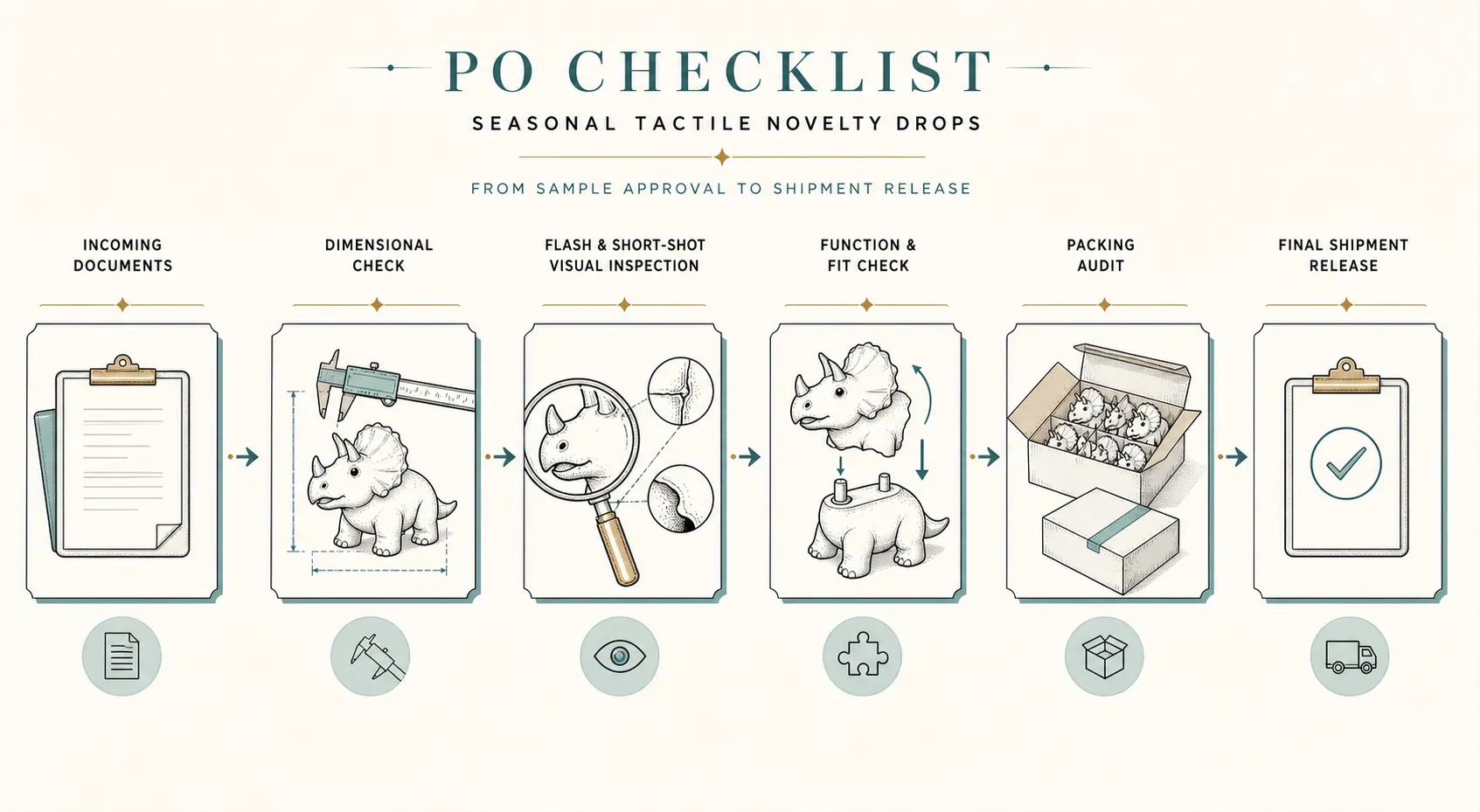
PO Checklist: What to Check at Each Stage
| Sample approval | Confirm golden sample is identified with ID, approval date, and revision code; verify color, texture, logo, and assembly against the physical sample, not a photo. |
|---|---|
| Tooling terms | Freeze fee, ownership, storage period, release conditions, and idle-tool disposition in writing. |
| Inspection plan | Reference a specific sampling standard (e.g., ISO 2859-1 / ANSI Z1.4) and define critical, major, minor defect classes in the PO. |
| Packaging & labeling | Confirm dimensions, label copy, language(s), and channel-specific formats (retail-ready, polybag, hangtag) match the destination market. |
| Safety documentation | Match report SKU, materials, colors, and production date/cohort to the PO; request documents for each destination market. |
| MOQ & lead time | Confirm MOQ per SKU, production lead time, and written commitment to the seasonal drop date. |
| Pre-shipment inspection | Inspect at 100% complete and 80% packed; verify quantity, workmanship, function, safety, and packaging against the approved sample. |
| Shipment release | Release only after all documentation checkpoints are cleared and the inspection plan's lot-release rules are met. |
What to ask suppliers before you release a shipment
Use these questions as your RFQ and PO checklist. A useful toy RFQ states destination market, age grade, materials and colors, packaging language, requested tests, sample policy, tooling terms, and the requested trade term.
1. "Can you provide named client references in [your channel] and [your geography]?" — verifiable references, not logos.
2. "Who owns the tooling after the fee is paid? How long will you store it? What happens if it sits idle for [X] months?" — get it in writing.
3. "What inspection plan is referenced in this PO, and what are the defect class definitions?" — a named standard, not a vague promise.
4. "What specific test reports, certificates, or compliance documents do you hold for [destination market]?" — match the report to the production lot.
5. "What is the MOQ per SKU, what is the production lead time, and can you commit to the [seasonal drop date] in writing?" — confirm before you commit.
What to watch for this year
For EU-bound shipments, note that Regulation (EU) 2025/2509 entered into force on 2026-01-01 and applies mainly from 2030-08-01, with Articles 28-44 and 49-55 applying from 2026-01-01. Directive 2009/48/EC remains relevant during the transition. The exact application timeline for all provisions is not confirmed from official text, so confirm the applicable requirements with your supplier or a compliance advisor before shipping.
For US-bound shipments, continue to verify ASTM F963 and CPSIA compliance, including lead limits and small parts requirements. Seasonal packaging does not waive these rules. If you are sourcing plush or stuffed tactile toys, ask whether the factory uses needle detection before packing — it is a standard practice in some factories and a useful question to include in your supplier vetting.
FAQ
For a first bulk order of wholesale fidget toys, what are typical MOQs and how do they vary between stock designs and custom OEM items?
MOQs vary widely by product and material. In one catalog, a felt busy book has a MOQ of 35, a plastic prank kit has a MOQ of 96, a paper novelty book has a MOQ of 180, and a silicone squishy set has a MOQ of 1440. Stock designs typically have lower MOQs, while custom OEM items with new tooling usually require higher minimums to amortize mold costs. Always confirm the exact MOQ per SKU in writing.
Can a supplier offer custom color or logo molding for wholesale fidget toys, and what are the usual mold costs and minimum quantities for that service?
Yes, many suppliers offer custom colors and logo molding, but the terms must be written into the PO or a separate tooling agreement. Mold costs and minimum quantities vary by product complexity and material — there is no standard figure. Ask the supplier to quote the tooling fee, ownership, storage period, and MOQ for the custom version before you commit.
What are the typical MOQs for bulk fidget toys when ordering directly from a Chinese manufacturer, and do they offer tiered pricing for higher volumes?
MOQs for bulk fidget toys from Chinese manufacturers typically range from under 100 units for simple stock items to over 1,000 units for complex or custom products. Tiered pricing for higher volumes is common but must be confirmed per supplier. Ask for a price break schedule at 1x, 2x, and 5x the MOQ to see where the discounts kick in.
Can a supplier provide OEM customization for bulk fidget toys, such as custom colors, logos, or unique shapes, and what are the setup costs?
Yes, OEM customization is standard in this category, but setup costs vary by the scope of changes. Custom colors and logo printing are usually cheaper than unique shapes that require new tooling. Ask the supplier to itemize the setup costs: tooling fee, sampling fee, and any minimum order uplift for the custom version. Get the tooling ownership and storage terms in writing.
How do lead times and shipping methods (sea vs. air) affect total cost and delivery windows for a wholesale order of bulk fidget toys?
Sea freight is cheaper but slower, typically adding several weeks to the delivery window; air freight can save weeks but adds significant cost per unit. For seasonal drops, work backward from the drop date: production lead time, inspection time, and shipping time all affect the window. Confirm the shipping method and its cost impact before you commit to a PO.
Does a lab test report cover my entire production lot?
No. A type-test or golden-sample report does not automatically cover a later production lot. You must match the report's SKU, materials, colors, and production date/cohort to the PO. If the report does not match, require updated documentation before shipment release.
Sources
Related Products & Categories
Request a Quote
Ready to move from sample approval to shipment release with fewer omissions? Send your RFQ with the destination market, age grade, materials and colors, packaging language, requested tests, sample policy, tooling terms, and trade term — and get a written response you can hold the supplier to.