Private-label silicone, TPR and foam material choices: color, logo, packaging and sample decisions
Learn how to customize silicone, TPR, and foam fidget toys: color, logo, packaging, MOQs, sample lead times, and compliance. Get a quote-ready checklist.
For a first private-label order of fidget toys, you can typically customize color, logo placement (molded or printed), and packaging, with MOQs starting around 720–1,080 pieces for stock designs; molded logos or custom shapes may require tooling costs and higher minimums. The practical question isn't just which material feels best—it's which changes you can request, what they cost, and how they affect MOQ and lead time. This guide lays out the customization options, MOQ logic, sampling process, and compliance checks so you can brief a factory correctly and avoid the classic pitfalls—like approving a product sample without a packaging proof or assuming a Pantone number is a production formula.
Key Takeaways
- Color matching on silicone and TPR is a controlled process, not a Pantone pick: final standards should be approved molded samples, reviewed under multiple light sources to avoid metamerism.
- Molded logos (embossed/debossed) are durable but typically require tooling costs and higher MOQs; printed logos need adhesion testing and add setup time—choose based on your volume and branding needs.
- Packaging is where barcodes, compliance claims, and branding live: define your label system (on-product vs. packaging vs. carton) before sampling to avoid rework and chargebacks.
- MOQs for stock designs (no customization) can be as low as 144–264 pieces, while custom OEM with tooling or color changes often starts around 720–1,080 pieces; ask for tiered pricing.
- Always request a production-representative sample with your logo and packaging proof before mass production, and agree on color tolerance (ΔE) and measurement conditions upfront.
Customization Options: What Can You Change and What It Costs
| Custom color (stock design) | MOQ: 720–1,080 pcs (typical); Tooling: none; Lead time: +7–14 days for color sampling; Notes: Color must match approved master sample; avoid last-minute changes after steel is set. |
|---|---|
| Molded logo (embossed/debossed) | MOQ: Higher (e.g., 2,000+ pcs); Tooling: Yes (mold modification or new insert); Lead time: +15–30 days; Notes: Durable, not for variable data like batch codes. |
| Printed logo (pad/screen printing) | MOQ: 720–1,440 pcs; Tooling: Setup cost for screens; Lead time: +5–10 days; Notes: Requires adhesion testing; check durability on TPR/foam. |
| Custom packaging (blister, box, pouch) | MOQ: 1,000–2,000 pcs per SKU; Tooling: Printing plates/dies; Lead time: +10–20 days; Notes: Must include barcode, compliance text, and artwork approval. |
| Stock design + your brand on packaging only | MOQ: As low as 144–264 pcs (stock item); Tooling: None; Lead time: Short (stock + label); Notes: Fastest route to market; verify barcode/SKU control. |
Personalized vs. Wholesale Bulk: Which Route Fits Your First Order?
Choose stock-plus-logo (private label on existing designs) if you need speed, low MOQ, and minimal risk—ideal for testing a market or launching a small ecommerce line. Choose full OEM (custom color, shape, and branding) when you own the design, expect repeat volume, and can absorb tooling costs and longer lead times.
For a first bulk order, many importers start with a stock design, add a printed logo and custom packaging, and then move to custom colors or a molded logo once sales justify the tooling. This staged approach keeps your initial investment low and gives you real sales data before committing to a mold.
If you're targeting Amazon, retail chains, or wholesale distributors, your packaging needs differ: Amazon requires FNSKU and carton labels; retail needs shelf-ready packaging and warning text; wholesale needs SKU labels and batch traceability. Define your channel before you approve artwork—it saves costly reprints.
A verbal 'quick color change' during peak season can miss a vessel. A professional supplier will write a design freeze date, change-over hours, and which job is on the press. Without that, a promised lead time is fiction.
How to Order Custom Fidget Toys: Step-by-Step Process
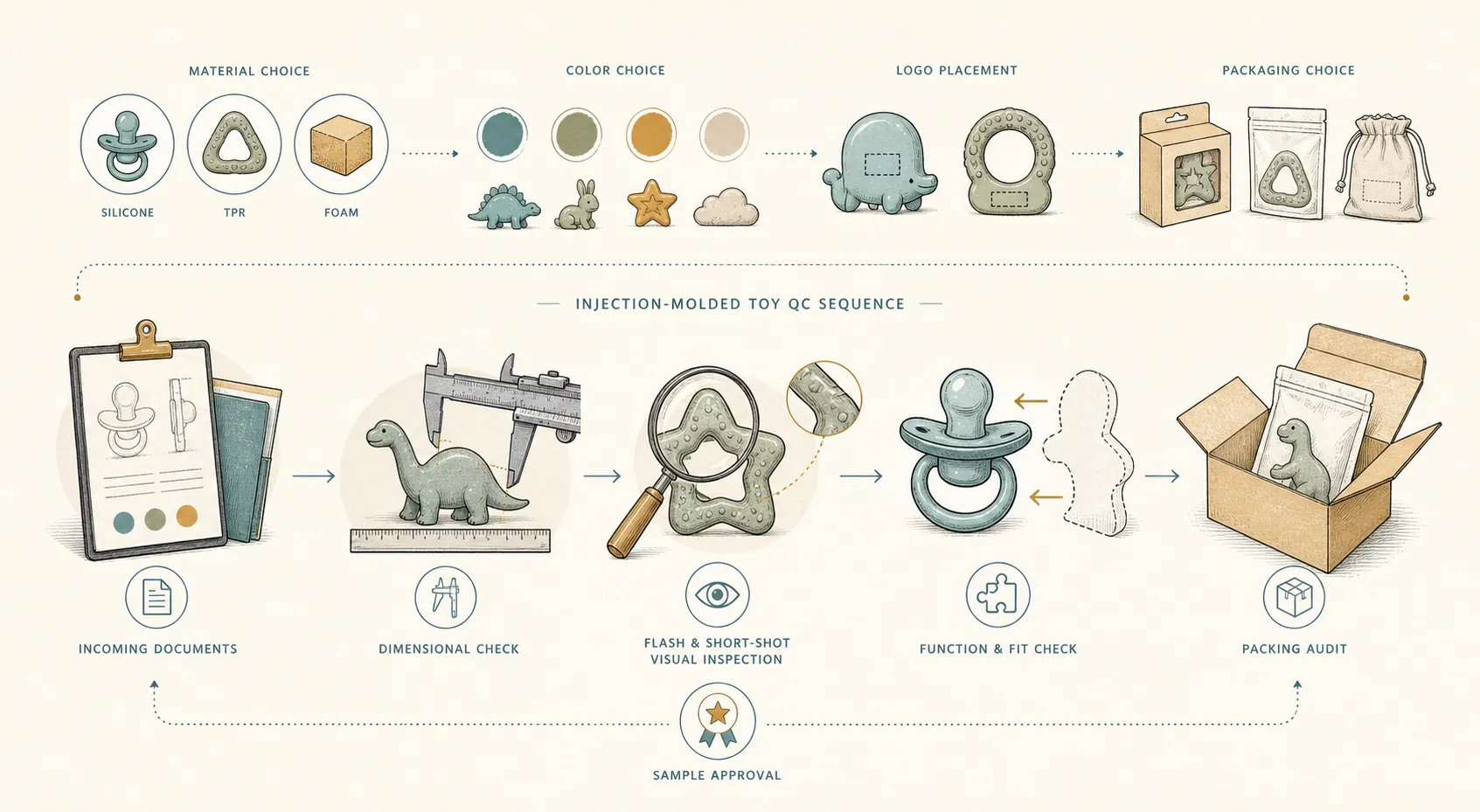
Ordering custom fidget toys follows a clear sequence: inquiry → quote → sampling/proofing → tooling (if needed) → mass production → QC → shipping. Here's what each step involves and what to check.
1. Inquiry: Send a complete RFQ: product type and size, target quantity, color references (Pantone is fine as a starting point), logo artwork (vector preferred), packaging type, barcode/SKU requirements, target market (US/EU/other), and compliance docs you need. The more detail, the more accurate the quote.
2. Quote: The supplier will quote based on material (silicone, TPR, PU foam), size, complexity, and quantity. Expect tiered pricing—higher volumes lower the unit cost. Ask for a price break at 500, 1,000, 2,000, and 5,000 pieces if relevant.
3. Sampling/Proofing: Always request an approved molded sample, not just a digital render. For color, ask for a sample under controlled lighting and compare it to your standard. For packaging, request a physical proof with your logo placed on the actual product—logo placement that works on a large size may not fit a small one. Approve the sample in writing, and keep a master sample for reference.
4. Tooling (if needed): For custom shapes or molded logos, the mold is usually owned by the buyer after payment. Confirm who owns the mold, the tooling cost, and the lead time (typically 15–30 days). Get a design freeze before the tool is released to avoid unapproved changes.
5. Mass Production: The factory should follow the approved sample and use the same resin grade, pigment system, and process parameters. Ask how they control color batch-to-batch (equipment cleaning, formula freeze) and request a pre-production sample if volume is high.
6. QC: Agree on an inspection standard (e.g., AQL sampling per ISO 2859-1) and whether you'll use a third-party inspector. Check for color difference, logo adhesion, packaging integrity, and that barcodes scan correctly. Ask for a carton mark and batch label check against the PO.
7. Shipping: Choose sea (cost-effective, 25–40 days transit) or air (fast, 5–10 days, but much higher cost). Factor in port-to-door logistics and customs clearance. Ask the supplier for export-standard packing to prevent damage in transit.
Worked example (illustrative, not a real shipment): A buyer orders 2,000 pcs of a TPR squishy in custom color (light blue) with a printed logo and a kraft box with a sticker. They request a color sample first, then a packaging proof. After approval, production takes 2 weeks, plus 1 week for sea freight from Shenzhen to Los Angeles. Upon arrival, the buyer's QC checks the first 125 pieces per AQL 2.5; they find a slight color shift on 3 pieces and a logo adhesion issue on 1. The factory is notified, and the next batch is reworked. This illustrates why sample approval and QC steps are critical—they catch issues before the whole shipment is affected.
What MOQs Should You Expect for Custom vs. Stock Fidget Toys?
MOQs vary by factory, but here's a typical picture: stock designs (no customization) can have MOQs as low as 144–264 pieces, as seen with certain items like a 3.5cm ice cube squishy (MOQ 264) or a magnetic cube (MOQ 144). Custom colors or printed logos usually push the MOQ to 720–1,080 pieces, and molded logos or custom shapes may require 2,000+ pieces to justify tooling costs.
Tiered pricing is common: the unit price drops as quantity increases. For example, a 0.55 USD squishy at 720 pcs might drop to 0.45 USD at 2,000 pcs and 0.40 USD at 5,000 pcs—ask for a price matrix. Always confirm whether the MOQ is per SKU or per order, and whether you can mix colors within one design to reach the minimum.
Tooling costs are separate: for a custom mold, expect a one-time fee (varies by complexity) and a longer lead time. If you're unsure about a design, start with a stock item and print your logo—it's the lowest-risk way to test your brand.
How Do Color, Logo, and Packaging Choices Affect Cost and Compliance?
Color is the most common customization, but it's not a simple Pantone fill. Silicone and TPR color is influenced by the resin grade, pigment system, concentration, thickness, surface texture, and molding conditions. Pantone numbers are references, not direct formulas—you must approve a molded sample. For light pastel colors, expect stricter process controls and potentially higher costs due to contamination risks. Fluorescent and metallic effects are harder to control and may have application restrictions.
Logo placement: Molded logos (embossed/debossed) are durable and premium, but they require mold changes and higher MOQs. Printed logos (pad/screen printing) are flexible and lower-cost, but they need adhesion testing on the specific material—TPR and foam can be tricky. For variable data like batch codes, use packaging labels instead.
Packaging is where compliance and branding meet. Your packaging must include product identification, intended use, net contents, manufacturer info, and any required warnings. For the US, this may include CPSIA/CPC and ASTM F963; for the EU, EN71. Claims like 'BPA-free' or 'food-grade' must be backed by test reports. Barcode control is critical—confirm UPC/EAN/FNSKU and run scan tests before packing to avoid chargebacks.
A lot or batch code on the package supports recall, complaint investigation, and stock segregation when the product or material changes. Always ask for a lot code on the carton and, if possible, on the individual package.
What Compliance Checks Should You Request for Silicone, TPR, and Foam Fidget Toys?
Compliance depends on your target market: the US requires ASTM F963 and CPSIA (with CPC for many toys); the EU requires EN71. Ask your supplier for test reports per item—not a blanket statement. For example, the Color-slide puzzle has ASTM and EN71, while the Small Color-Printed Butter Cheese Sticks (PU foam) has EN71. Some items may be 'certification in progress'—clarify the timeline.
If you're selling on Amazon US, you may need a Children's Product Certificate (CPC) and documentation of ASTM F963 testing. For the EU, the General Product Safety Regulation (GPSR) and Digital Product Passport (DPP) are separate regimes—don't confuse their deadlines. The DPP timeline is not confirmed from official text, so verify with your supplier's compliance team.
Food-contact claims (like for maltose-filled squishies) require FDA or LFGB documentation if you market them as such, but squishies are toys, not food—be cautious about making such claims without evidence. Always match your marketing claims to the documentation you have.
Worked example (illustrative, not a real shipment): A buyer plans to sell TPR squishies in the EU. They request EN71 test reports from the factory. The factory provides reports for a similar product but not the exact item. The buyer rejects the shipment and asks for per-item testing. This highlights why you should specify compliance requirements in the RFQ and verify reports before production.
FAQ: Private-Label Fidget Toys
What is the typical MOQ for a first bulk order of wholesale fidget toys?
Stock designs can have MOQs as low as 144–264 pieces, while custom colors or printed logos typically start around 720–1,080 pieces. Molded logos or custom shapes may require 2,000+ pieces. Confirm per-SKU and per-order minimums with your supplier.
Can a supplier offer custom color or logo molding for wholesale fidget toys, and what are the usual mold costs?
Yes, most suppliers offer custom color and logo molding. Mold costs vary by complexity and are typically a one-time fee; for molded logos, expect higher MOQs (2,000+). Printed logos have lower setup costs but need adhesion testing. Always request a molded sample for color approval.
Do Chinese manufacturers offer tiered pricing for higher volumes of bulk fidget toys?
Yes, tiered pricing is common. For example, a unit price might drop from 0.55 USD at 720 pcs to 0.45 USD at 2,000 pcs and lower at 5,000 pcs. Ask for a price matrix based on your target quantities.
What setup costs should I expect for OEM customization (colors, logos, unique shapes)?
Setup costs include tooling for molds (if custom shape or molded logo), screen setup for printed logos, and packaging plate/die costs. These are one-time fees. Expect sample costs (often refundable on order) and possibly a color development fee for custom colors. Confirm all costs upfront.
How do lead times and shipping methods (sea vs. air) affect total cost and delivery windows?
Sea freight is cost-effective but takes 25–40 days transit; air freight is faster (5–10 days) but much more expensive. Lead time for production is typically 2–4 weeks after sample approval, plus shipping. Factor in peak season delays—a verbal 'quick color change' in September can miss a vessel. Always confirm the freeze date and change-over hours.
Will a supplier sign an NDA and let me own the mold?
Most professional suppliers will sign an NDA to protect your design and IP. Mold ownership is negotiable—typically, if you pay for the mold, you own it, and the supplier may keep it for your exclusive use. Confirm mold ownership and storage terms in your contract.
Sources
Related Products & Categories
Request a Quote for Your Custom Fidget Toy Line
Ready to spec your private-label silicone, TPR, or foam fidget toys? Send your design, target quantity, and market requirements for a custom quote. Our team can guide you through color matching, logo options, packaging, and compliance—so you get a product that's shelf-ready and safe for your market.