
Rainbow Mystery Squishy Bun Toys: Which Samples to Approve
Use the Rainbow Mystery Squishy Bun Toys recall to separate fill checks, lab testing and approval conditions for wholesale squeeze-toy samples.
For SqueeZaa, approve samples against the agreed written specification—not squeeze feel alone—and resolve water-bead expansion questions through qualified laboratory testing. Identify the fill and mechanism first, then inspect function, finish, dimensions and packaging. The Rainbow Mystery Squishy Bun Toys recall shows why that sequence matters: a pleasant hand feel cannot establish safe bead-expansion performance. Only after approval should a sample become the retained production reference; it complements the specification and change records rather than replacing them.
What did CPSC publish about Rainbow Mystery Squishy Bun Toys?
CPSC’s September 17, 2026 recall states that the named Rainbow Mystery Squishy Bun Toys violated the mandatory toy safety standard because their internal water beads expanded larger than permitted, creating a deadly ingestion hazard. The published hazard also describes choking and intestinal obstruction risks if a bead is ingested. This is a dated US recall finding about the named product, not a finding about every squishy or shelf fidget. CPSC recall
The review question is therefore not just “Does the shell leak?” It is also “What exactly is inside, and what evidence addresses that component’s behavior?” An intact-looking sample does not answer the expansion question. Equally, the recall notice does not establish that a seam failure caused the published violation.
A sample identified as the recalled product should not enter an ordinary approval trial. CPSC instructed consumers to stop using the recalled toys immediately and contact the importer for a refund. Keep recall identification separate from the evaluation of other candidates. CPSC recall
Is the sample water-bead-filled, sand-filled or a magnetic slider?
Classify the actual fill and mechanism before transferring any recall-derived question to a candidate. Ask for a component-level description of the outer body, filling, closure and any moving or magnetic parts; compare that description with the sample.
For a water-bead-filled squishy, separate containment observations from qualified testing of bead expansion. For a sand-filled squeeze toy, inspect containment, leakage, fill distribution and the agreed squeeze response; sand is not evidence of the water-bead expansion mechanism. A magnetic slider needs a different review focused on its sliding action, assembly and magnet retention, with applicable safety conclusions left to qualified testing.
Maltose fill, PU foam, TPR, water beads and sand are not interchangeable descriptions. Some identify a filling; others may identify a body or component material. If the declaration says only “soft material” or “ABS,” request the complete construction description rather than choosing a test route from appearance.
Magnet presence alone neither makes a product a toy nor determines its age classification. Likewise, a buyer’s hand check cannot establish regulatory safety or assign a suitable age.
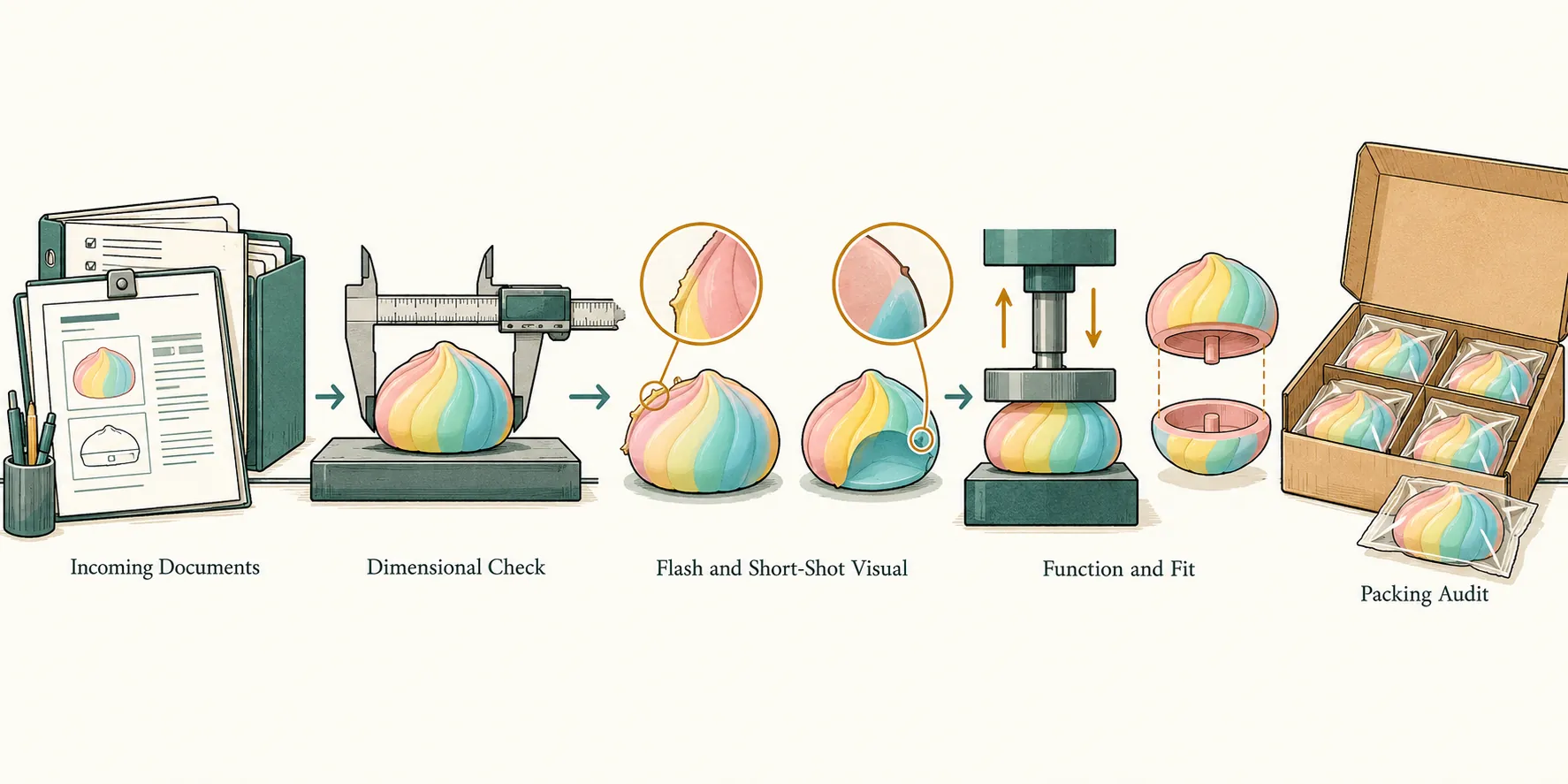
What should buyers inspect against the first-sample specification?
| 1. Identity and materials | Inspect: sample identifier, declared outer-body material, filling and closure construction. Compare: specification revision, component declaration and design drawing. Failure signal: an unexplained component, visible contents inconsistent with the declaration, or a sample that cannot be linked to the reviewed construction. Next decision: hold classification and obtain a corrected declaration or replacement sample. |
|---|---|
| 2. Squeeze function and recovery | Inspect: resistance, recovery, fill movement and consistency during the agreed handling sequence. Compare: written functional requirements; for subjective feel, document the agreed description and review conditions. Failure signal: sticking, incomplete recovery, unexpected hard inclusions or a change in feel during handling. Next decision: record the deviation and require correction or an explicitly approved specification change. |
| 3. Seams, closures and containment | Inspect: visible seams, plugs, closure areas, cracks and any escaping contents before and after handling. Compare: assembly drawing and containment requirements. Failure signal: an opening, wet residue, particles outside the body or visible separation. Next decision: stop handling the affected sample, contain any released contents and hold approval for investigation. |
| 4. Finish and quiet repeat play | Inspect: surface tack, printing, coating transfer and unintended squeaks, clicks or rattles during the agreed action. Compare: finish specification, artwork and the buyer’s quiet-play requirement. Failure signal: material transfer, damaged graphics or sound outside the agreed criterion. Next decision: request a finish or mechanism correction and review the revised sample. |
| 5. Dimensions | Inspect: the agreed dimensions in a defined, unstressed condition, recording the measurement method. Compare: drawing dimensions and buyer-approved tolerances. Failure signal: a measurement outside the agreed range or a different measurement condition. Next decision: remeasure consistently, then resolve any confirmed discrepancy before approval. |
| 6. Packaging and labeling | Inspect: the agreed bag or display box, item identity, artwork, instructions and specified label content. Compare: packaging specification and artwork revision. Failure signal: the wrong pack format, mismatched identity or unapproved text. Next decision: correct the packaging and reassess the affected elements; keep destination-specific document review separate. |
Which questions require qualified testing rather than a hand check?
Water-bead expansion performance requires qualified testing using the applicable prescribed method; visual inspection, squeezing and an informal soak cannot establish compliance. Ask the laboratory to confirm the applicable requirements and identify the tested construction, components, conditioning, methods and results.
Check that the report covers the candidate’s actual filling and construction. A report for sand fill, a different bead formulation or another closure design is not automatically evidence for the submitted sample. Coverage follows the tested construction and applicable rules—not a universal expiry date or an automatic requirement to retest every internal item code.
A hand inspection can reveal leakage or a visible assembly defect. It cannot clear ingestion hazards, certify safety or replace specified laboratory mechanical testing. Do not improvise a pliers or pull test and label the result compliant.
Keep US, EU and other destination reviews distinct. The US recall supplies a specific failure mechanism; it does not establish another market’s legal requirements or provide the candidate’s destination paperwork.
What do the ABS catalog examples establish about their filling?
The Squeezing Toy and Baking Workshop Squeezable Fun catalog entries identify ABS as a material, but that field does not establish the complete construction or filling. Their recorded packaging differs: an OPP bag for the Squeezing Toy and a display box for Baking Workshop Squeezable Fun.
Neither description identifies a water-bead component. That is not proof that the physical samples are bead-free, nor does an ABS entry prove the whole item is rigid. Request a component-level declaration and reconcile it with the samples before selecting the review route.
For a candidate confirmed to contain no water beads, the recalled water-bead expansion mechanism is absent. Continue the checks relevant to its actual construction; absence of that component is not an overall safety conclusion. These catalog comparisons do not establish involvement in the recall.
What belongs in a checkable sample approval record?
| Identity and revision | Record the supplier reference, buyer item reference, sample identifier, receipt date, specification revision, drawing revision and packaging-artwork revision. |
|---|---|
| Fill and mechanism classification | Record the declared outer body, filling, closure and mechanism; state whether water beads are present and identify the supporting component declaration. |
| Specified target versus observation | For each inspected feature, enter the written target, observed condition or measured result, inspection method and pass, deviation or test-required status. |
| Supporting evidence | Reference relevant declarations, drawings, laboratory reports and inspection notes. Attach photographs where useful; a missing photograph alone does not invalidate other sound evidence. |
| Decision and conditions | State approved, held pending closure, or rejected. List each unresolved condition and distinguish appearance or functional acceptance from safety-related review. |
| Responsible approver and date | Name the person authorized to approve the sample, record the decision date and identify any separate technical reviewer responsible for test conclusions. |
| Follow-up closure and retained reference | Assign an owner and due date to each action. Record the correction, replacement-sample or report reference, recheck result, closure approver and closure date. After approval, identify and retain the approved production reference. |
What happens after a discrepancy, and how does bulk comparison follow?
A discrepancy should trigger a scoped hold, documented correction and recheck—not an automatic rejection of every valid observation.
Consider a hypothetical first sample declared as sand-filled, with a dry exterior and acceptable squeeze recovery, but visible rounded inclusions that do not reconcile with the declaration. Record the acceptable observations, but hold fill classification and sample approval. Appearance alone does not prove those inclusions are water beads. Obtain a reconciled component declaration, investigate the construction and route any confirmed water-bead questions to qualified testing.
If the supplier changes the fill or closure to resolve the issue, review the revised construction and whether existing test coverage still applies. Close the condition only when the relevant correction and evidence have been accepted by the responsible approver. Do not turn an unresolved first sample into the production reference.
Bulk comparison comes next: inspect production against the approved written specification, retained reference, packaging requirements and authorized change records. The retained sample helps compare feel and finish, but it is not the only valid inspection basis. Neither a retained sample nor a signed record can, by itself, reveal an undisclosed internal change; component identification and appropriately scoped testing remain separate controls.