
Squeeze Toys & Fidgets: Choose Photos or SKU Records?
Compare source photos with a traceable SKU record using a maltose-filled cube and an ABS squeeze toy, with sample checks and purchase approval controls.
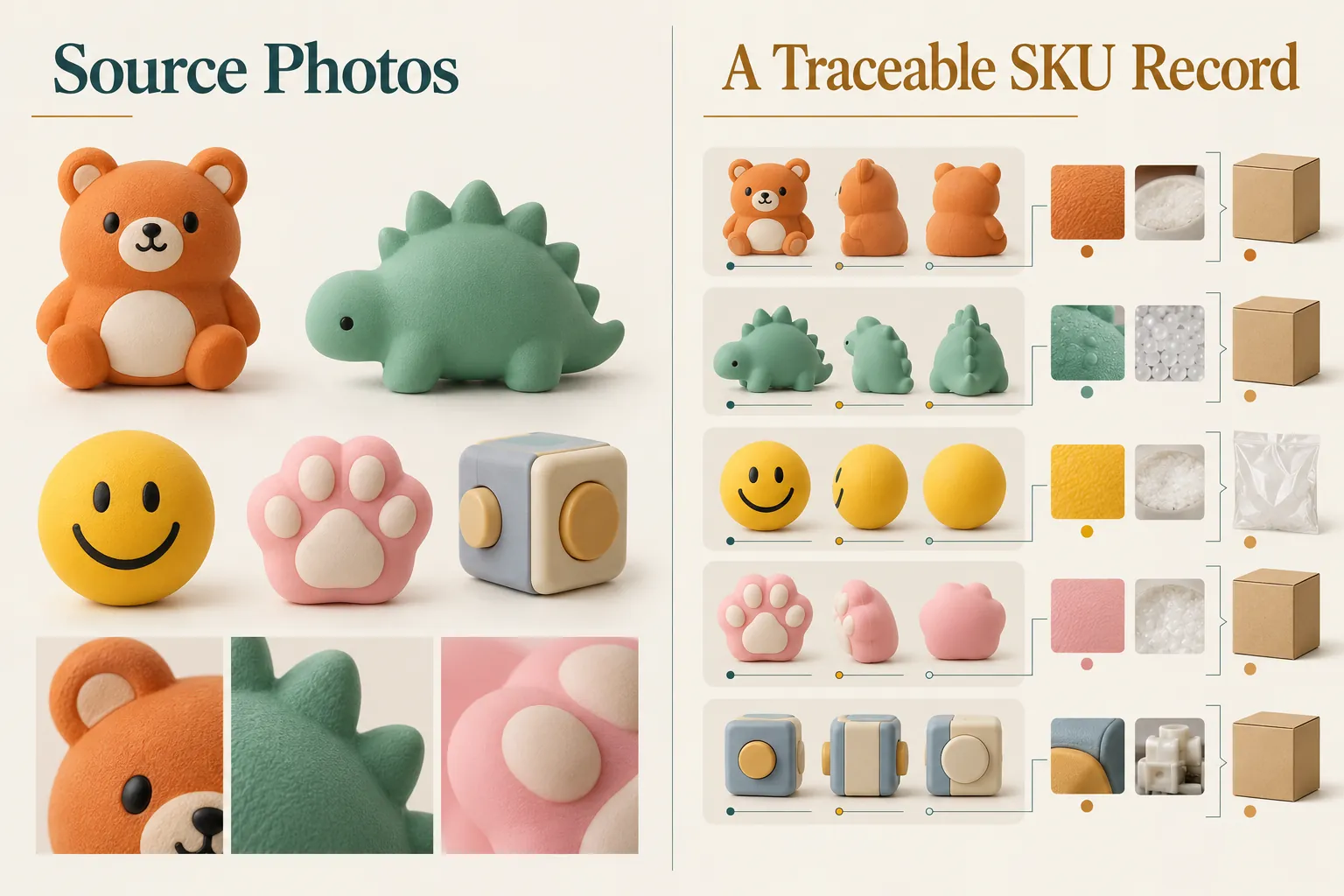
Use source photos to shortlist squeeze toys and shelf fidgets, but use a traceable SKU record to approve the purchase. A transparent TPR cube filled with maltose liquid calls for different sample checks than a squeezing toy cataloged as ABS. Neither squeeze feel nor quiet repeat play can be established from a still image. Approve the exact sampled construction and packaging, link them to the order, and record who accepted the specification—not just which photograph looked right.
For a SqueeZaa sensory shelf, the practical question is whether the product delivers the intended hand interaction. The record supports that decision; it does not replace handling the sample.
Which product details change the shelf decision?
| 3.5 cm ice-cube squishy — catalog identity | SKU: CPS348379. The October 9, 2026 catalog snapshot describes a transparent, thickened TPR soft-rubber cube shell filled with maltose liquid, with a subtle pearlescent sheen. |
|---|---|
| 3.5 cm ice-cube squishy — packing and quantities | Packing: OPP. Reference base MOQ: 264 units. Recorded units per carton: 264. |
| Squeezing toy — catalog identity | SKU: CPS349725. Catalog product name: Squeezing Toy. Recorded material: ABS. This material entry does not establish the complete construction, fill, squeeze response or operating mechanism. |
| Squeezing toy — packing and quantities | Packing: display box. Reference base MOQ: 1,152 units. Recorded units per carton: 576. |
When are source photos enough?
Source photos are enough for visual shortlisting, but not for approving squeeze feel, construction or an order-specific product identity.
Use them to compare the pictured shape, transparency, finish and presentation. Save the selected images under the exact product record, including the supplier’s reference and the date received. A photograph of packaging can help identify the version being discussed; it does not establish that the ordered goods will use that packaging.
For the cube, a clear appearance does not prove that the fill is maltose liquid or that the shell is TPR. For the ABS-listed toy, an attractive image does not explain which component moves or deforms. Even a squeeze video is a demonstration of the filmed sample, not a measurement of the buyer’s sample or proof of shipment contents.
Choose the photo-only route when the decision is simply whether to request a sample. Choose the record-and-sample route before committing to a purchase. Neither photographs nor a completed commercial file establish safety compliance.
What should the sample comparison establish?
The sample comparison should establish whether the exact product meets the intended squeeze feel, recovery behavior, sound level and shelf presentation.
For the liquid-filled cube, handle an identified sample and record resistance to squeezing, visible fill movement, recovery after release, surface feel, seam condition and any leakage observed. Keep the catalog’s shell-and-fill description separate from what handling actually demonstrates: a hand check cannot chemically identify the fill.
With the ABS-listed squeezing toy, establish how it works before assigning it to a quiet desk-fidget assortment. Identify the moving or deforming component, document the assembled construction, and assess the action and sound in the intended desk setting. Do not infer that the whole toy is rigid—or soft—from the ABS entry alone.
Use an agreed reference sample or a written buyer target for the comparison. Define acceptable action, sound and appearance before the review, then record observations against those targets. These are proposed purchasing checks, not compliance tests or predictions of return rates. Retain the accepted sample and its labeled photographs as the reference for later comparisons.
What belongs in each traceable SKU record?
| Identity and revision | Carry the exact catalog identifier into the buyer’s internal record. Record the supplier’s corresponding model, product description, variation and specification revision. Attach the selected source photos without using the image filename as the sole identifier. |
|---|---|
| Cube-specific sample instruction | For CPS348379, use the cataloged 3.5 cm transparent TPR-shell, maltose-liquid construction as the comparison basis. Obtain written confirmation of the proposed construction and packing, identify the physical sample, and record the handling observations separately. |
| ABS-toy-specific sample instruction | For CPS349725, obtain a construction description identifying the ABS component and the squeeze mechanism. Identify the sample and record its action, sound and display-box presentation before assigning its assortment role. |
| Specified target versus observation | Record the buyer’s intended squeeze response, recovery behavior, sound and presentation alongside the actual sample observations. Identify the reviewer, review date, sample reference and supporting photographs or video. |
| Supplier and commercial documents | Record the supplier’s business identity, current quotation reference, purchase order, ordered quantity and purchase date. Add the supplier-issued invoice when available. Map each relevant document line to the exact product record; a shared document may be linked to several records. |
| Selling unit and packing | Obtain explicit confirmation of what one quoted unit contains, any pieces per set, units per display and units per shipping carton. Keep these separate from the base MOQ and any expressly agreed order multiple. |
| Receipt and storage | At receipt, log the received quantity, date, product and packaging identity, applicable lot or batch markings, receiving inspection reference and storage location. Compare the goods with the approved revision and retained sample. |
How should the two products be routed for approval?
Route the cube to a shell-and-fill sample review and the ABS-listed toy to a mechanism review; release neither purchase solely because the source photograph matches the desired look.
For the cube, the purchase condition should name the accepted construction, sample reference, squeeze response and packing. For the ABS-listed toy, close the mechanism description and quiet-play assessment before treating it as a substitute for a soft filled squishy. A shared category name is not enough to make the products interchangeable.
Reconfirm the catalog quantities in the current quotation. A base MOQ is a minimum, not an order multiple, and a carton quantity alone does not establish a full-carton purchasing restriction.
Use the following handoff record for each product. It deliberately requires real names, dates and observations rather than a prefilled signature.
| Product and approval basis | Enter the exact product identifier, specification revision, sample reference, quotation revision and order reference being reviewed. |
|---|---|
| Decision | Record approve, approve with stated conditions, or hold. Specify whether the decision authorizes sample evaluation, purchase placement or shipment release; do not let one approval silently authorize all three. |
| Product-specific conditions | For the cube, close the construction, sample-handling and packing review. For the ABS-listed toy, close the mechanism, action, sound and display presentation review. Link each condition to its target and recorded observation. |
| Responsible approver and date | Enter the purchasing approver’s full name, signature or controlled electronic approval, decision date and the revision approved. Identify the sample reviewer separately if a different person performed the assessment. |
| Follow-up and closure | Assign each open condition to a named owner with a due date and closure evidence. Record the closure date and accepting reviewer. If a revised sample, construction or pack changes the approval basis, document the new revision and obtain the relevant reapproval. |
What does a traceable record actually prove?
A traceable record supports a reviewable connection between the selected product, the approval and the transaction; it does not by itself prevent or reveal an undisclosed substitution.
Keep the physical comparison at receipt. A complete file can still accompany goods that differ from the reference, while one absent document does not erase other valid evidence or prove supplier misconduct.
Preserve supplier-issued originals. If an invoice needs correction, request a corrected document from its issuer and retain the revision trail; do not alter or backdate it yourself. The EcomAI Stack traceability guide likewise cautions against creating, editing or backdating invoices in authenticity inquiries.
The purchasing rule is straightforward: photos select the candidate; an identified sample establishes the handling reference; the SKU record connects that reference to the approved order and subsequent receipt.