Sourcing · Jul 23, 2026
Squishy Toy Safety Crisis 2026: How to Source EN71 & ASTM Compliant Stress Toys
Source EN71 & ASTM F963 compliant squishy and stress toys in 2026. Avoid the NeeDoh recall crisis with a vetting checklist, MOQ facts, and a supplier RFQ guide.
In short: Source EN71 & ASTM F963 compliant squishy and stress toys in 2026. Avoid the NeeDoh recall crisis with a vetting checklist, MOQ facts, and a supplier RFQ guide.
A single batch of goo-filled squishy toys that split open during a heatwave can trigger a total recall across 200 retail locations, costing a distributor tens of thousands of dollars overnight. The root cause isn't a shipping accident—it's a chemical failure. In 2026, sourcing a compliant stress toy means verifying material safety before your container ships, not after a CPSC alert. This guide lays out exactly how to verify EN71 and ASTM F963 compliance, covering the material failures behind recent crises, the certification paperwork you must demand, and the factory audit questions that separate a real safety partner from a reseller with a PDF.
Key Takeaways for Compliant Sourcing
- These are the non-negotiable sourcing rules for 2026.
- The 2026 Crisis Root Cause: Recent 'NeeDoh-style' recalls stem from chemical migration (phthalates, BPA, boron) in low-durometer TPR/TPE and liquid-filled designs. Even 'water-based' fillers can harbor bacteria if the seal is imperfect.
- Mandatory Certifications: EN71 parts 1-3 (Europe) and ASTM F963-17 (USA) are the floor, not the ceiling. For the US market, you also need a CPC (Children's Product Certificate) backed by CPSC-accepted lab results.
- Material vs. Structure Risk: Gel-filled or liquid-core toys pose higher leakage and contamination risk than solid silicone or ABS friction-fit designs. If you must buy liquid-core, demand a 1.5-meter drop test report and a microbial test.
- MOQ Reality Check: Stock stress toys often start at 1 carton (120–240 pcs per design). Expect OEM MOQs to jump to 1,000–3,000 units per SKU. A $0.30–$0.60 unit cost is typical for small ABS squeezes at volume.
Why the Squishy Toy Supply Chain Broke in 2026
The safety crisis that hit importers in early 2026 wasn't a single bad batch—it was a predictable failure of low-cost material sourcing. Factories racing to capitalize on the 'sensory toy' trend substituted medical-grade silicone or stabilized TPR with cheaper, recycled PVC compounds. These substitutes leach oily plasticizers, especially when subjected to the pressure and heat of a sealed shipping container crossing the equator. The result: toys that arrive on US shelves already beginning to degrade, split, or release a suspicious odor. Videos of these failures circulated widely in wholesale sourcing groups, triggering the CPSC alert.
A pre-shipment inspection that only checks color and shape is useless. You are buying chemical composition. If a factory can't provide a batch-specific, third-party lab report for EN71-3 (migration of certain elements) or ASTM heavy metal limits, you are the quality control department—and the legal target.
How to Vet a Supplier's Safety Claims (Step-by-Step)
Don't accept a certificate at face value. Follow this sequence to filter out paper-only 'compliant' suppliers.
Supplier Vetting Checklist for 2026
| Step 1: Request a batch-specific test report | What to check: Verify the lab name is CPSC-accepted (US) or an EU Notified Body. Check that the report number matches the product SKU you are buying. Red flag: A generic 'certificate' without a test report number, or a report older than 12 months. |
|---|---|
| Step 2: Demand material sub-component listing | What to check: For a squishy filled ball, demand the MSDS-like breakdown for the outer TPR and the inner filler. Red flag: The factory says 'it's a secret recipe' or cannot name the specific polymer supplier. |
| Step 3: Check the Closure Mechanism | What to check: For liquid or gel-filled items, inspect the plug or ultrasonic weld. A friction-fit plug is a leakage hazard. Red flag: No secondary seal or visible glue residue around the filling point. |
| Step 4: Validate on-site via video call | What to check: Ask to see the in-house tensile testing machine or a retained sample from your pre-production run being drop-tested. Red flag: A spotless, unused testing area or reluctance to show the production line live. |
| Step 5: Order a pre-shipment sample to a 3rd party lab | What to check: Randomly select units from your packed cartons (not factory-provided 'golden samples') and send them to a lab like Intertek, SGS, or Bureau Veritas. Red flag: Factory pushes back strongly on this, offering a discount instead. |
Popular Compliant Picks: Solid & Safe Stress Toys
The safest way to avoid a chemical recall is to eliminate the chemical variable. Solid ABS squeeze mechanisms and mechanical fidgets deliver tactile relief without the leakage or migration risks of liquid-filled designs. The items below ship with verifiable EN71 and ASTM F963 certification from the production line.
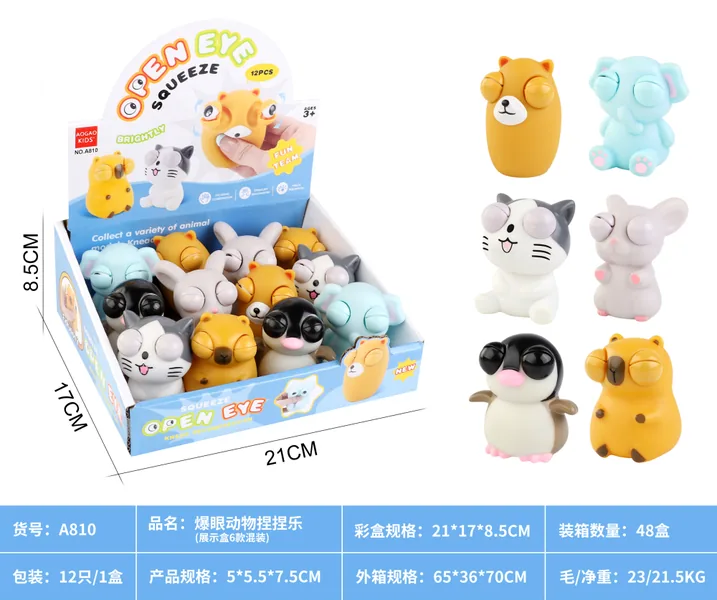
| Pop-Eye Cartoon Animal Squeezer | A solid ABS squeeze mechanism. When pressed, the eyes bulge—no gel, no liquid. It removes the chemical leakage variable entirely. MOQ around 576 units. |
|---|---|
| Food & Vegetable Squeeze Replicas | Small ABS items modeled as fruit or vegetables. At a MOQ of 1,152 units and a very low unit cost, they are a high-margin, low-risk item for party favors and impulse retail. |
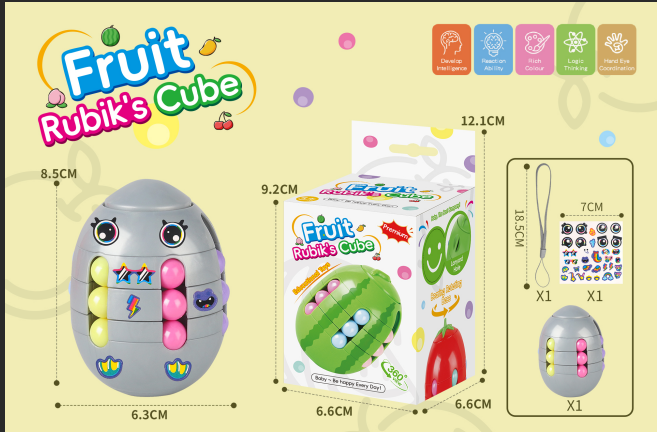
| 12-Hole Rainbow Spinning Ball | Combines ABS with a soft silicone composite. The multi-texture fidget action is fully mechanical. It ships with EN71 certification, making it a drop-in replacement for retailers pulling goo-filled items. |
| Stress-Relief Top & Cube | A hybrid desktop toy. ABS construction with no fillers. It carries a dense cert stack including EN71, ASTM, and PAHS, which signals a factory comfortable with high-compliance markets like Germany and California. |
Sourcing by Market: EU vs. US Compliance Differences
The paperwork burden differs sharply by destination, and misunderstanding this is a common and expensive mistake.
For the European Union, the EN71 standard is your baseline. You must also have a Declaration of Conformity and CE marking. For squishy toys, EN71-1 (mechanical and physical properties) is a common failure point: if the toy can be bitten into and a piece swallowed, it fails. For gel toys, EN71-3 (migration) is the chemical gauntlet. For the United States, ASTM F963 is the standard, but the Consumer Product Safety Improvement Act (CPSIA) is the law. You need a CPC issued by the importer of record, backed by a CPSC-accepted lab test. The US has a stricter heavy metal and phthalate regime. A factory that breezes through EN71 can still fail ASTM lead limits if they use the wrong paint or plasticizer.
What to Ask Suppliers Before You Order (RFQ Checklist)
| Liquid or solid core? | If liquid, what is the viscosity and chemical composition? Ask for a microbial test report if it contains water. |
|---|---|
| Certificate validity | Send me your EN71-3 and ASTM F963 heavy metal reports for this specific item, dated within the last 6 months. |
| Material source | Who is your raw TPR/ABS/silicone supplier? Is it a branded resin (e.g., Dow, BASF) or a domestic compounder? |
| Seal integrity | What is your factory's internal drop-test standard? (We require a 1.5m drop onto concrete without rupture for any filled toy). |
| OEM MOQ & mold cost | If we design a new shape, what is the mold cost and minimum quantity per colorway? (Expect 1000–3000 units). |
| Pre-shipment protocol | Will you allow us to send a random sample from our finished cartons to SGS or Intertek before balance payment? |
FAQ
For a first bulk order, what are typical MOQs and how do they vary between stock and OEM items?
Stock stress toys start at one carton (120 to 240 units per design). OEM custom items require 1,000 to 3,000 units per SKU due to raw material preparation and mold setup.
Can a supplier offer custom color or logo molding, and what are the usual costs?
Yes. For a simple logo pad print on an existing mold, the setup cost is absorbed into the unit price. A completely new shape requires a mold fee (varies by size and complexity) and a higher MOQ.
How do lead times and shipping methods affect cost and delivery?
Stock items dispatch within 3 to 7 days. Custom OEM orders need 25 to 45 days after sample approval. Sea freight (25-35 days to the US West Coast) is cost-effective for volume; air freight (5-7 days) can rescue a stockout but will consume the margin on a low-cost FOB item.
What is the single biggest red flag when sourcing squishy toys in 2026?
A supplier that provides a 'universal' certificate not tied to your specific product's batch. A valid report must list the exact SKU and be dated recently. Anything else is a placeholder that will not protect you in a CPSC investigation.
Are there any stress toy designs that completely avoid the liquid-fill risk?
Yes. Solid ABS squeeze mechanisms, like pop-eye animal squeezers or spinning fidget balls, deliver tactile relief with no chemical leakage risk. They are mechanically simple and vastly easier to certify.
Related Products & Categories
Request a Quote for Compliant Stress Toys
The 2026 safety landscape rewards prepared buyers. If you need a production partner whose product line is built around EN71 and ASTM F963 compliance, SqueeZaa provides batch-specific documentation with samples and direct access to their quality team. Build a container that sells through—without a recall.
Source this range with SqueeZaa
SqueeZaa is the wholesale brand of CPS Toys Trading Co., Ltd. in Chenghai, Shantou. Send your product list, target market, quantity and packaging needs for FOB / EXW pricing, samples, certificates and OEM/ODM options.
Ready to source fidget and stress toys?
Browse the wholesale catalog or send an inquiry with your target category and quantity.
View all products Request a Quote