Supplier evaluation for sensory novelty assortments: a buyer checklist before the PO
A buyer checklist for evaluating sensory novelty assortments: product fit, packaging, MOQ, safety evidence, and supplier audits before you place the PO.
Shortlist a sensory novelty supplier the way you would audit a food-look bakery set: verify product fit, assortment economics, and safety evidence before you commit to a single PO. A generic best-list claim tells you nothing about whether a Chenghai squishy factory can hold color on a sealed golden sample, or whether a fidget distributor actually tests button-cell compartments. This checklist turns the broad 'sensory toys wholesale' query into a buyer-ready framework that connects product fit, packaging and MOQ questions, safety evidence, and delivery checks with a quote-ready next step. Use it to evaluate any factory objectively — not to fall for a pretty listing photo.


What is the difference between a sensory toy supplier and a trading company?
A supplier can be a factory that molds, assembles, and packages the toys, or a trading company that aggregates from multiple factories. The distinction matters most for quality control and communication. A factory in Chenghai, Shantou—the world's densest toy cluster—can often respond faster to mold changes and in-process checks. A trading company offers a wider catalog but adds a layer between you and the production line. Ask directly: 'Are you the manufacturer?' and verify with a factory audit or video call that shows the actual production floor. The answer changes how you handle sample approvals, defect disputes, and change notifications.
For sensory novelty assortments specifically, the supplier's ability to control material consistency is critical. Slow-rebound PU foam, for example, must feel and spring back the same way lot after lot. In-process checks during production catch drift in dimensions, color, weight, flash, short shots, and assembly before the entire lot is complete. A trading company may not have the authority to stop a line for a color mismatch. A factory does.
How do I verify a supplier's product fit for sensory novelty toys?
Product fit goes beyond 'does it feel nice?' It means the texture, sound, visual appeal, and even scent align with your target customer's expectations and your channel's constraints. Ask the supplier how they validate sensory appeal. Do they run consumer panels, descriptive analysis with trained testers, or simple preference tests? A supplier that conducts structured sensory testing can better predict consumer acceptance, reducing your risk of slow-moving inventory.
Consider the 'food-look' risk. Squeeze bakery toys that look edible can be refused by a channel if they lack a warning. In one real case, a buyer's carton was rejected because the food-look warning was missing. The fix was not a prettier cake photo—it was adding the warning, a small-parts check, and a print-rub test on the icing. When you evaluate a supplier, ask how they handle food-look products. Their answer reveals whether they understand channel-specific compliance, not just toy function. For your own assortment, check if the product texture and packaging language match the sensory experience you promise. Clear, consumer-friendly language on packaging bridges the gap between technical specs and what a shopper feels.
What packaging and labeling options do sensory toy suppliers offer for retail-ready distribution?
Packaging is a sensory touchpoint and a compliance document. Options range from bulk polybags to retail-ready display boxes, and increasingly eco-friendly materials. For retail-ready distribution, ask if the supplier can provide display boxes that sit on a shelf without extra handling. For private-label programs, confirm they can print your logo and branding on the packaging, not just on a sticker.
Labeling is where compliance lives. For the US market, you need a tracking label (often with a CPSC code), cautionary statements like 'WARNING: CHOKING HAZARD—Small parts' for toys under 3, and for button-cell products, the specific warnings required by US button-cell rules. For the EU, you need the CE mark, the importer's address, and often the EN71 standard reference. A supplier that treats the warning as an afterthought is a red flag. The conversation about the button-cell compartment and its warning should happen before you discuss the toy's function, not after. A cute electronic that opens with fingernails should not ship. Ask to see a sample of the label artwork before you approve the PO.
What MOQ should I expect for custom sensory toy assortments?
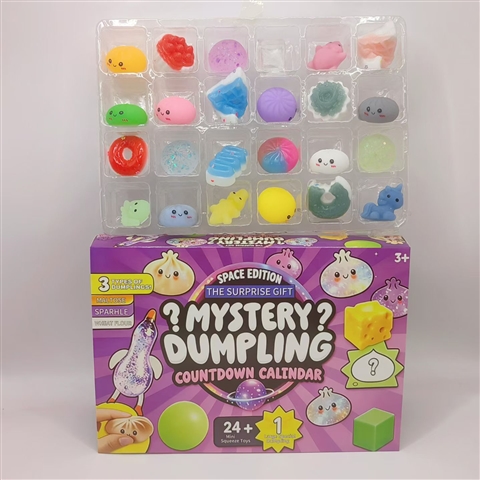
MOQs vary by product type, factory, and level of customization. For a standard stock squishy, a factory in Chenghai might accept a few hundred pieces. For a custom-molded fidget with your logo, the MOQ jumps because the mold and tooling costs need to be amortized. For a multi-item assortment like a 24-day countdown calendar, the MOQ applies to the set, not the individual piece, and can be in the low hundreds to thousands depending on the number of SKUs inside.
A simple PU foam squishy might start around 500 to 1,000 pieces. A custom calendar or kit with multiple components could require 500 to 2,000 sets. A full private-label program with custom packaging and mold changes can start higher. Do not ask for a number upfront. Instead, ask: 'What is your MOQ for this specific SKU, and how does it change if I add a custom color or logo?' The answer will show you their production flexibility and whether they are a good fit for your order size.
How to compare different types of sensory toy suppliers
| Type of Supplier | Specialty / Strength |
|---|---|
| Chenghai squishy & fidget specialist (Guangdong) | PU foam, squishies, pop-its, stress balls; deep mold & material expertise; fast iteration. OEM/ODM common. MOQ from ~500 pcs; varies by spec. |
| Shantou general toy factory (Guangdong) | Plastic toys, electronics, building sets; wider range, strong in hard-goods; often handles licensing. OEM/ODM available. MOQ from ~1,000 pcs; varies by spec. |
| Yiwu novelty & party-goods trader (Zhejiang) | Low-cost party favors, bulk novelties, varied catalog; less control over individual factory QC. Mostly stock items, light OEM. MOQ often lower (100-500 pcs); varies by spec. |
| Specialized sensory/educational brand (varies) | Focus on developmental & sensory benefits; stronger on documentation and testing; higher price point. ODMs possible. MOQ higher; varies by spec. |
Why is Chenghai the default starting point for sensory novelty sourcing?
Chenghai, a district in Shantou, Guangdong, is the world's most concentrated toy manufacturing cluster. Thousands of factories, mold shops, and component suppliers sit within a few square kilometers. That density creates a supply-chain advantage you can feel: if you need a custom mold, a resin supplier, a printing shop for packaging, and a QC lab, they are all within a short drive. For sensory novelty toys—which rely on specific materials like PU foam, TPR, and silicone—this ecosystem matters. Factories here have deep experience with the tactile qualities that define a good squishy or stress ball.
The trade-off is the need for diligence. Because the cluster is dense, it includes both world-class factories and small workshops. Your evaluation checklist—asking for certifications, inspecting the factory, and comparing sealed samples—is what separates them. A factory that has been in Chenghai for over a decade, like the one behind many sensory brands, has institutional knowledge about the color fights and the material sources that cause them. The team's experience is the invisible asset that a simple catalog cannot show.
Which certifications apply to sensory novelty toys sold in the US and EU?
For the US market, the mandatory standard is ASTM F963 (the Consumer Safety Specification for Toy Safety), enforced by the CPSC. You also need a Children's Product Certificate (CPC) and, for many toys, third-party testing by a CPSC-accepted lab. If the toy is for children under 3, small-parts testing per 16 CFR Part 1501 is critical. For magnets, the 2017 ASTM F963-17 rule requires that magnets be either too big to swallow or too weak to be hazardous, tested after the abuse sequence—not just a magnet-strength value. For button-cell batteries, the Reese's Law (Public Law 117-171) requires secure compartments that resist opening by children and specific warning labels.
For the EU market, the key standard is EN71, a multi-part set covering mechanical, physical, flammability, and chemical properties. The CE mark is mandatory, and you need a Declaration of Conformity. Reach and RoHS regulations also apply to materials and chemicals. Ask the supplier for a copy of the test report from an accredited lab (like TÜV, SGS, or Bureau Veritas), not just a self-declaration. Confirm the report matches the exact model you are buying, not a similar one. Label illustrative scenarios as such; never assume a certification covers a product it was not tested for.
How to verify a Chinese toy factory: a step-by-step audit checklist
Verification is about evidence, not trust. Start with a video call to see the production line, then follow up with a third-party audit if the order size justifies it. During the audit, look for the sealed golden sample—the physical reference piece that settles color and assembly arguments. In Chenghai, the argument that ends a color dispute is the sealed sample on the QC shelf, not an email. Compare bulk production to that physical piece: color, fit, flash, and function. Buyers who approve only a photo often pay for it on the second lot.
Ask about their in-process checks. Do they measure dimensions, color, weight, and flash during production? Do they retain samples from each batch? Retained samples support later comparison of color, construction, packaging, and failure investigations, and they should be identified by model and lot. Finally, confirm their change-notice policy. A responsible supplier should notify you before changing resin, colorant, mold, process, component, sub-supplier, or packaging that could affect the released toy. If they cannot promise that, your next batch might not match the first.
What are the best payment terms and logistics options for importers?
Payment terms are a negotiation, not a fixed rule. Common structures include 30% deposit and 70% balance before shipment, or a 30/70 split with the balance against a copy of the Bill of Lading. Letters of Credit (L/C) are used for larger orders or first-time relationships. Escrow services through platforms like Alibaba provide some protection but add cost. For a first order, a 30% deposit is standard; be wary of any supplier demanding more than 50% upfront.
For logistics, the standard term is FOB (Free On Board) from a Chinese port like Shantou or Shenzhen. Your freight forwarder handles the ocean or air freight. Confirm the Incoterms clearly—FOB, CIF, or DDP—and who pays for what. DDP (Delivered Duty Paid) can simplify things for ecommerce sellers but shifts more responsibility to the supplier. Always confirm the carton dimensions and weight for freight quotes, and request photos of the loaded container if possible. For sensory toys, ensure the goods are not compressed too tightly in the carton, as PU foam can deform under pressure.
FAQ: Sourcing Sensory Novelty Assortments
What is the typical MOQ for a custom sensory toy with my logo?
A custom-molded fidget or stress ball with your logo typically requires an MOQ of 1,000 to 3,000 pieces to amortize mold and tooling costs. For a standard stock item with just a custom print, the MOQ may be lower, around 500 pieces. Confirm with the factory, as the exact number depends on the material, mold complexity, and packaging.
How can I verify a supplier's EN71 or ASTM certification is real?
Ask for the test report from an accredited lab (e.g., TÜV, SGS, Bureau Veritas) and check the report number online with the lab if possible. Ensure the report cites the exact model number you are buying and the correct standard (ASTM F963 for the US, EN71 for the EU). A report for a 'similar' product is not sufficient evidence.
What is the safest payment method for a first order with a Chinese toy factory?
A 30% deposit with a 70% balance against a copy of the Bill of Lading is common. For first-time relationships, consider a Letter of Credit or a platform escrow service. Avoid paying more than 50% upfront, and never pay the full amount before production is confirmed.
How do I check if a food-look squishy needs a special warning?
If the toy looks like food, it may be considered a 'food-look' toy and require a warning to prevent ingestion, especially for children under 3. The requirement depends on the destination market. For the US, the CPSC may consider it a choking hazard under small-parts rules. Ask the supplier if they have a food-look warning and test for small parts, and confirm it complies with your channel's policies.
What inspection should I do before the goods ship?
Arrange a pre-shipment inspection (PSI) by a third-party agency like SGS or QIMA. The inspector should compare bulk production to the sealed golden sample, check color, dimensions, flash, assembly, and function, and verify packaging and labeling. In-process checks during production are also valuable to catch drift early, and retained samples help with later failure investigations.
Sources
Related Products & Categories
Request a Quote & Factory Audit
Ready to move from checklist to purchase order? Send us your target product specs, your destination market, and your desired quantity. We can provide a quote, arrange a video factory tour, or set up a third-party audit to verify our production line against this exact checklist. We are one example of a Chenghai-based factory, and we can also help you understand how to evaluate other suppliers you are considering.