
Supplier Evaluation for Tactile Desk Toys: A Buyer Checklist Before the PO
A risk-first supplier evaluation checklist for tactile desk toys: product fit, MOQ economics, CPC and EN 71 evidence, packaging, and delivery checks before you commit.
Treat a tactile desk toy supplier quote as a risk document, not a price list. Before you issue a PO for fidget, sensory, or desk novelty items, confirm three things: the exact SKU matches your tactile intent and channel, the safety file maps to that SKU and your destination market, and the MOQ and packaging terms survive a landed-cost check. If any of those three is missing, the quote is not PO-ready.
This checklist walks through product fit, assortment economics, US and EU safety evidence, packaging and labeling, delivery checks, and the supplier questions that separate a documented factory from a showroom with a catalog.
Key sourcing verdicts before you shortlist
- For US-bound tactile desk toys intended for children 12 or younger, the compliance gate is a Children's Product Certificate based on testing at a CPSC-accepted laboratory, with the CPC and test reports in English — a generic factory certificate does not satisfy this.
- For EU-bound toys, the gate is conformity with Toy Safety Directive 2009/48/EC, including CE marking and an EU Declaration of Conformity that matches the specific product scope; packaging and product markings are controlled fields that can change with the SKU.
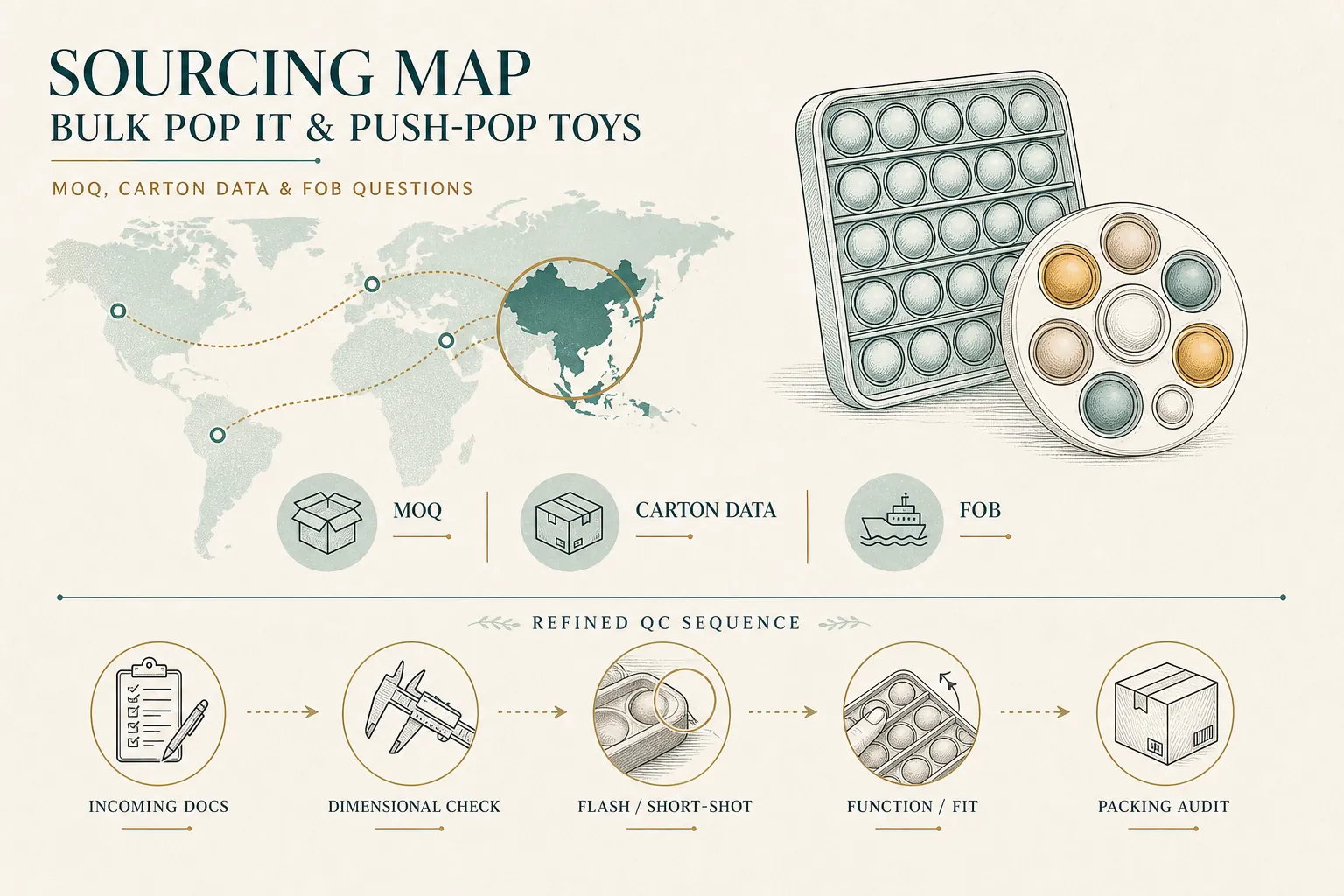
- MOQ is a negotiation variable, not a fixed wall. In Chenghai, published MOQs have ranged from roughly 36 units for small playsets to over 1,000 for low-cost foam items, so ask whether mixed SKUs or colors can combine and what the price curve looks like at 2x and 5x the minimum.
- Tactile products fail on hand-feel and smell before they fail on safety paperwork. A tactile desk toy that does not return slowly after squeezing or smells overwhelming when opened will generate returns regardless of its certificate file.
- The EU Packaging and Packaging Waste Regulation 2025/40 entered into force on 11 February 2025, so packaging material and labeling choices for EU-bound tactile desk toys should be reviewed against current requirements rather than archived 2024 packaging specs.
What does product fit mean for tactile desk toys specifically?
Product fit means the supplier actually produces the material and construction your channel needs, not just lists it in a showroom. Tactile desk toys live or die on touch: a toy that supports the fingers just enough, returns slowly after squeezing, and does not smell overwhelming when opened is a different product from a generic plastic fidget with the same catalog photo.
Ask the factory to describe the material system — ABS, plastic, felt, or a self-contained liquid play component — and to explain how they test hand-feel. If a catalog record shows a material field as empty, do not fill it by inference. Request the material specification in writing.
Channel fit matters too. A gift shop buying display-ready tactile novelty items has different packaging and unit-count needs than an Amazon seller buying polybagged multi-packs. Confirm the supplier can produce the configuration your listing or shelf requires before you compare price.
How should buyers read MOQ and assortment economics?
MOQ is a catalog field, and catalog fields are starting points. Published MOQs for tactile and fidget-adjacent toys vary widely by SKU and material — small felt busy boards and handheld logic puzzles typically sit at lower minimums, while low-cost ABS items such as decompression gyro balls can require several hundred to over a thousand units.
Do not assume the MOQ applies per color or per SKU. Ask whether mixed SKUs or colors can combine to reach the threshold, whether sample quantities count toward the first production run, and what the price breaks are at 2x and 5x the minimum. A 10% price drop at 2x MOQ has been described as common in Chenghai, but you should request the actual quote curve rather than accept a rule of thumb.
Assortment economics also include CBM. Mixed-container importers often need high-turnover filler to complete a 20GP or 40HQ load alongside slower-moving goods. Tactile desk toys are compact and often work as filler, but generic unbranded filler complicates the story you tell your own retail customers. Decide early whether you need branded, retail-ready packaging or bulk polybag.
Which safety and compliance documents apply to tactile desk toys?
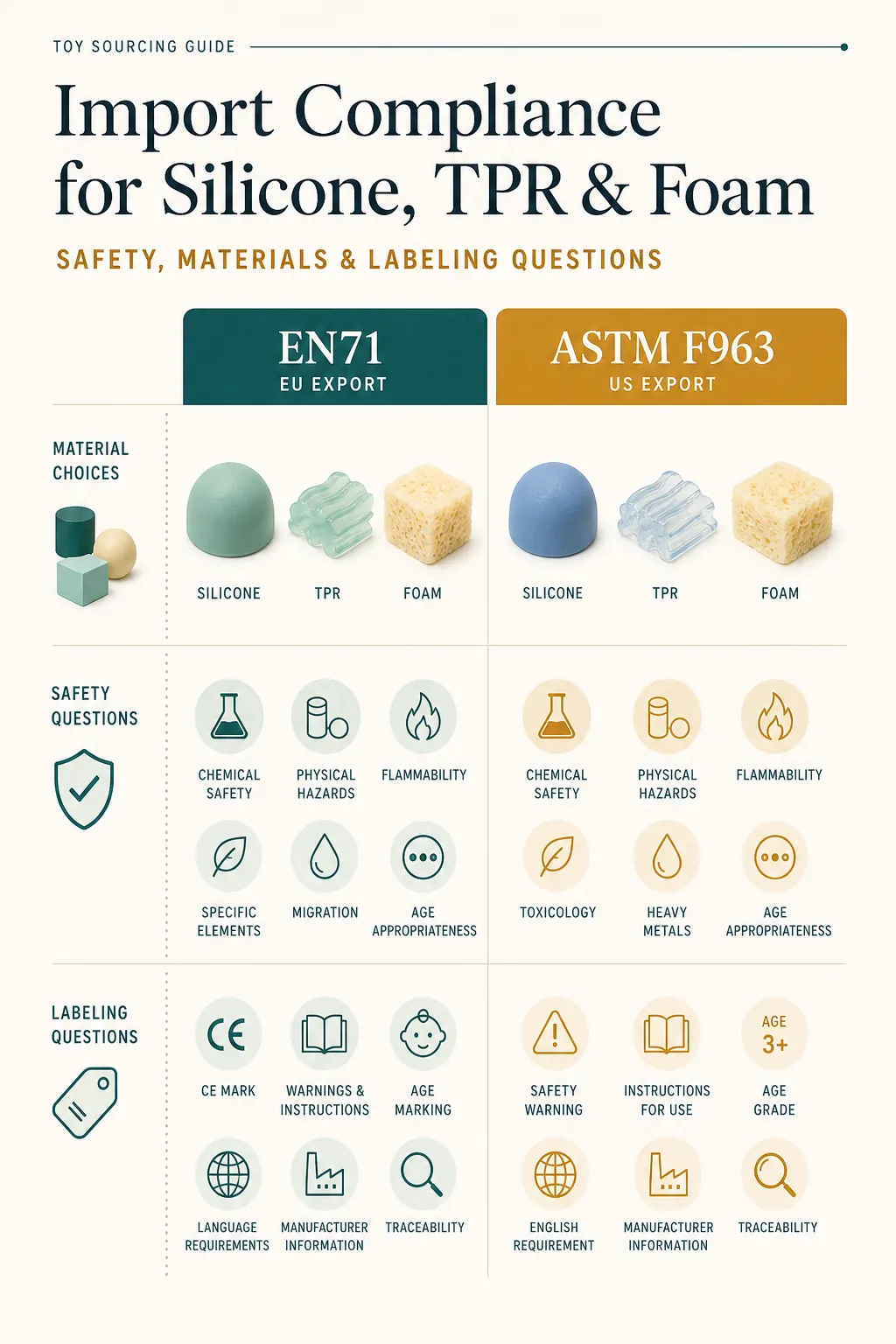
The applicable document set depends on the destination market and on whether the product is intended primarily for children 12 or younger. For US-bound children's products subject to a CPSC-enforced safety rule, the supplier should be able to provide a Children's Product Certificate based on test results from a third-party, CPSC-accepted laboratory. The CPC and supporting test reports must be in English.
A CPC is product-specific and should not be described as a blanket factory certificate. It must identify the product, cite each applicable CPSC children's product safety rule, name the domestic manufacturer or importer certifying compliance, provide contact information for the person maintaining test records, list the date and place of manufacture, list the date and place of testing, and identify the third-party CPSC-accepted laboratory. No specific template is required, but all seven elements must be present and accurate.
For EU-bound toys, the Toy Safety Directive 2009/48/EC sets the essential safety requirements, and CE marking plus an EU Declaration of Conformity belong to the conformity process. The declaration must be matched to the product scope. The General Product Safety Regulation (EU) 2023/988 is a separate legal instrument, so do not treat a GPSR reference as a substitute for toy-specific documentation.
Two practical checks are frequently missed. First, the applicable edition of ASTM F963 and 16 CFR Part 1250 should be read from the current regulation before a report is quoted, because a test report must identify the product configuration, age grade, and standard edition tested against. Second, tracking labels and small-parts assessment should be reviewed together with packaging and lot control, since age grading and small-part risk are connected to the actual product configuration.
What packaging and labeling options do tactile desk toy suppliers usually offer?
Standard formats for tactile and fidget toys include bulk polybag, blister, window box, and display box. For tactile products, retail display packaging often needs to function as a test zone where a customer can touch or squeeze the item, so confirm whether the packaging format allows that without damaging the product or the carton.
Private-label and custom packaging requests should be quoted as separate line items: printed polybag, branded display box, insert cards, barcodes, and any hang-tag or shelf-ready requirements. Ask whether the supplier can produce retail-ready packaging and bulk packaging from the same production run, and whether the MOQ changes between the two.
For EU-bound shipments, review packaging material and labeling against the EU Packaging and Packaging Waste Regulation 2025/40, which entered into force on 11 February 2025. Treat packaging wording and product markings as controlled fields that can change with the SKU, and confirm who owns the final artwork approval.
How do you verify a Chinese toy supplier before the PO?
Sequence verification by risk: legal entity and product safety documentation first, then operational and pricing review. Ask for the business license, the factory address, and the name of the entity that will appear on commercial documents. If the quoting entity and the manufacturing entity differ, ask why and who holds the tooling and the test records.
Request SKU-level documentation, not a general supplier certificate binder. A test report must match the product, age grade, material, and test edition. Certification checks should validate certificates directly with issuing bodies and cross-check certificate numbers and issue dates. Expired credentials introduce immediate compliance risk, so record renewal dates and set internal alerts.
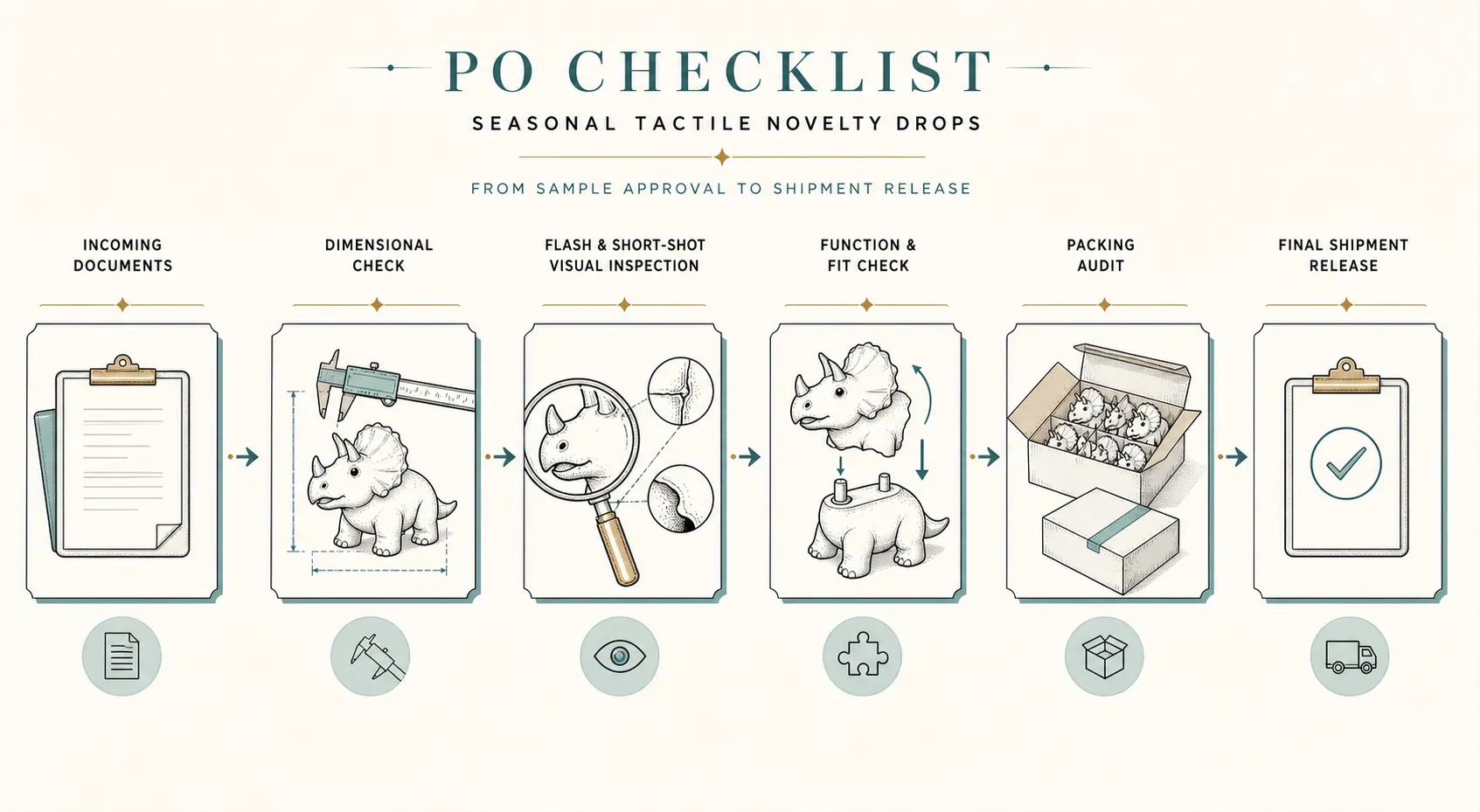
Sample the product before you negotiate hard on price. In-process checks catch drift in dimensions, color, weight, flash, short shots, and assembly before an entire lot is complete, so ask how the factory controls those variables and whether production-part approval compares the first released parts with the signed drawing, golden sample, and applicable safety test sample. Go/no-go gauges can provide fast assembly or feature checks when the gauge is validated and linked to the product tolerance.
A Chenghai-based supplier such as SqueeZaa can be asked the same questions as any other factory — business license, SKU-matched test reports, tooling ownership, and inspection plan — and the answers, not the region, should decide the shortlist.
What delivery and logistics checks belong in a tactile desk toy PO?
Write inspection expectations into the PO rather than relying on a brochure claim. Specify AQL levels for critical, major, and minor defects and the sampling method; ANSI/ASQ Z1.4 is a common reference. Confirm who performs the inspection, where, and at what stage.
For carton and pallet specs, ask for double-wall construction where needed, corner boards, edge crush test values, and pallet height limits. Corner-sensitive goods die in LCL when the booking instruction is a thank-you note, so put the packing requirements in the booking file. If you are mixing tactile desk toys with heavier goods, confirm the stacking and compression assumptions.
For US-bound children's products, note that beginning July 8, 2026, importers of most regulated consumer products must electronically file certificates of compliance with US Customs and Border Protection via a Partner Government Agency Message Set. Confirm with your customs broker how that affects your filing workflow and which party submits the data.
Supplier evaluation checklist at a glance
| Product fit — material and construction | Verify the material system (ABS, plastic, felt, liquid play component) and hand-feel criteria; request written material specs if the catalog field is empty. |
|---|---|
| Product fit — age grade and intended use | Confirm the intended age grade in writing; this determines whether US children's product rules and CPC requirements apply. |
| Assortment economics — MOQ | Ask whether mixed SKUs or colors combine, whether samples count, and request the quote curve at 2x and 5x the minimum. |
| Assortment economics — packaging | Quote bulk polybag and retail-ready display packaging as separate line items; confirm MOQ differences. |
| Safety evidence — US market | Request a Children's Product Certificate based on CPSC-accepted third-party lab testing, plus English test reports, if the product is for children 12 or younger. |
| Safety evidence — EU market | Confirm conformity with Toy Safety Directive 2009/48/EC, CE marking, and an EU Declaration of Conformity matched to the product scope. |
| Safety evidence — report-to-SKU linkage | Require that test reports identify the product configuration, age grade, and standard edition; reject generic certificate binders. |
| Tooling and ownership | For custom molds, put fee amount, mold ownership, revisions, storage period after production ends, and release conditions in a written clause. |
| Inspection plan | Write AQL levels and sampling method into the PO; confirm inspector, location, and production stage. |
| Delivery and packing | Confirm carton construction, corner boards, ECT, pallet height, and that packing requirements appear in the booking file. |
| Certificate expiry tracking | Record renewal dates for test reports and certificates; set alerts and suspend affected SKUs if documentation lapses. |
| Legal entity and payment | Verify the quoting entity, manufacturing entity, and the party holding test records; confirm payment terms and dispute workflow before deposit. |
What is the decisive trade-off between a low-documentation and a fully documented supplier?
The trade-off is per-unit savings versus the cost of a non-compliant shipment. A supplier that cannot produce a SKU-matched test report or a product-specific CPC may quote lower, but a customs hold, recall, or marketplace delisting can wipe out the savings on the entire lot.
Choose the low-documentation supplier only if you are importing a product clearly outside children's product rules, selling in a channel with no safety documentation requirement, and accepting the brand risk yourself. Choose the fully documented supplier if you sell into US or EU retail, marketplaces, or any channel that can demand evidence after the sale.
If the supplier is in Chenghai or Shantou, the location itself is not evidence. Documented evidence, not showroom size or region, should drive the shortlist.
FAQ: Tactile desk toy supplier evaluation
What packaging options do fidget toy wholesale suppliers offer for retail-ready distribution?
Common formats are bulk polybag, blister, window box, and display box. For tactile products, confirm whether the retail packaging allows a customer to touch or squeeze the item without damaging it, and quote bulk versus retail-ready packaging as separate line items because MOQ can differ.
What packaging and labeling options do suppliers usually offer for private-label custom fidget toys in wholesale quantities?
Suppliers typically quote printed polybags, branded display boxes, insert cards, barcodes, and hang tags as separate items. Ask whether private-label packaging can run in the same production batch as bulk packaging and whether the MOQ changes; for EU-bound goods, review packaging against EU Packaging and Packaging Waste Regulation 2025/40.
How can buyers compare reliable suppliers for custom stress balls?
Compare on documented evidence, not showroom size: SKU-matched test reports, a product-specific CPC or EU Declaration of Conformity where applicable, a written tooling clause for custom molds, an AQL inspection plan in the PO, and verifiable client references. Request the quote curve at 2x and 5x MOQ rather than a single unit price.
What MOQ should I expect for tactile desk toys from a Chinese factory?
MOQ varies by SKU and material and is a negotiation starting point. Published Chenghai MOQs have ranged from roughly 36 units for small playsets to over 1,000 for low-cost foam items, so ask whether mixed SKUs or colors combine and what the price breaks are at higher volumes.
Does a CE mark or a factory certificate prove my tactile desk toy is compliant?
No. CE marking is the manufacturer's declaration of conformity and must be matched to the product scope; a CPC is product-specific and should not be described as a blanket factory certificate. Verify the certificate directly with the issuing body and confirm the test report matches your exact SKU, age grade, and standard edition.
What changes for US imports of children's tactile desk toys from July 2026?
Beginning July 8, 2026, importers of most regulated consumer products must electronically file certificates of compliance with US Customs and Border Protection via a Partner Government Agency Message Set. Confirm with your customs broker which party submits the data and how it affects your filing workflow.
Sources
Request a sample, quote, or factory audit
Send us your tactile desk toy shortlist — SKU, target market, age grade, packaging format, and target quantity — and we will respond with a sample plan, MOQ and packaging quote, and the safety documentation questions that need to be answered before a PO. If you need an on-site check in Chenghai or Shantou, we can coordinate a factory audit scope covering production-part approval, in-process checks, and final inspection planning.