What Are Typical MOQs for Custom OEM Stress Toys in 2026?
Realistic MOQs for custom OEM stress toys range 500–1,000 pieces per SKU in 2026. See how product type, safety docs, and molding costs shape your order threshold.
A typical minimum order quantity (MOQ) for custom OEM stress toys in 2026 lands between 500 and 1,000 pieces per SKU—but that number swings from 108 plush boxers up to 3,000 braided twist toys depending on product complexity, material, and packaging. This page maps the real MOQ landscape for sensory squeeze toys, so procurement managers can plan inventory and custom development with numbers that reflect actual production thresholds, not sales brochures. What drives MOQs higher: mold fees, compliance documentation, multi-component assembly. Where small-batch opportunities hide: ready-made plush patterns, bulk-packed ABS items without branded boxes. The risk to watch: a low MOQ means nothing if the shipment fails EN71 or ASTM F963 because the factory cut corners on material density or phthalate-free compounds.
What Are Custom OEM Stress Toys, and Why Are Buyers Ordering Them?
Custom OEM stress toys are sensory squeeze items—stress balls, fidget cubes, flip chains, plush punching bags—manufactured to a buyer's own color, logo, shape, or packaging spec, rather than pulled from a catalog as stock. The OEM distinction matters for compliance: a stock stress ball might ship with generic EN71 test reports, but a custom-molded shape with a corporate logo requires material documentation per SKU and often a fresh heavy-metals migration test, because the pigment, density, and surface coating are no longer the factory's default.
Demand is shifting away from the gas-station-giveaway look. A corporate gifting agency in Monterrey that serves tech companies and call centers found that generic stress balls looked cheap and offered no brand presence. They switched to OEM stress balls in corporate colors, with Spanish stickers, a display box, and full material documentation per SKU—and the client complaint about bad smells and deformation disappeared. Buyers aren't just ordering shapes; they're ordering proof that the product won't become a liability.
Categories that move well in 2026 include office stress relief kits (a "Monday potato"-style character paired with a mini fidget cube and stickers), sensory toys for special-needs channels, and party-favor-sized ABS clickers and spinners. Tactile quality—rebound speed, surface finish, density—drives reorders more than novelty alone.
Benefits of Buying Wholesale Custom Stress Toys
Wholesale OEM consolidates your compliance burden. Instead of chasing test reports across five stock SKUs from three suppliers, you negotiate one set of material documentation, one mold ownership agreement, and one quality standard. That becomes a moat: once your mold and color masterbatch are approved, re-orders are faster and cheaper because the tooling and color matching are already amortized.
Volume unlocks packaging control. A 500-piece MOQ on a simple ABS fidget cube might ship in a polybag, but at 1,000 pieces you can often specify a display box, branded insert, or retail-ready hang tab without a separate surcharge. For office gift sets—like the "ugly-cute potato" stress toy bundled with a mini fidget cube—packaging is half the perceived value, and wholesale OEM lets you build that kit under one supplier's roof.
Tiered pricing is real but not dramatic at the bottom. A $0.56 ex-factory ABS flip-flop ladder toy at 1,152 pieces might drop a few cents at 5,000 pieces. The bigger savings come from sea freight consolidation and avoiding the air-freight premium that eats margin on small, urgent re-orders.
MOQ Ranges by Product Type: What 500–1,000 Pieces Actually Buys
The 500–1,000 piece anchor range is a good planning number, but the product type pushes it up or down. Simple single-material ABS items—a one-shot injection-molded fidget clicker with no overmolding—can sometimes hit 500–600 pieces per SKU, especially if the factory already runs a similar base mold. Multi-component items with assembly (a spinner inside a cube, a braided twist toy with multiple strands) often land at 800–1,500 pieces because the line setup and manual assembly time don't justify smaller runs.
Plush adds a different math. A plush dinosaur boxer with stitched details and stuffing might quote an MOQ as low as 108 pieces, but that number assumes the factory has a library of existing patterns. If you need a custom plush shape from scratch, the MOQ jumps to 500–1,000 pieces plus a pattern-making fee, and the lead time stretches by 15–20 days for sampling.
The hidden MOQ driver is packaging. A 576-piece MOQ for a pop-eye cartoon animal squeezer in a polybag becomes a 1,000-piece MOQ when you add a custom display box with Spanish or English stickers, because the box maker has its own minimum sheet run. Always ask whether the quoted MOQ covers the printed item only, or the item plus its branded packaging.
Safety and Compliance: The Real MOQ You Can't Skip
Frame every OEM decision around this: a shipment that fails EN71-3 (migration of certain elements, per the European Committee for Standardization) or ASTM F963 (Standard Consumer Safety Specification for Toy Safety, per ASTM International) at the port is a total write-off, not a discount opportunity. The MOQ you negotiate must cover the cost of pre-shipment testing, and that cost doesn't scale down gracefully. A lab might charge $300–$500 for a full EN71 set (mechanical, flammability, heavy metals) regardless of whether you order 500 or 5,000 pieces. At 500 pieces, that's $0.60–$1.00 per unit in testing cost alone, before the product, mold, and freight.
Ask for material documentation per SKU before you pay the deposit. A responsible factory will provide a bill of materials showing the ABS grade, color masterbatch supplier, and any soft-touch coating. If the factory can't name the phthalate-free plasticizer in a squishy stress ball, walk away—that's the shortcut that produces the bad-smelling, deforming fidget toys that generate chargebacks.
Mold ownership clauses protect your compliance investment. If you pay for a custom mold (typically $500–$2,000 for a simple ABS fidget toy cavity, depending on complexity and number of impressions), the contract should state that the mold is yours, stored at the factory, and usable only for your orders. That way, if you switch suppliers later, you can take the mold—and the compliance history that goes with it—to a new partner.
Popular Picks: MOQ Snapshots from the 2026 Catalog
Below are real product examples that illustrate how MOQ, material, and price interact. These numbers come from a current ABS-based line; plush and multi-material items show different thresholds. Use them as calibration, not a price list—your exact MOQ depends on color matching, packaging, and order history.
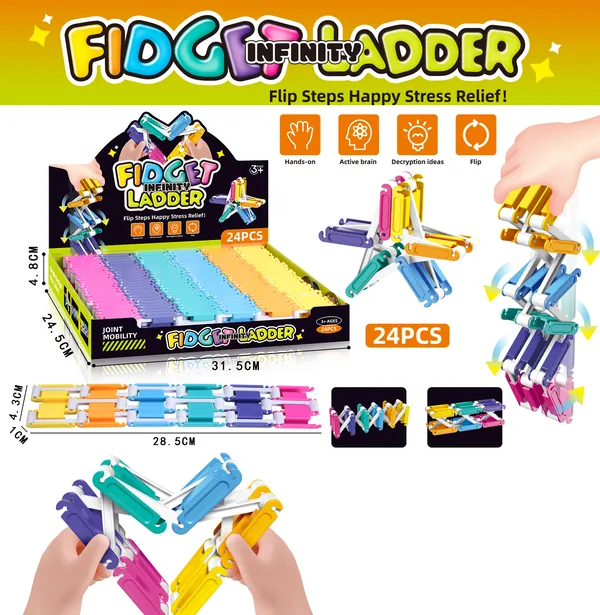
The Stress-Relieving Flip-Flop Ladder Toy (24 pieces per display box) quotes an MOQ of 1,152 pieces. At $0.56 ex-factory, the per-unit cost is low, but the 1,152 threshold reflects the boxed retail-ready format. If you drop the box and take bulk polybags, the MOQ might fall—ask explicitly.
A plush outlier: the Xule Plush Dinosaur Boxer sits at 108 pieces MOQ and $5.86 per unit. This is a ready-made pattern, not a custom shape. For a corporate wellness kit or a desk-punching gag gift, 108 pieces is a test-order quantity that lets you validate the channel before committing to a container load.
At the high-volume end, the Braided Twist-and-Play toy requires 3,000 pieces at $0.17 each. That's a low unit price but a high cash outlay—over $500 in product cost before freight. It only makes sense for buyers who already have distribution for impulse-buy fidget items and need the absolute floor price.
MOQ and Price Snapshot: Selected Stress Toy SKUs
| Stress-Relieving Flip-Flop Ladder (24PCS/BOX) | MOQ: 1,152 pcs | ~$0.56/unit | ABS | Retail box format |
|---|---|
| Stress-Relieving Stacking Toy (16PCS/BOX) | MOQ: 576 pcs | ~$0.59/unit | ABS | Boxed set |
| Striped Rubik's Cube Finger Toy (12PCS/BOX) | MOQ: 648 pcs | ~$0.56/unit | ABS | Display box |
| Triangle Flip Stress-Relief Finger Spinner | MOQ: 1,440 pcs | ~$0.41/unit | ABS | Bulk-friendly |
| Xule Plush Dinosaur Boxer | MOQ: 108 pcs | ~$5.86/unit | Plush | Low-MOQ outlier |
| Stress-relief Top & Cube | MOQ: 960 pcs | ~$0.58/unit | ABS | Multi-part |
| Pop-Eye Cartoon Animal Squeezer | MOQ: 576 pcs | ~$0.32/unit | ABS | Lowest unit price in range |
| Braided Twist-and-Play | MOQ: 3,000 pcs | ~$0.17/unit | ABS | High-volume, lowest unit cost |
What to Ask Suppliers Before Committing to an OEM MOQ
An MOQ quote without the underlying assumptions is a guess. Before you place a deposit, run through this checklist with the supplier—preferably in writing, on company letterhead or official email—so you can compare offers on equal footing.
1. Is the MOQ for the bare product, or does it include the quoted packaging (display box, sticker, insert)? Sometimes the product MOQ is 500, but the box printer demands 1,000 sheets. Ask for a split quote.
2. What mold fee applies, and who owns the mold? For a simple ABS cavity, expect $500–$2,000. The contract must state that the mold is your property, stored at the factory, and not used for other clients.
3. Which EN71/ASTM F963 clauses does the factory test against, and will they provide a fresh test report for your custom color and material—not a generic one from a previous batch? A report older than 12 months or one that doesn't list your specific colorant is a red flag.
4. What is the per-unit surcharge for a custom color masterbatch? Some factories quote the base white ABS price and then add $0.03–$0.08 for color matching, which changes the MOQ math.
5. What are the lead times for a pre-production sample (with your color/logo) and for the full production run? Sample lead times typically run 7–15 days; production 25–40 days after sample approval. Sea freight adds 30–45 days to the US West Coast; air freight adds 5–7 days but can cost more than the product itself at small volumes.
OEM MOQ Red Flags: Quick Reference
| Supplier won't provide material documentation per SKU | Red flag — compliance risk; walk away |
|---|---|
| MOQ quoted without specifying packaging format | Red flag — box printer MOQ may be higher than product MOQ |
| Generic EN71 report, not specific to your custom color/material | Red flag — port rejection risk if tested |
| Mold fee quoted but no mold ownership clause | Red flag — you may lose the mold if you switch suppliers |
| Factory can't name the plasticizer in squishy items | Red flag — likely phthalate contamination source |
| Price too low versus market ($0.10 for a multi-part spinner) | Red flag — likely regrind material or skipped safety tests |
FAQ: Custom OEM Stress Toy MOQs
For a first bulk order of wholesale fidget toys, what are typical MOQs and how do they vary between stock designs and custom OEM items?
Stock designs often ship at 300–500 pieces per SKU because the mold and color are already tooled. Custom OEM items typically start at 500–1,000 pieces per SKU—the jump covers mold setup, color matching, and fresh compliance testing that a stock item avoids.
Can a supplier offer custom color or logo molding for wholesale fidget toys, and what are the usual mold costs and minimum quantities?
Yes. A simple single-cavity ABS mold for a fidget clicker or spinner usually costs $500–$2,000, and the MOQ for that custom-molded part starts around 500–1,000 pieces. Logo molding (embossed or debossed) is typically included in the mold fee if specified before tooling begins.
What are the typical MOQs for bulk fidget toys when ordering directly from a Chinese manufacturer, and do they offer tiered pricing?
Factory-direct MOQs in 2026 cluster between 500 and 1,500 pieces per SKU for ABS-based items; plush can dip to 108 pieces. Tiered pricing is standard—a $0.56 unit at 1,152 pieces might fall to $0.48–$0.52 at 5,000 pieces—but the steeper savings come from sea freight consolidation, not per-unit discounts alone.
Can a supplier provide OEM customization for bulk fidget toys, such as custom colors, logos, or unique shapes, and what are the setup costs?
Most manufacturers offer full OEM: custom Pantone-matched colors (add $0.03–$0.08 per unit for masterbatch), pad-printed or in-mold logos, and unique shapes via a new mold ($500–$2,000). Setup costs include the mold fee, one-time color-matching, and a pre-production sample charge (often credited against the production order).
How do lead times and shipping methods (sea vs. air) affect total cost and delivery windows for a wholesale order of custom stress toys?
Typical lead times: 7–15 days for a pre-production sample, then 25–40 days for production after approval. Sea freight to the US West Coast adds 30–45 days and keeps per-unit freight low; air freight adds 5–7 days but can cost more than the product itself at MOQ-level volumes. For a 500-piece order, air freight often erases the margin—sea is the default unless the stockout cost is extreme.
Related Products & Categories
Request a Quote for Your Custom OEM Stress Toy Project
If you're ready to move from MOQ research to a concrete quote—with material documentation, mold ownership terms, and a compliance roadmap built in—contact SqueeZaa. The team works with buyers who need stress toys that feel good in the hand and pass the port inspection the first time. Reach out with your spec for a real MOQ, not a brochure number.