
US/EU Countertop & Gift-Store Displays: Which Import Data?
Request SKU specs, display layouts, draft packaging and report coverage before a US/EU import PO; reconcile shipment records before dispatch.
Before importing countertop and gift-store displays to the US or EU, request a revision-controlled SKU specification, display layout and load brief, draft packaging artwork, sample approval record, itemized customization quotation, and destination-specific report coverage file. Use these to decide whether the assortment fits the counter, whether the proposed construction supports its contents, and which private-label changes to approve. Request final shipment documents later, once production and packing details are established—not as a condition for receiving an initial quotation.
Build the file around both the sellable novelty or fidget item and its display. An attractive display drawing does not describe the toys inside it, and a toy specification does not establish the display’s capacity. Identify the actual destination country rather than using “global market” as the approval scope.
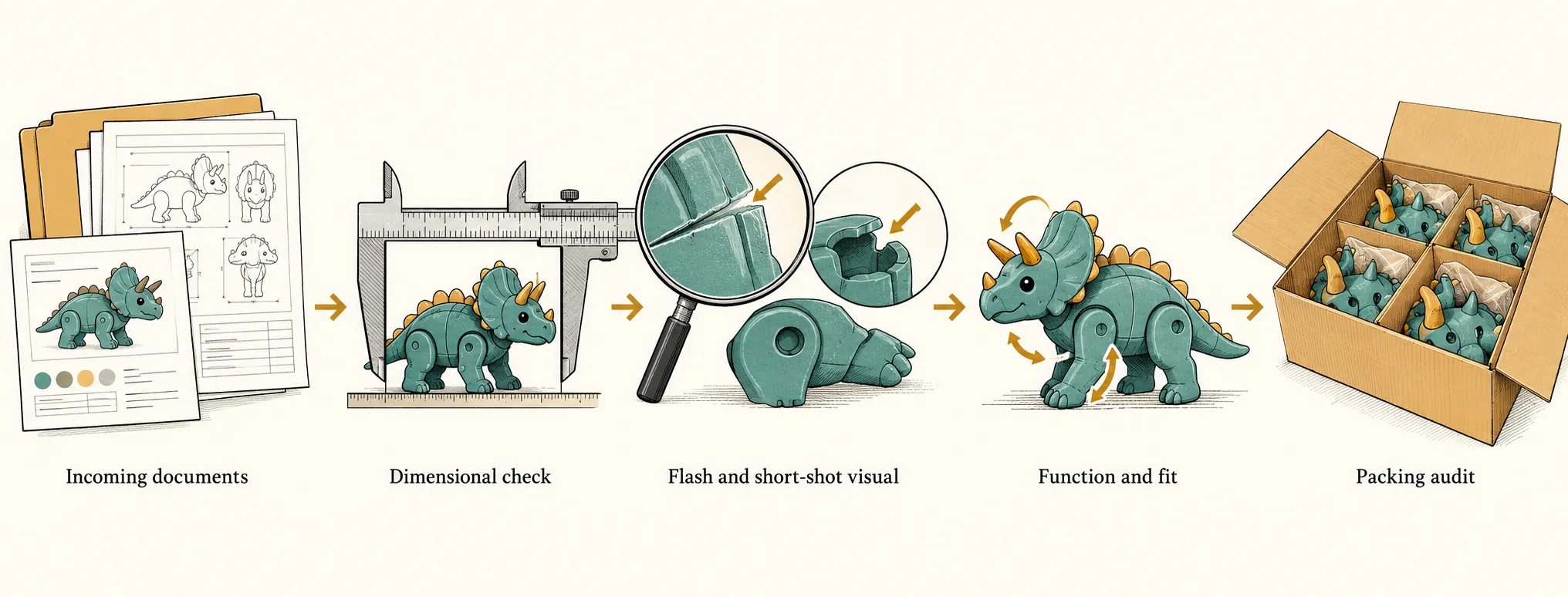
Which documents should buyers request before placing the purchase order?
| SKU specification sheet | Owner: product supplier prepares; buyer’s product lead approves. Useful fields: buyer and supplier item references, revision/date, product description, component and material breakdown, functions, variant identifiers, unpackaged dimensions, sale-ready packaged dimensions, and separately identified weights. For electronic fidgets, include power source, battery inclusion and operating instructions. Mismatch consequence: samples, quotations and packaging may describe different constructions or functions. |
|---|---|
| Display layout and structural brief | Owner: buyer defines counter constraints and assortment; display designer supplies the drawing and structural proposal. Useful fields: assembled footprint and height, usable compartment dimensions, header clearance, units and variants per compartment, packaged unit weight, packaging rigidity, planned load, calculation assumptions, display construction, and flat-packed versus preloaded shipping method. Mismatch consequence: the quoted assortment may not fit, remain accessible or match the proposed support arrangement. |
| Draft packaging and artwork file | Owner: supplier or packaging designer prepares the dieline; buyer’s packaging lead approves content and coordinates destination review. Useful fields: retail-unit, display and export-carton identifiers; artwork revision; logo placement; barcode allocation; product description; instructions and proposed destination-specific label content. Mismatch consequence: the wrong variant, artwork or barcode may be printed, or retail units may be confused with complete displays. Draft artwork is appropriate before the PO; final print approval belongs before printing. |
| Sample and color approval record | Owner: supplier identifies and retains the reference sample; buyer’s product or quality approver signs acceptance. Useful fields: sample ID, linked specification and artwork revisions, physical color master, component finish, texture, logo and assembly references, specified target versus observed result, acceptance conditions, approver/date, and correction owner with closure evidence. Mismatch consequence: production may follow a different reference from the one the buyer intended. Agree the approval method before the PO and close the physical-sample approval before production release. |
| Itemized quotation and customization scope | Owner: supplier’s commercial team prepares; buyer’s purchasing lead accepts. Useful fields: quantities expressed as retail units and complete displays, assortment allocation, included packaging, color or logo changes, tooling or artwork charges where applicable, sample scope, quoted delivery basis, payment terms, quotation validity, and approval-dependent schedule assumptions. Mismatch consequence: the buyer may compare a product-only quote with a display-packed quote or approve customization that was never included. |
| Report coverage and product-change file | Owner: supplier provides reports and construction history; buyer’s destination-market reviewer assesses relevance and requests clarification from the issuer where needed. Useful fields: report number/date, issuer, tested sample identity and photographs, construction, materials, relevant colors/components, stated test scope, item-reference crosswalk, and changes since testing. Mismatch consequence: the evidence may not support the construction being purchased. Review coverage before commitment; assess production changes again before shipment. |
How should assortment density and display loading shape the specification?
Choose the assortment layout before approving private-label artwork: fewer variants with deeper stock suit a compact presentation, while more variants need enough visible, reachable space for each choice. Treat that as a merchandising decision, not a prediction of sales.
Ask for a loaded layout showing each variant’s position, quantity and facing. Check whether shoppers can identify and remove a product without disturbing neighboring items, whether price labels remain visible, and how staff will refill the display. An empty rendering cannot answer those questions.
For custom corrugated displays, the useful design inputs are packaged unit weight, dimensions, pack-out quantity, packaging rigidity, and shipping or assembly method. These inputs are also identified in ONE PLUS DISPLAY’s design guidance. Soft or irregular novelty items should be assessed in their actual retail packaging rather than assumed to stand upright on their own.
For a mixed assortment, calculate planned merchandise weight by adding each variant’s packaged unit weight multiplied by its quantity. Review each compartment or shelf separately as well as the complete display. Ask the designer to state the design margin used; the same guidance proposes a 1.3–1.5 multiplier for corrugated displays. That is a supplier design recommendation, not a legal requirement or proof that an assembled display will carry the load.
State expected display duration, humidity exposure and whether the display travels empty or preloaded. Require the proposed assembly and support arrangement to be evaluated with the intended assortment. Keep this commercial fit-and-load check separate from product safety testing.
How should a buyer reconcile an actual fidget item with its display brief?
| Identity and revision | Required target: one identified product version across quotation, sample, artwork and display layout. Catalog reference: handheld finger-dancing fidget with music and lights. Buyer action: assign the buyer item reference and link it to the supplier reference, specification revision and sample ID. Decision consequence: resolve any function or version difference before accepting the quote. |
|---|---|
| Retail packaging | Required target: a confirmed sale-ready package that fits the display compartment. Catalog reference: color box. Buyer action: approve that format as a brief input, then obtain its dieline, external dimensions and opening orientation. Decision consequence: do not finalize compartment width or depth from the words “color box” alone. |
| Dimensions | Required target: separately labeled product and packaged dimensions, with length, width and height defined. Catalog reference: 13.8 × 11.9 × 12 cm, with the measurement basis to be confirmed. Buyer action: have the supplier identify what was measured and compare it with the sample. Decision consequence: hold final footprint approval until the sale-ready package dimensions are established. |
| Weight and load | Required target: measured weight of one sale-ready packaged unit, plus separately labeled display and export-carton weights. Buyer action: weigh the approved packaged sample and use that value in the assortment load calculation. Decision consequence: do not substitute a logistics or carton weight for individual product weight. |
| Construction and functions | Required target: component-level description, operating functions, power source and battery inclusion status. Catalog reference: “plastic” material entry and music/light functions. Buyer action: obtain the component breakdown and demonstrate the specified functions on the sample. Decision consequence: a material-family label does not define the whole construction or the electronic configuration. |
| Variant allocation | Required target: approved colors and quantities by display compartment. Buyer action: connect each variant to its physical color reference, item identifier and proposed display position. Decision consequence: approve the assortment map separately from total quantity; a total alone does not define shopper choice. |
| Release and correction closure | Required target: a signed disposition tied to the sample and document revisions. Buyer action: record approve, approve with stated conditions, or revise; name the responsible approver and date, correction owner and due date, then attach closure evidence. Decision consequence: release only the defined scope. This record supports traceability but does not itself detect an undisclosed substitution. |
Which sample and report checks should close the private-label decision?
Approve private label only after the physical reference and document scope describe the proposed product, packaging and display—not merely the logo. For a first order, keep the underlying construction unchanged if branding is the only business need; treat changes to components, functions or package size as separate specification decisions.
For plastic color matching, define the resin grade, surface finish, viewing conditions and approved physical master. A monitor image is useful for discussion, not final acceptance. Identify the master sample and agree how differences will be assessed rather than assuming a universal color tolerance.
For tactile novelties, add the intended texture and manipulation behavior to the sample record. For music-and-light fidgets, record the demonstrated functions and power configuration. Do not borrow approval fields from unrelated products simply because they share a display.
Review test reports against their tested construction and stated scope. A report for a reference sample does not automatically establish coverage of every later production configuration. Equally, a new internal SKU or a later batch does not automatically invalidate a report. Check construction changes, coverage, applicable retesting duties and retailer policies separately with the responsible reviewer.
Use a crosswalk when buyer and supplier item numbers differ. Record how the tested sample connects to the ordered version through descriptions, photographs, materials and change records. Neither a familiar standard name nor a stack of unrelated reports establishes coverage for an entire gift-store assortment.
Which documents belong at shipment review rather than before the PO?
| Final commercial invoice | Owner: seller/exporter prepares; buyer’s purchasing or logistics team reconciles. Useful fields: parties, PO reference, product descriptions and item references, quantities, values, currency and agreed delivery terms. Mismatch consequence: the commercial shipment record may not match the accepted order. Resolve differences before accepting the final document. |
|---|---|
| Final packing list | Owner: factory packing team or exporter prepares; buyer’s logistics team reviews. Useful fields: retail units per display, displays and loose units per export carton, variant allocation, carton count, carton marks, dimensions, and net/gross weights identified by level. Mismatch consequence: receiving staff may be unable to reconcile carton contents with the order or assortment. A carton quantity does not, by itself, establish an order multiple. |
| Production inspection and change-closure record | Owner: supplier quality team or appointed inspector records observations; buyer’s designated approver accepts disposition. Useful fields: production/lot identifiers, approved specification and sample revisions, checks performed, observed results, deviations, corrective actions, closure evidence and release approval/date. Mismatch consequence: the buyer cannot clearly connect the recorded inspection to the released goods. Commercial inspection is not a substitute for applicable safety testing. |
| Final artwork and destination-specific document set | Owner: supplier supplies final files and production details; buyer’s destination-market reviewer coordinates acceptance. Useful fields: released artwork revision, actual product and packaging identifiers, relevant reports and other documents identified for the destination and product, plus disposition of changes since the pre-PO review. Mismatch consequence: the shipment may differ from the version previously reviewed. Assess each document’s relevance rather than treating one report as universal approval. |
What should buyers send in a sample and private-label quotation request?
Send a request that separates the assortment, display engineering and customization scope so the supplier can quote the same deliverable you intend to approve.
Subject: Countertop gift-store display — sample assortment and private-label quotation for [destination country].
Please propose a novelty/fidget assortment for our counter envelope of [width × depth × height]. Show each variant’s position, quantity and facing, the total retail units per display, and how the display will be replenished.
For each proposed item, please provide a revision-controlled specification with product and sale-ready packaged dimensions, separately identified weights, component/material description, functions and variant references. Include power and battery details for electronic items.
Please provide the display drawing, packaged-product fit assumptions, load calculation and design margin, proposed construction, assembly instructions, and flat-packed or preloaded shipping method. Use the stated retail environment and intended display duration in the proposal.
Please separate standard product supply from color changes, logo application, packaging artwork, inserts and any tooling. Identify quotation assumptions, sample charges where applicable, approval stages and the proposed schedule. Supply draft artwork now; final packing details can follow when established.
Please identify the physical sample and color master for approval, provide relevant report coverage and construction-change information, and name the person responsible for each correction. We will record the approval conditions, responsible approver/date and closure evidence before production release.
Use this brief to request a sample assortment, color brief or private-label quotation.