
Wholesale Squeeze Toys: Which Identity Fields to Require?
Match squeeze toys and shelf fidgets to samples, construction, tracking details, and test records with a product identity worksheet and release criteria.
Identify the squeeze, pop, or spin mechanism and its components before approving a wholesale squeeze toy or shelf fidget compliance file. Require a model identifier, sample and specification revision, component-level materials and fill, intended age and destination, manufacturer identity, production traceability, packaging identity, and links to applicable test and certificate records. For squeeze toys wholesale purchases, the practical decision is whether those records describe the actual construction being ordered—not merely a toy with the same name or display box.
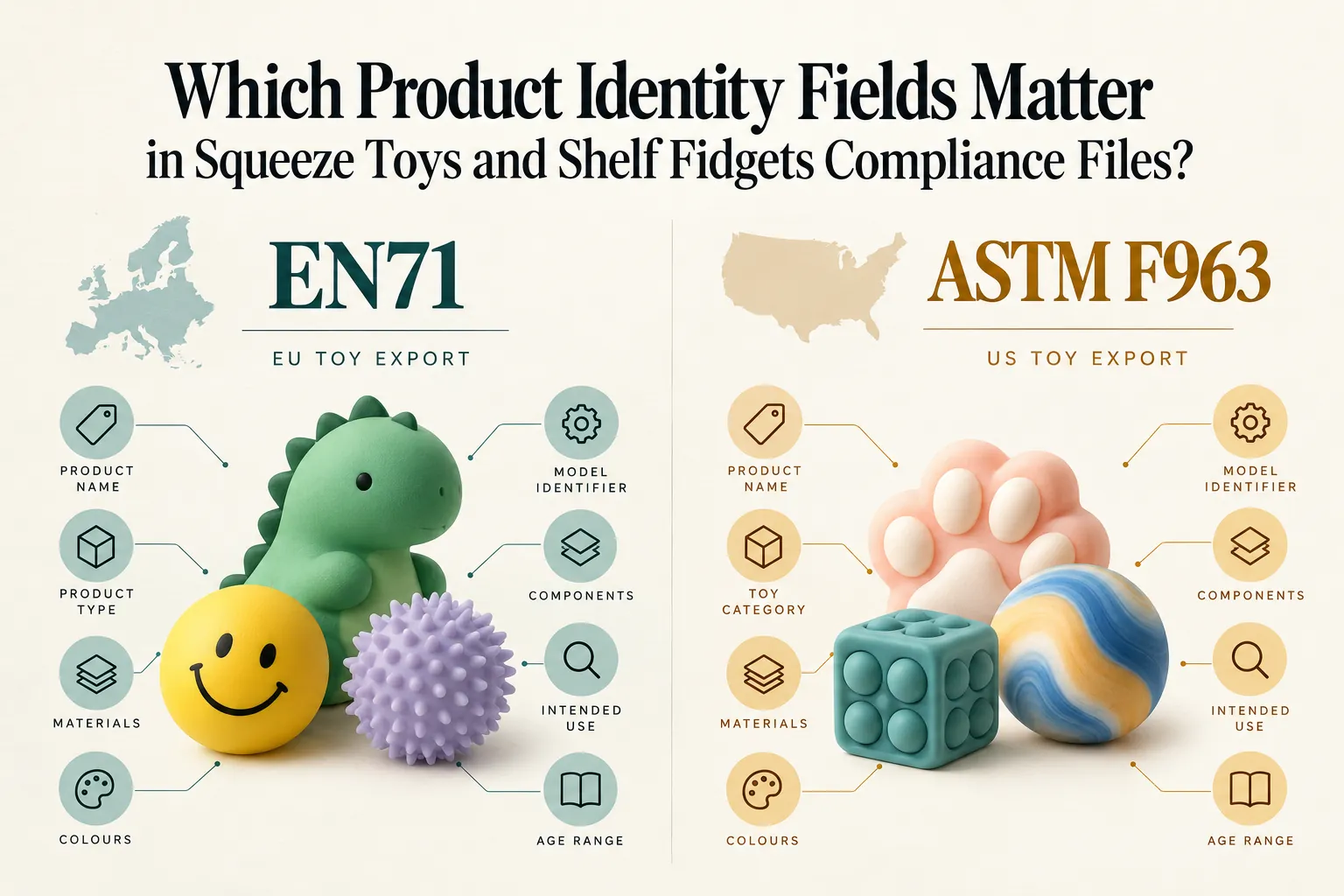
Which mechanism and construction details belong in the identity record?
Record what the user manipulates, what moves or compresses, and which components create that action. A merchandising description such as “squeezable” does not identify the construction closely enough to match a sample to a compliance file.
For a squeeze item, specify the compressible part, outer construction, fill if present, closures, and attached or removable pieces. For a pop-it or spinner, identify the moving elements and assembly. Record any light, sound, battery, or included accessory rather than assuming the principal toy is the entire product.
Keep shelf-selection observations separate from safety conclusions. Squeeze resistance, recovery behavior, and sound during repeated play help a buyer select a quiet sensory assortment; they are not substitutes for safety testing. Record those observations against an identified sample so that “quiet” or “soft squeeze” refers to something reproducible.
A material entry such as ABS must be assigned to the component it actually describes. It does not establish the material of every part, the presence or absence of fill, or the feel of the finished toy.
What identity information do the two Baking Workshop records establish?
| Product reference CPS344332 | Name: Baking Workshop Squeezable Fun; recorded material: ABS; packaging: display box; reference MOQ: 192 units; units per carton: 64. |
|---|---|
| Product reference CPS344333 | Name: Baking Workshop Squeezable Fun; recorded material: ABS; packaging: display box; reference MOQ: 192 units; units per carton: 64. |
Which identity fields connect the product to U.S. compliance duties?
Intended age, construction, responsible-party identity, and manufacturing traceability connect a product record to the applicable U.S. compliance review. A catalog title or internal model number cannot perform that job alone.
For U.S. toys intended for children 12 years of age and under, CPSC states that third-party testing and a Children’s Product Certificate are required for applicable children’s product safety regulations, including 16 C.F.R. part 1250. The domestic manufacturer—or importer for overseas-made products—is responsible for identifying the applicable sections of the toy standard. Record the intended age, destination, responsible entity, and its applicability determination rather than treating an “ASTM” label as a product-specific conclusion. CPSC Toy Safety FAQ
CPSC also identifies the tracking information for children’s products intended for ages 12 and under: manufacturer or private labeler, date and place of manufacture, batch or run information, and the specific production source. Capture these details and retain product and packaging marking artwork or photographs for review. A brand name and a country name alone do not capture all of those identity elements. CPSC Toy Safety FAQ
These are U.S.-specific explanations. Keep destination as an explicit field so a U.S. document review is not reused as an EU or global compliance determination. The worksheet below is a recommended purchasing control, not a statutory form or a certificate of compliance.
How should the buyer complete the product identity worksheet?
| Model and variant identity | Copy the catalog reference and product name; add supplier model aliases, variant description, and dated product photographs. Record how each identifier maps to the order line and supporting documents. |
|---|---|
| Sample and specification revision | Enter the sample identifier, sample receipt date, specification revision, and photograph references. Record which exact revision is proposed for approval. |
| Mechanism and sensory target | Specify the intended squeeze, pop, or spin action and the buyer’s quiet-play target. Record observed operation, squeeze response where relevant, recovery behavior, and sound against that sample. |
| Component materials and fill | Map ABS to the relevant component. Record the remaining component materials, fill identity if present, closures, and the construction drawing or component-list revision used for comparison. |
| Included parts and accessories | List attached and removable parts, accessories, and any light, sound, or battery components. Record the actual supplied configuration, not just the main toy. |
| Age and destination | Enter the proposed intended age, destination market, supporting age-assessment reference, and matching package wording. Route the proposed age and construction to the responsible compliance reviewer. |
| Responsible entities | Record manufacturer or private-labeler identity and the relevant importer. For the U.S. review, name the domestic manufacturer or importer responsible for determining applicable toy-standard sections. |
| Manufacturing traceability | Record the manufacturing date and place, batch or run identifier, specific production source, and the references that connect these details to product and packaging markings. |
| Packaging and assortment identity | Start with the recorded display-box format. Attach the artwork revision and specify the contents of the selling unit, display, and carton, including any variant mix. |
| Compliance-document match | Record applicable-rule determination, report and certificate references, document dates, and the model or construction each covers. Have the responsible reviewer resolve differences between the tested construction and the ordered variant. |
Can the two Baking Workshop references share one compliance file?
The two references can use a shared document set only when the responsible reviewer confirms that its coverage includes both constructions. Keep a separate identity mapping for each reference even when documents are shared.
Here is the bounded comparison: both catalog entries say Baking Workshop Squeezable Fun, ABS, and display box. Those matches support a shared catalog description. They do not establish that the squeeze element, fill, closures, accessories, or packaging contents are identical.
Compare the two identified samples and their component lists. If the distinction is cosmetic, document that distinction and obtain a coverage decision. If the construction differs, record the difference and review its effect on applicable requirements and existing reports before release. A different internal identifier does not automatically require a separate test; an identical product name does not automatically establish coverage.
When is the identity record complete enough to release the order?
Release the order only after the ordered construction is identified, consequential mismatches are resolved, and the named approvers accept the relevant specification and document mapping. A completed worksheet supports traceability; it does not itself prove compliance or reveal an undisclosed substitution.
Use a short approval sequence. The product buyer accepts the mechanism and sensory-shelf fit against the identified sample. The responsible compliance reviewer accepts the age, destination, applicable-requirement determination, and document coverage. The authorized order approver then records the release decision.
Separate order-release conditions from later shipment checks. For example, an assigned future production batch can be a controlled shipment condition if the record names who will verify the final batch and marking details, and prohibits shipment until that condition closes. Do not use conditional approval to postpone resolving which construction is being purchased.
What must the final approval entry contain?
| Approval basis | Enter product reference, variant, order-line reference, approved sample identifier, specification revision, and packaging-artwork revision. |
|---|---|
| Target versus observation | Summarize the matched construction and list any departures from the specified target, with evidence references. |
| Decision and conditions | Record release, conditional release, or hold. Define each condition and whether it blocks order release or shipment. |
| Responsible approvers and dates | Enter the product buyer, responsible compliance reviewer, and authorized order approver, with each decision date and scope of approval. |
| Follow-up closure | Assign an owner and due date for each condition. Record closure evidence, reviewer, and closure date; obtain renewed approval when a change affects the accepted construction or document coverage. |