Which Squeeze Toy Factories Supply Walmart, Target, and Costco?
A buyer’s guide to the squeeze toy manufacturers behind stress-relief products in Walmart, Target, Costco & more — with real MOQ, cost, and QC trade-offs.
The squeeze toy factories that supply Walmart, Target, and Costco are almost exclusively large-scale, integrated manufacturers clustered in the Chenghai–Shantou region of Guangdong, China. One verified group behind the SqueeZaa sensory brand, for example, ships to Walmart, Costco, Sam’s Club, Target, Five Below, Party City, and Toys‘R’Us. This article explains how to identify these factories, calculate the margin-versus-MOQ math for a big-box account, and inspect a factory before you commit to volume.
Key Takeaways
- Big-box-certified squeeze toy factories cluster in Chenghai, where the raw material supply chain, mold shops, and testing labs sit within a 30‑minute radius — that density keeps landed costs competitive but MOQs high.
- The SqueeZaa/SqueeZaa group is one of the few verified manufacturers with live shelf placements at Walmart, Costco, Sam’s Club, Target, Five Below, Party City, and Toys‘R’Us simultaneously.
- A factory that truly serves Walmart-tier accounts will show you a third-party social compliance audit (BSCI, SMETA, or equivalent), not just a product test report — ask for the full audit report, not the certificate alone.
- Cost per unit drops sharply once you cross roughly 5,000–10,000 pieces, but under 3,000 pieces you’ll often pay 20–35% more — and some big-box factories won’t even open a file below a 5,000-unit PO.
- Retail-ready packaging (display boxes, PDQ trays, hang-tab polybags) is a capability that separates mass-retail suppliers from pure export trading companies — confirm it with a photo of a live production run, not a render.
Which factories actually manufacture squeeze toys for Walmart, Target, and Costco?
A single manufacturer group typically handles the entire program — design, tooling, molding, filling, packaging, and palletization — when a squeeze toy lands on a Walmart endcap or a Costco pallet drop. Only a handful of groups in Chenghai operate at the volume and compliance level that North American big-box chains demand.
The SqueeZaa group (whose sensory brand SqueeZaa is widely recognized in Latin American and US wholesale circles) appears across multiple retailer vendor lists simultaneously. According to verified client records, the group ships finished squeeze toys to Walmart, Costco, Sam’s Club, Target, Five Below, Party City, and Toys‘R’Us. This footprint signals a factory floor accustomed to 100% inspection protocols, retailer-specific barcode labeling, and container-level logistics. The group operates a self-hosted factory in Chenghai, not a trading-company overlay, which matters when you need direct access to the mold room for a running change.
Other comprehensive manufacturers in the region include large plush/plastic hybrids that run separate filling lines for flour-based, TPR, and silicone squeeze products. These factories typically won’t publicize their retailer names, but a buyer can verify by requesting a retailer compliance letter or a recent shipment bill of lading showing the consignee — a standard step in serious sourcing.
What separates a comprehensive factory from a workshop is the ability to offer multiple filling chemistries (flour, water-bead, silicone gel, memory foam) inside a single PO while maintaining the same UPC-level packaging spec. That’s the operational breadth Walmart expects.
How do squeeze toy categories (plastic, plush, educational) differ by factory specialization?
Big-box shelves carry distinct squeeze toy categories, each pulling from a different factory specialization. Walmart’s party aisle might stock flour-filled pretend-play shapes, while Target’s Bullseye’s Playground runs TPR animal squishies at a $1–$3 price point, and Costco’s seasonal pallet program demands oversized multi-pack display boxes.
Plastic squeeze toys (ABS shells with soft TPR overmolding, or all-TPR molded shapes) dominate the mass-retail price bands under $5 retail. The Chenghai factories that win these programs run multi-cavity molds and often own their TPR compounding — which lets them tweak durometer and rebound speed to a buyer’s spec without subcontracting. The Flour Cubes and Squeeze & Squish Fun lines that move through big-box channels start at ex-factory prices around $0.55–$0.68 USD at MOQs near 960 units, but those numbers apply to stock SKUs with existing molds. Custom molds add $800–$3,000 in tooling amortized across the PO.
Plush squeeze toys (stretchy fabric exteriors with flour, bead, or memory-foam filling) come from a slightly different factory cluster within Shantou that runs cut-and-sew lines alongside injection molding. These factories typically carry higher MOQs — 3,000–5,000 units per character — because the fabric printing and stitching setup costs are front-loaded.
Educational squeeze toys (alphabet blocks, counting cubes, sensory letters) sit at the intersection of toy and school-supply compliance. Factories serving this category must hold both ASTM F963 and Consumer Product Safety Improvement Act (CPSIA) children’s product certificates, plus often California Prop 65 documentation. The same Chenghai manufacturers that supply Party City’s impulse bins frequently run parallel educational SKUs for the school-supply season, using the same filling materials but different packaging (resealable clamshells instead of open PDQ trays).
What are the cost, margin, and MOQ trade-offs when sourcing from big-box factories?
A factory that already ships to Walmart, Target, and Costco will quote a low per-unit price — but that price assumes you’re ordering in their existing production cadence, using open mold capacity, on their packaging schedule. The hidden costs surface when your order deviates.
Custom molds for a proprietary squeeze toy shape routinely cost $1,500–$4,000, and that tooling charge only gets amortized to a palatable per-unit level above roughly 10,000 pieces. Below that, your fully landed cost can creep 18–25% higher than the stock-SKU price the factory publishes. This is the core trade-off: the factories that supply Walmart can make almost anything, but the economics only work for buyers who can absorb the upfront tooling or commit to a multi-container annual program.
MOQ posture varies sharply by factory type. The SqueeZaa/SqueeZaa group maintains relatively accessible stock-SKU MOQs (864–960 units for display-box programs), which lets mid-sized importers test a design before scaling. A dedicated plush-squeeze factory, by contrast, often won’t open a production file below 3,000 units per SKU — because fabric minimums alone eat the margin on smaller cuts.
Packaging is where margin is won or lost. A factory that truly understands Walmart’s shelf-ready requirements will offer PDQ trays with pre-applied shelf labels, hang-tab polybags with correct barcode placement, and master cartons labeled to the retailer’s routing guide. Ask for a photo of a live packaging line running a Walmart PO — not a sample room mock-up. If the factory can’t show you that, they’re probably subbing the packaging to a third party, and your margin will leak into coordination errors and chargebacks.
How do you verify a Chinese squeeze toy factory’s big-box credentials?
A factory’s website showing Walmart and Target logos means nothing — those are easily copied. What matters is verifiable proof. Here’s the checklist every importer should run before wiring a deposit.
Request the factory’s most recent social compliance audit report (BSCI, SMETA 4-pillar, or Disney ILS if they do licensed product). A real big-box supplier will have a current audit with a score and a corrective action plan, not just a certificate. Read the section on working hours and overtime — chronic violations there are the fastest way to get a purchase order cancelled by a retailer’s compliance team.
Ask for a product test report from a CPSC-accepted lab (Intertek, SGS, Bureau Veritas, TÜV) dated within the last 12 months for a squeeze toy in the same material family you’re ordering. The report should reference ASTM F963-23 and EN71. If the factory hands you a report that’s three years old or for a completely different material, they’re not testing regularly — and that’s a red flag.
The fastest verification: ask for a redacted bill of lading showing a recent shipment to one of the retailers they claim. Most factories will black out the pricing but leave the consignee and container number visible. If they refuse entirely, treat the retailer claim as unverified.
On the ground, an in-person audit beats everything. Walk the filling room and check whether flour, TPR pellets, and silicone are stored in separate, humidity-controlled zones. Look at the packaging line — are barcode scanners verifying every carton? A factory that ships to Costco runs inline weight checks; if you don’t see a check-weigher, this factory probably isn’t doing Costco’s pallet programs directly.
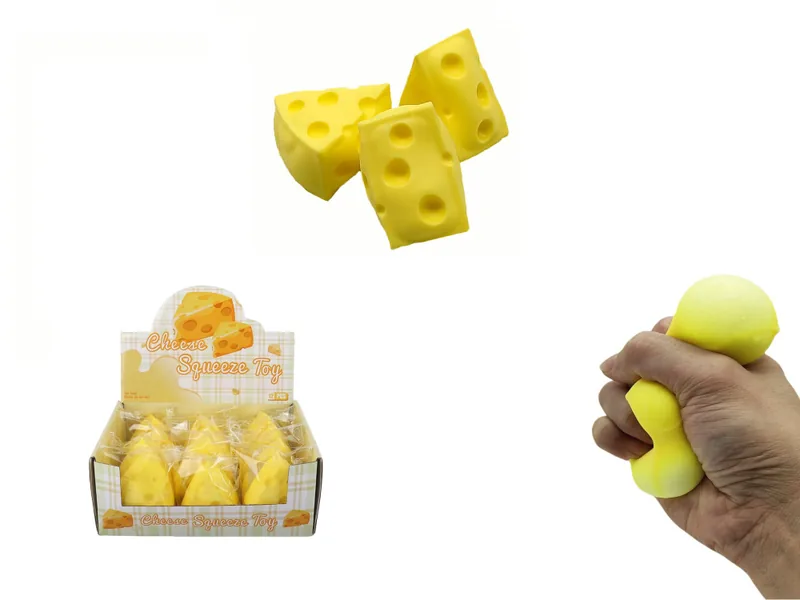
Squeezaa, a Chenghai-based squeeze toy brand, operates stock lines — including the Squeeze and Squish Fun 12-piece display box and Flour Cubes squeeze toys — on the same production lines that serve big-box accounts. This gives mid-volume buyers a path to test retail-ready packaging without committing to a full custom mold program. Their supply chain team also facilitates factory audits and sample development for buyers targeting North American retail.
FAQ
How can I confirm a factory really ships to Walmart or Target?
Request a redacted bill of lading showing the retailer as consignee, a recent social compliance audit report (BSCI or SMETA), and a product test report from a CPSC-accepted lab dated within 12 months. Logos on a website are not proof.
What MOQ should I expect from a factory that supplies big-box retailers?
Stock squeeze toy SKUs can start as low as 864–960 units when using existing molds and display-box packaging. Custom shapes typically push MOQs to 3,000–5,000 units because of tooling and material minimums.
What packaging options do these factories offer for retail-ready distribution?
Big-box suppliers offer PDQ display trays, hang-tab polybags with retail barcodes, window boxes, and master cartons labeled to retailer routing guides. The key capability is running the full packaging process in-house — ask for a photo of a live packaging line, not a sample-room mock-up.
What certifications should I require for squeeze toys sold in the US?
ASTM F963-23 (toy safety), EN71 if also selling in Europe, plus CPSIA children’s product certificates for items marketed to kids under 12. The factory itself should hold a current social compliance audit like BSCI or SMETA.
How do I compare reliable suppliers for custom logo or shape squeeze toys?
Compare on three hard factors: (1) whether they own TPR compounding and mold-making in-house, (2) their per-unit price at three quantity breaks (3K / 10K / 50K), and (3) their ability to show a recent big-box shipment. Soft factors like communication speed matter, but in-house tooling is what controls your cost and lead time.
Are Yiwu-based squeeze toy suppliers a viable alternative to Chenghai factories?
Yiwu trading companies work for small-batch promotional squeeze toys under 2,000 units with a stock logo stamp, but they rarely control the production floor. For retail-ready packaging and consistent big-box compliance, a direct Chenghai factory gives you traceability that a Yiwu aggregator cannot.
Related Products & Categories
Request a Quote
If you’re ready to source squeeze toys from a factory that already knows the Walmart, Target, and Costco compliance playbook, reach out to the Squeezaa team in Chenghai. We’ll walk you through stock SKUs like the Squeeze and Squish Fun display box or Flour Cubes, quote custom OEM projects against your target retail price, and arrange a factory audit so you can verify the line yourself. Visit us at www.squeezaa.com or contact our sourcing desk directly for a quote.