
Wholesale Fidget Toys in Toy Safety Awareness Month: Spotting Knockoff Hazards Before They Reach Shelves
Screen wholesale fidget toys for burst membranes, small parts, phthalates and missing lot codes—with practical US compliance checks before shelf approval.
A retail buyer squeezes a soft stress ball: the resistance feels right, the fill moves evenly, and repeat play is quiet. Before that sample joins a purchase order for wholesale fidget toys, the buyer needs more than a reassuring feel. For an under-3 product, a detached piece creates a separate small-parts question; for a children's toy, soft plastic also brings the 0.1% phthalate limit into view.
Use November's Toy Safety Awareness Month review to separate appealing samples from supported inventory. This evidence set does not establish a specific November counterfeit-squishy recall or burst incident. A lookalike shape, uneven membrane or missing code is a release concern—not proof of counterfeiting. The defensible decision rests on sample condition, age-specific test evidence, chemical results and traceable production identity.
For US children's products intended primarily for ages 12 and younger, certification must match the actual product. SqueeZaa buyers should treat this walkthrough as a sourcing screen, not evidence that any catalog SKU has passed testing. US toy dollar sales grew +20% from January through September 2026 versus the same period last year, with units up +18% and average selling price up +2%, so a faster assortment cycle raises the cost of a weak release check.
Follow a membrane failure through to the under-3 decision
Start the sample review with the squeeze surface, closure, decorative attachments and fill containment. Record leakage, seam opening, tearing and detached pieces against the sample identity. Squeezing, pulling and dropping samples can expose concerns during an editorial receiving screen, but these actions are not a substitute for the applicable laboratory use-and-abuse sequence under the small-parts framework.
Under 16 C.F.R. part 1501, the relevant object is not just the intact toy. A whole toy, separate component or piece that breaks off during use-and-abuse testing counts as a small part when it fits entirely into the prescribed cylinder without compression in any orientation. Evaluate a detached membrane fragment on that basis; do not force soft material into the fixture to manufacture a failure.
A product intended for children under 3 is banned when it presents the covered small-parts hazard. Review detached eyes, plugs, beads, spinner pieces and pop-it attachments as well as the squishy body. These are inspection targets, not claims that every construction contains detachable parts. The CPSC small-parts guidance gives the governing definition and cylinder reference at § 1501.4.
A choking warning is not a workaround for an under-3 failure. Where applicable, warnings follow 16 C.F.R. § 1500.19, and advertising follows § 1500.20. The reinforces age labels, secure parts and sturdy construction; it supplements, rather than replaces, regulatory testing.
Replace “non-toxic” reassurance with component-level evidence
For children's toys intended for ages 12 and younger, 16 C.F.R. part 1307 prohibits more than 0.1%—1000 ppm—of any listed phthalate in an accessible plasticized component. The eight substances are DEHP, DBP, BBP, DINP, DIBP, DPENP, DHEXP and DCHP. This is not a combined allowance across the eight substances, nor an average across the complete toy.
For bulk sensory toys, match the report's tested material to the accessible plasticized component it represents. Distinguish membrane, fill and decoration in the component description; do not assume a membrane result establishes the composition of a different fill. The CPSC phthalates guidance specifies the CPC citation: “16 C.F.R. part 1307 – Phthalates.”
Accessible children's-product components also face the 100 ppm total lead limit. The CPSC total lead guidance identifies the CPC citation as “15 U.S.C. § 1278a – Total lead content.” Keep substrate lead evidence distinct from the phthalate assessment; passing one requirement does not establish the other.
Testing exemptions require a precise material basis. CPSC identifies certain untreated materials under § 1500.91 and certain untreated, unfinished engineered wood under § 1252.3(a) for lead-testing exemptions. Specified materials also have phthalate-testing exemptions. Neither exemption removes the underlying limit or applicable CPC obligation; a soft-plastic SKU does not earn an exemption merely because another component qualifies.
Illustrative planning calculation: a small percentage difference still fails
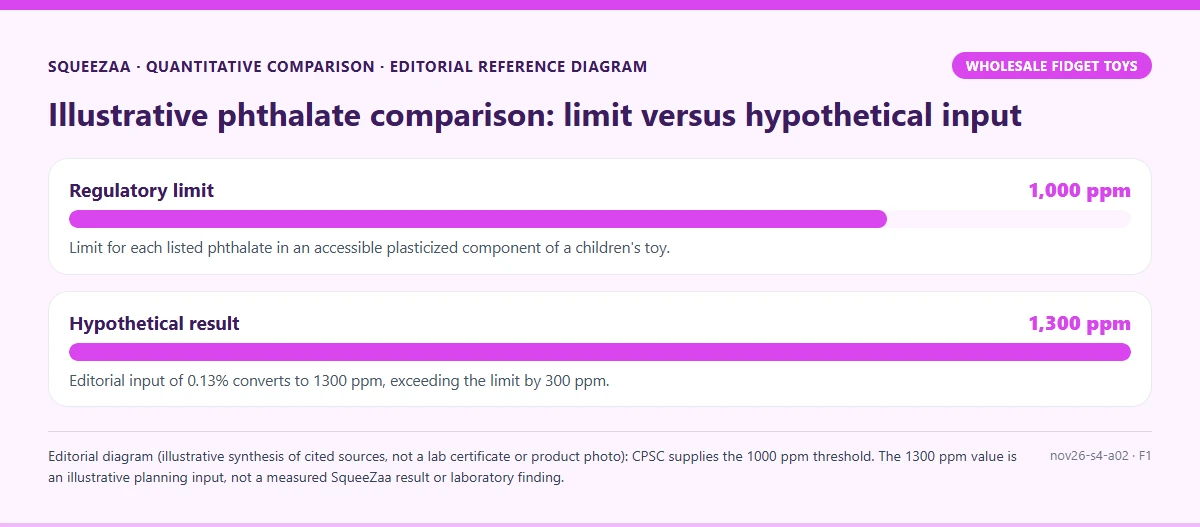
This illustrative planning example uses a hypothetical result, not a laboratory measurement from a SqueeZaa product. Assume one regulated phthalate is reported at 0.13% by weight in a gel-fill component established to be accessible and plasticized. The applicable comparison is 0.1%, or 1000 ppm.
Convert percentage to ppm: 0.13 × 10,000 = 1300 ppm. Then calculate the excess: 1300 − 1000 = 300 ppm. In percentage terms, 0.13% − 0.10% = 0.03 percentage points. The hypothetical component exceeds the limit despite the small-looking decimal difference.
The planning decision is to reject that hypothetical result for release, identify the corrected material and establish passing evidence before certification and ordering. A revised CPC alone cannot cure a 1300 ppm component, and a whole-toy average cannot replace the accessible-component comparison.
Pre-shelf evidence matrix for fidget toys wholesale
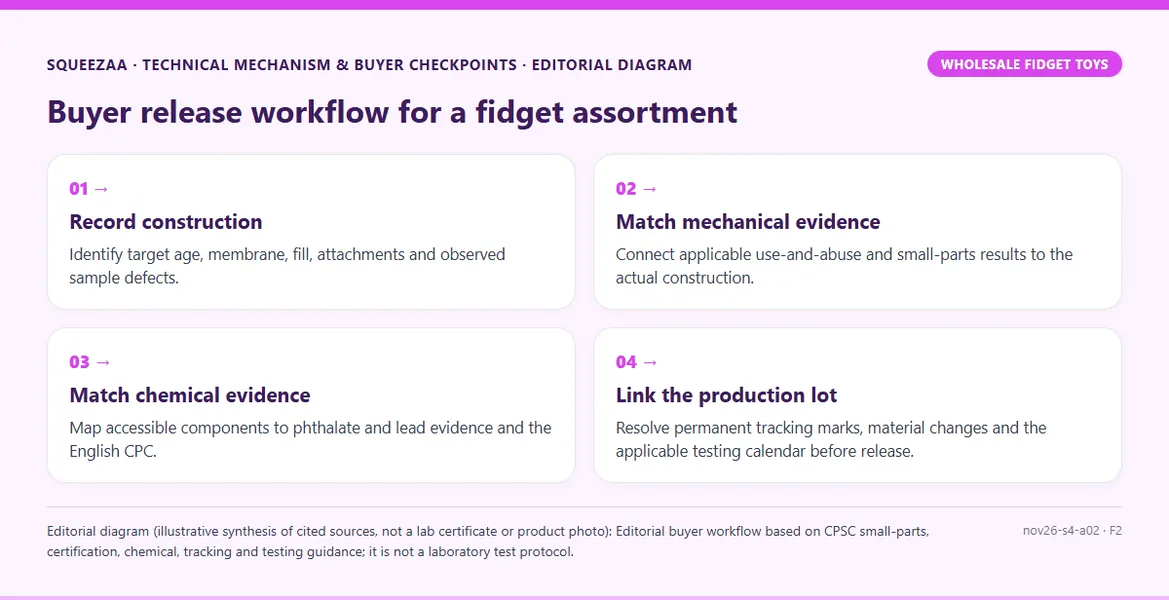
Use this matrix as a release record, not a complete list of every applicable toy requirement. Each row connects a physical or documentary check to its own decision; the 1000 ppm chemical threshold and under-3 mechanical assessment are separate gates.
| Checkpoint | Rule or basis | Release decision | Evidence to retain | Threshold or required field |
|---|---|---|---|---|
| Membrane and detached parts | 16 C.F.R. part 1501 | Hold a failed under-3 construction; a warning does not cure it | Applicable use-and-abuse and small-parts results tied to product identity | Under 3: covered small-parts hazard prohibited; cylinder fit without compression |
| Accessible plasticized components | 16 C.F.R. part 1307 | Reject an over-limit result; establish compliant material | Component-matched results and applicable CPC citation | No listed phthalate above 0.1% / 1000 ppm |
| Accessible component lead | 15 U.S.C. § 1278a | Reject excess lead; do not confuse testing exemption with permission | Relevant results or documented testing-exemption basis; CPC | 100 ppm total lead |
| Production identity | CPSC tracking-label requirement | Hold missing or unresolvable traceability | Product/package marking artwork and code interpretation record | Business identity, production location/date, batch/run or equivalent detail |
| Certification identity | 16 CFR part 1110 | Hold a certificate covering a different product | Matching product description, applicable citations and testing basis | Product-specific CPC and supporting reports in English |
Connect each lot to its materials, certificate and testing calendar
A burst complaint needs a production identity, not just a product name. Under the CPSC tracking-label guidance, visible, legible, permanent marks belong on product and packaging to the extent practicable. They must make the responsible business, production location and date, batch/run or equivalent manufacturing details, and specific source ascertainable. Coded information works only when consumers know whom to contact for interpretation.
Keep label artwork and code meanings with the purchase record. Tracking labels are not a safety rule requiring CPC certification, so their absence from the certificate is not itself a defect. Conversely, a CPC does not establish that the physical product carries the required marks. Link complaints and retained samples to the actual production code.
For custom fidget toys, treat gel formulation, membrane material, decoration and component source as change-control fields. Under CPSC material-change guidance, a change that could affect compliance requires testing by a CPSC-accepted laboratory and a new CPC after passing results. Scope testing to affected requirements: component chemistry alone does not resolve a changed construction's small-parts performance. A change of manufacturer requires retesting and recertification.
Continuous manufacture also needs a testing calendar under 16 CFR § 1107.21. The CPSC periodic-testing guidance describes 1-, 2- and 3-year frameworks, not freely interchangeable renewal dates. The annual option requires a written plan, testing at least once per year, and retention of plans and results for 5 years. Importers share these obligations.
The CPSC certificate guidance requires the CPC and supporting reports in English and flags eFiling for most regulated imports beginning July 8, 2026. Keep EU orders separate: the European Commission toy-safety overview identifies Directive 2009/48/EC and states that Regulation (EU) 2025/2509 enters into force on 1 January 2026 and applies from 1 August 2030 after a 4.5-year transition. US paperwork is not an EU clearance.
What phthalate limit applies to wholesale fidget toys sold in the US?
The limit is 0.1% (1000 ppm) for each of eight listed phthalates in an accessible plasticized component of a children's toy. For applicable certification, the CPC must cite “16 C.F.R. part 1307 – Phthalates.” A generic “phthalate-free” statement does not supply component identity, measured results or the certification basis.
Is a burst squishy membrane a small part?
A detached membrane fragment is a small part when it fits entirely into the prescribed cylinder without compression in any orientation. Under 16 C.F.R. part 1501, fragments produced during use-and-abuse testing count in the assessment. A covered small-parts hazard makes a toy intended for children under 3 unacceptable; intact-toy size does not override the fragment result.
What has to be on a fidget toy tracking label?
The marks must identify the manufacturer, importer or private labeler, production location and date, batch/run or equivalent manufacturing information, and specific source. They must be visible, legible and permanent on product and packaging to the extent practicable. An interpretable code is allowed; the tracking requirement itself does not need a CPC citation.
Build the shortlist around evidence, then approve the assortment
For a SqueeZaa sourcing shortlist, record target age, construction, accessible materials, decoration and production-code format beside squeeze feel and quiet repeat play. Before choosing a fidget toy manufacturer or approving a reorder, match the English CPC and reports to the actual SKU, including the applicable part 1307 and part 1501 evidence.
Keep release blocked for leakage, unexplained substitutions, mismatched documentation or unresolved traceability. Hand inspection is the receiving screen; laboratory evidence and change control support compliance. That distinction keeps an attractive sample from becoming unsupported shelf inventory.
Sources
www.cpsc.gov — Phthalates Business Guidance | CPSC.gov
www.cpsc.gov — Small Parts Ban and Choking Hazard Labeling | CPSC.gov
www.cpsc.gov — Total Lead Content | CPSC.gov
www.cpsc.gov — Children's Product Certificate | CPSC.gov
www.cpsc.gov — Tracking Label Business Guidance | CPSC.gov
www.cpsc.gov — Material Change Testing | CPSC.gov