
Squeeze Toy & Shelf Fidget RFQs: Which Carton Specs to Fix
Build a two-row squeeze-toy and shelf-fidget RFQ covering carton dimensions, CBM, count, weight, strength, marks, and final packing approval.
For SqueeZaa’s sensory shelf, separate squeeze-and-recovery toys, rotating fidgets, and music/light games before requesting quotes: those mechanisms are not interchangeable. Use the two-row worksheet below to carry forward recorded SKU identities, request samples that demonstrate the intended shelf role, and resolve packing questions before quote approval. Freeze the agreed product and packing revision—not unverified catalog values. Approve final shipment data only after packed-carton measurements reconcile with the packing list; keep age and destination-document approval separate.
Which product mechanism belongs in each RFQ row?
Use separate RFQ rows for the burger-shaped spinner and the music/light finger game; neither catalog description establishes a soft-filled squeeze toy.
The mini magic-bean burger item is described as a plastic stress fidget spinner. Treat it as a candidate for rotating repeat play, and request a working sample to assess its action and operating sound before placing it in a quiet-desk assortment. The finger-dancing handheld game explicitly includes music and lights, so quote it as an active sensory-game option—not as a quiet substitute unless a suitable silent mode is demonstrated.
For a genuine squeeze-toy line, specify the intended squeeze feel, fill construction, and recovery behavior separately. Agree sample identity, compression depth, hold time, recovery endpoint, and observation conditions before comparing samples. Those are commercial selection checks, not safety certification. A catalog material entry of “Plastic” may describe a shell or component; it does not establish the complete construction of either example.
Which catalog fields should the two-row RFQ carry forward?
Carry the recorded identity and packing references into the RFQ, but require the supplier to reconfirm the proposed configuration before quote approval. “Recorded” means present in the catalog, not verified against a current sample or shipment. Keep supplier proposals, agreed targets, and measured results in separate fields.
The following references come from the October 9, 2026 catalog snapshot. Keep them attached to their exact product and pack configuration: Burger spinner listing and Finger-game listing. The supplier should return a current quote, dated pack specification, sample identity, and marked-up deviations for each row.
Use external safety findings to sharpen questions, not to label these SKUs. In CPSC recall 26-515, the named Anzmtosn Luminous Fidget Spinner Balls included a mini flashlight with button-cell batteries that children could easily access, creating an ingestion hazard. No connection to SqueeZaa, its suppliers, or either worksheet SKU is established. As buyer follow-up—not additional recall findings—ask whether each proposed configuration contains batteries, what type, how access is secured, and which components can detach or become small parts. Request construction details and applicable item-specific test evidence; do not assume the music/light game uses button cells or that the burger spinner contains batteries.
For both rows, leave age suitability, certification status, price, stock, and delivery unresolved until the relevant response and evidence have been reviewed. Specify the intended destination market in the RFQ. Request proposed age grading and its basis, warning artwork, and applicable certificates and test reports matched to the exact model and construction. A matching SKU helps trace coverage but does not itself prove compliance. Record each open item’s supplier response, evidence reference, buyer reviewer, decision date, and closure status.
| Mini magic-bean burger spinner | Recorded identity: CPSCPS226184. Recorded material: Plastic; retail packing: box. Catalog references: MOQ 20; 160 units/carton; carton 49 × 33 × 45 cm; gross weight 3.0 kg; individual package field 15 × 15 × 15 cm. Reconfirm all commercial and packing values. Request the exact selling-unit definition, inner-pack arrangement, proposed net weight, carton strength specification, shipping-mark artwork, and representative working and packed sample references. Resolve the individual-package/carton-count conflict before accepting this pack configuration. Open—supplier confirmation and buyer review required: proposed age grading with supporting basis and warnings; applicable destination-specific certification and test documents; current quote with currency, selling unit, terms, and validity; current stock quantity for this exact configuration and response date; production or restock lead time with its starting conditions, proposed dispatch date, and separate transit estimate where quoted. |
|---|---|
| Music/light finger-dancing handheld game | Recorded identity: CPS308452. Recorded material: Plastic; retail packing: color box. Catalog references: MOQ 216; 72 units/carton; carton 80.5 × 46 × 53 cm; net weight 18 kg; gross weight 20 kg; carton volume 0.196 m³; individual package 14.1 × 12.2 × 12.3 cm. Reconfirm these as one complete packing configuration. Request the exact selling-unit definition, inner-pack arrangement, carton strength specification, shipping-mark artwork, and representative working and packed sample references. Open—supplier confirmation and buyer review required: proposed age grading with supporting basis and warnings; applicable destination-specific certification and test documents, including battery-related evidence where applicable; current quote with currency, selling unit, terms, and validity; current stock quantity for this exact configuration and response date; production or restock lead time with its starting conditions, proposed dispatch date, and separate transit estimate where quoted. |
What must be resolved before the proposed packing data becomes an approved target?
Resolve incompatible package figures before freezing the packing specification; a catalog entry is a starting reference, not an approved pack-out.
The burger-spinner row provides a useful worked check. If 15 × 15 × 15 cm describes one boxed unit, 160 such boxes cannot fit inside a carton measuring 49 × 33 × 45 cm. Ask the supplier to identify what that package-size field measures, confirm units per carton, and provide a pack-out diagram or witnessed packing record. Do not silently replace one figure or assume the product is compressible. Approve only the corrected, internally consistent configuration.
The finger-game row illustrates a different decision. Its stated carton dimensions calculate to 0.196259 m³, which rounds to the recorded 0.196 m³. That rounding alone is not a packing failure. Confirm the rounding convention and retain the dimensions used for the calculation.
Mark the pre-PO sheet “proposed packing data.” After agreement, issue an approved packing revision with dimensional and weight tolerances, count requirements, board specification, closure method, and mark artwork. Reference MOQs are not order multiples, and units per carton do not establish a full-carton purchasing restriction.
How should the closed shipping carton be inspected?
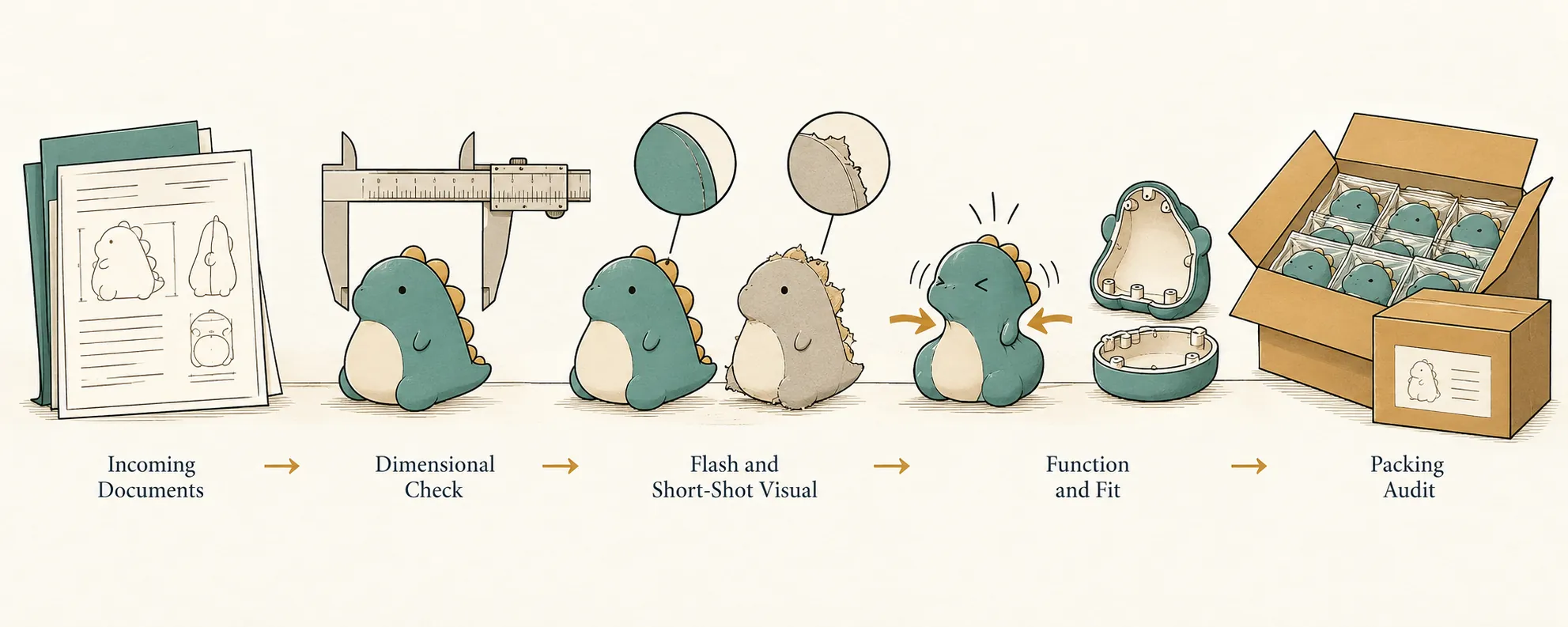
Inspect the closed, fully packed carton against the approved packing revision, recording the observation, discrepancy, and disposition for each check.
Identify inspected cartons by SKU, pack revision, lot or production reference, and carton number. Agree the inspection scope and tolerances with the supplier in advance. These are buyer acceptance criteria—not legal standards or predictors of return rates.
| 1. External dimensions and units | Inspect: measure maximum external length × width × height of the closed carton, including bulging, in the agreed units; photograph the measurement points. Compare: approved packing revision and proposed quotation dimensions. Discrepancy: different units, a retail-box measurement used as carton size, or dimensions outside the agreed tolerance. Next decision: remeasure; accept within tolerance, approve a documented revision, or require repacking and remeasurement before release. |
|---|---|
| 2. Carton count and contained quantity | Inspect: tally cartons by SKU and pack configuration; compare exterior quantity marks with the documented pack-out. Compare: approved units/carton, packing records, order quantities, and packing list. Discrepancy: unexplained shortages, mixed configurations, incorrect quantity marks, or an unlisted partial carton. Next decision: reconcile the affected quantities and correct the packing list or packing. A sealed carton alone cannot prove its internal count; use a witnessed pre-closure count or a controlled opening, recount, and reseal where needed. |
| 3. Gross and net weights | Inspect: weigh the fully packed closed carton in kilograms or the agreed unit, using a checked scale. Compare: approved gross-weight target and final packing list. Reconcile net weight using the agreed definition and supporting packing records or validated tare data. Discrepancy: unexplained weight variation, mixed weight units, or product and packaging weights being confused. Next decision: check the scale, tare, and pack composition; recount or reweigh as appropriate before correcting the record or packing. |
| 4. Carton strength and closure | Inspect: look for crushed corners, split seams, punctures, moisture damage, bulging, and closure departures. Compare: approved board specification, supplier material or test record, closure method, and any agreed packed-carton performance requirement. Discrepancy: damaged cartons, a documented board substitution, or test results below the agreed requirement. Next decision: segregate affected cartons, replace damaged packaging, and obtain the required verification before release. Appearance and hand pressure do not verify strength. |
| 5. Shipping marks and labels | Inspect: check the agreed SKU or carton identifier, product description, quantity, carton numbering, weight and dimension fields, and receiving barcode where specified. Compare: approved artwork, buyer receiving instructions, and final packing list. Discrepancy: wrong identity, unreadable print, duplicated carton numbers, or marks that disagree with contents records. Next decision: correct labels and documents, then recheck the affected cartons before release. |
What strength evidence should the RFQ request?
Request a defined carton-board specification and relevant supporting records rather than accepting “strong export carton” as a measurable requirement.
Ask for a supplier material data sheet identifying grammage in g/m², flute type, and burst strength with its test method and units. This is consistent with the Packaging RFQ checklist, which also recommends comparing sample records line by line with the commercial quote.
Where stacking or transport handling drives the requirement, agree the relevant packed-carton performance test, configuration, conditioning, and acceptance criteria before approval. A board property is not the same as demonstrated performance of the packed carton. If the board, packing arrangement, or closure changes, review whether the existing evidence still covers the revised configuration.
How do you calculate CBM and reconcile the final packing list?
Calculate CBM from final external carton measurements, then total each distinct packing configuration separately.
Explicitly hypothetical example—not either catalog SKU: a closed carton measures 50 × 40 × 30 cm. CBM per carton = L(cm) × W(cm) × H(cm) ÷ 1,000,000 = 50 × 40 × 30 ÷ 1,000,000 = 0.060 m³. For 100 identical cartons, total volume = 0.060 × 100 = 6.000 m³.
Do not apply one full-carton volume to differently sized partial cartons. Record their actual dimensions and add their volume separately. Apply the same configuration-by-configuration approach to gross weight and contained quantity.
The final packing list should identify the actual carton quantities, units per carton, total units, dimensions, volume, and weights for each SKU and configuration. Compare it with the approved order and inspection record. A dimensional difference within the agreed tolerance may be acceptable; an accepted change still needs an accurate final packing list. An unexplained count or weight difference needs reconciliation, not a copied catalog value.
Who approves the RFQ, packed carton, and remaining conditions?
Use a revision-controlled approval record that separates sample selection, quote approval, and final packing release.
Approve the quote against the agreed proposed configuration; approve final packing against actual packed-carton observations. Keep product-safety release and destination-specific documentation in a separate approval track. A satisfactory carton inspection does not establish product safety, age suitability, or certification.
| Identity and revision | Record supplier, RFQ number and revision, date, product/SKU identity, pack revision, approved sample reference, quote revision, and inspected carton or lot identifiers. |
|---|---|
| Specified target versus observation | For each checked field, enter the approved target and tolerance beside the observed result, measurement unit, evidence reference, inspector, and inspection date. Keep proposed values distinguishable from final packed measurements. |
| Decision and conditions | Record each stage as approved, conditionally approved, or held. Identify the exact discrepancy and affected cartons. State whether correction, repacking, remeasurement, a revised quote, or a buyer-approved specification change is required. |
| Responsible approver and date | Name the buyer responsible for sample selection, commercial approval, and packing release, with each decision date. Keep any separate destination-document or safety-release responsibility identifiable. |
| Follow-up and closure | Assign each condition an owner and due date. Attach corrected records and reinspection results; record the closure decision, approver, and date. Reissue the packing list and relevant revision when an accepted change affects them. |